
(An earlier version of this post was published last year. For a variety of reasons, I’ve updated it and am putting it out there again… because here we are again. If you’re looking for the text for the original post, you’ll find it here [scroll to the end].)
Plain and simple, I believe that the current standardized tests in ELA (English Language Arts) and Math, given annually from grades 3-8, are poorly designed and age-inappropriate and, ultimately, should be entirely revamped. I’ll go one step more: I think that a lot of families have no idea what’s happening.
Lemme break it down.
1. Testing isn’t going anywhere
Tests have been around since the dawn of schooling (and probably before that; you know that cave people were totally devising hunting “challenges” for one another). Standardized testing in the United States has been around since at least WWI. Pretty much anyone who’s lived in the USA over the last 40-50 years has heard about our “failing” education system, how we don’t “measure up” to other nations, etc. – so, clearly, something had to be done. Hence, the Elementary and Secondary Education Act was passed which, in 2002, turned into No Child Left Behind where – I’m simplifying here – in order to receive federal funds, schools needed to prove that their students were showing academic improvement. That act was met with such vitriol, this past December, the Obama administration rejiggered it into the Every Child Succeeds Act (ESSA).
Whether or not American schools are, indeed, “failing” is up for intense debate, but the fact remains that standardized tests have been around forever. They offer one small snapshot into one moment of a student’s academic year. Taken alongside the numerous other evaluations that are performed throughout any given school year, they can contribute a few brushstrokes to a child’s academic progress canvas. If these tests are well-written, developmentally appropriate, and accurate, they can also provide some sort of (small) basis with which to compare schools and teachers.
I’m down with standardized testing, as a general concept. I think most parents, teachers, and families are.
2. Common Core confusion
States adopted the Core standards with a very specific goal in mind: money. Not education reform, not improving student learning, not evaluating teaching practices or helping teachers to better their approaches, but cold, hard cash. See, there was this thing called Race To The Top (RTTT) that was rolled out in 2009-2010 that essentially said (I’m paraphrasing here ever so slightly): Hey, governing people! Want to earn more FUNDING for your states for education? THEN COME COMPETE FOR IT!! All you have to do is prove that you’re evaluating teachers more stringently, identify and turn around failing schools, promise you won’t prohibit the formation of more charter schools, adopt some common standards, and create some nifty data systems! The faster and better you do that, the faster you can earn MORE MONEY!!! It’s like a carnival up in here!
In theory, a set of shared standards isn’t such a bad idea. I like the Common Core benchmarks, broadly speaking. I like the idea of everyone in the US learning some basic, shared content. I like the thought that, if your kids changed schools or districts or moved across the country, you could count on them not being too far behind (or ahead) because everyone’s learning the same stuff at the same time, from poverty-stricken inner cities to wealthy suburbs.
In practice, because of the whole SHOW ME THE MONEY thing, the standards were written in a bit of a hurry – and, many people assert, they were written without any educator input. No, for real: according to many experts, not one single K-12 educator or child development expert was included in the creation of these standards. So they’re a bit off-base in terms of what’s developmentally appropriate for each grade level, by which I mean that they’re asking kids to know a heckuva lot more, and to use an awful lot of more complex thinking, than they’ve done before.
Which, in itself, might not be so bad — maybe even inspiring and hopeful — if the standards had been adopted at a reasonable pace with teachers being given adequate support and training to properly teach the new material.
But because there was money on the line, and because states had to act super fast if they wanted their share, they adopted Common Core with lightning speed. There was no gradual roll-out. No trying-and-seeing to determine if this set of standards was reasonable, achievable, or appropriate. No oversight by anyone in the field of education. Buckle up!
3. Many of the tests are poorly written
Even so – even with way more complex standards written by non-education people that were put into practice before anyone had a chance to review them – things might have been okay had the accompanying tests that were meant to measure performance been good, strong, accurate evaluations. But many of them are not.
For one thing, they – like the standards – are written by non-educators. (I understand that in New York state, the tests before the Common Core-based evaluations were also written by non-educators, so this is nothing new, but that doesn’t make it a good idea.)
Perhaps unsurprisingly, given their authorship, the tests have been found to be riddled with errors. The test questions themselves, especially on the ELA portion of the exam, are often written at reading levels two to nine grades ahead (asking, say, third graders to read and evaluate passages that are actually appropriate for 5th- 12th graders).
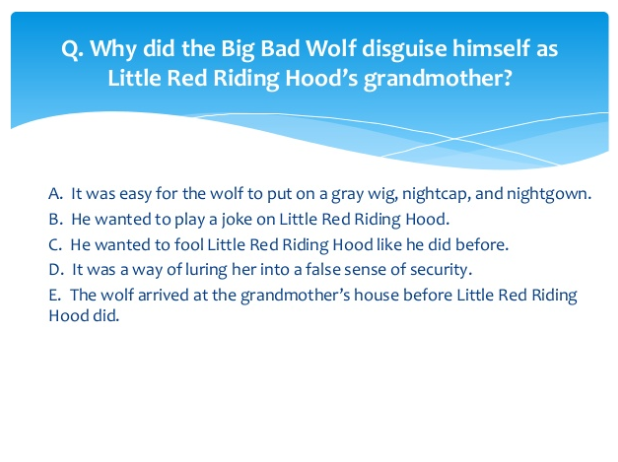
These are taken from the PARCC ELA test…
 Yes. Our eight year-olds are probably familiar with the idea of “luring” someone into “a false sense of security.”
Many of the test questions are vague or even deliberately misleading, which makes choosing the answer more of a guessing game than a true demonstration of understanding.
4. The results don’t mean anything
Given that the tests are badly written, error-filled, and are developmentally inappropriate, it seems safe to say that their results don’t really mean much. Additionally, since student results aren’t provided until the end of summer (or even into the start of the next school year), the child’s teacher can’t use the scores to adjust his or her instruction to better serve those kiddos.
Sure, in theory, a teacher could look at the results from last year’s class, see a deficiency in a particular area, and think, “Oh, I guess I didn’t do a good job teaching Main Idea. I’d better work on that with this year’s batch of students.” In fact, I would bet that the vast majority of teachers try to do exactly that. But the information that teachers are given – at least in New York – is rather limited.
Teachers aren’t allowed to see the actual questions from the test, nor to know ones were answered incorrectly – they only receive a broad overview of concepts and standards and whole-class percentages rather than individual student breakdowns. Did last year’s students really not understand Main Idea, or were the Main Idea questions vague? Were they deliberately misleading? Were they “sample” questions that are thrown out there each year just to see how kids do on them? Were they just plain incorrect or filled with typos?
Even if the data was reliable – there’s one final catch: the passing score changes from year to year and is determined… AFTER THE TESTS HAVE BEEN SCORED. I wish I could say that I’m kidding, but I’m not. Movable passing scores!!
5. Teachers are more than just a (faulty) number
Here’s where things get really personal for me. Let’s just backtrack for a moment and pretend that the current tests are awesome. Let’s pretend that they are appropriate, accurate, and superbly written. Even if this were the case, I think we can all agree, still, that they represent merely one moment in a child’s education, several hours out of their lives. They don’t actually demonstrate all that children have learned – not even the best tests in the entire world – because most of what we call “learning” cannot be shown in a two-dimensional standardized test.
What standardized test results really show us is how well individual children tested on a particular day. And yet many states have decided that test scores do accurately demonstrate how well teachers are teaching, often counting the scores for up to 50% of a teacher’s evaluation.
And let’s not forget about the rest of the teachers. Tests are given at only at certain grade levels in certain subjects – meaning that that the majority of teachers do not teach these subjects/grades. K-2 teachers? 9-12 non-Regents class teachers? Gym, music, art? Science (students are tested in science but not in every grade), social studies/history, foreign language, library, computer, home ec, graphics…?
And yet 50% of their evaluations are also based on test results. Based on the performance of students they may never have laid eyes on IN SUBJECTS AND GRADE LEVELS THAT THEY DO NOT TEACH.
This is fair, appropriate, or okay because… why?
6. Greed is a powerful motivator
For decades now, politicians have been talking about how American education is failing. Thus, politicians find it pretty easy to gain financial backers for education reform. After all, once a school is determined to not pass muster, something must be done — new curricula, new textbooks, new resources.
One of the largest supporters of Common Core is Bill Gates – yes, that Bill Gates – who has poured hundreds of millions of dollars into its adoption. While I believe that Bill Gates genuinely wants to help, it’s hard to ignore the fact that Microsoft and Pearson – one of the largest producers of Common Core materials – have banded together to get additional Microsoft resources into schools.
Many people have taken issue with the fact that companies such as Pearson [which authored a) the Common Core standards, b) the great majority of the current Common Core tests, c) the “modules” of instructional materials that are sold to schools to prepare students for said tests, d) and – as of 2015 – the teacher certification examinations in eighteen states] is a business company, not a company run by education or child development professionals. (I acknowledge that pre-Common Core, tests were still written by contracted, outside companies; that still doesn’t make it right.)
That would be galling enough, but even more maddening is that Pearson is positively rolling in the money it is making off of its materials. Since Common Core was adopted so quickly, school districts had to act fast to provide their teachers with adequate curricula resources. Who better to provide that than the author of the Common Core standards? Enter the Pearson instruction modules! Need additional support materials? Pearson’s got those, too!
7. Teacher demoralization
I’m just going to put it bluntly: because of all of this Common Core testing and the hoopla surrounding it, many of our teachers* feel like crap. They have been told, in no uncertain terms, that the jobs they were doing weren’t good enough. No matter how well-liked they were, how many kids graduated from their classes, how many years they’d been teaching, how many children they taught to read or how to multiply, how many hours they stayed after school, how many hungry children they fed, how many concerts they attended… it wasn’t enough. They have to change, fast. And if they don’t? Their very jobs are at stake.
All of the teachers I know – the ones for whom I sub, the ones with whom I sub, the ones with whom I went to college, the ones with whom I used to teach, the ones who teach my own children, or the ones I’ve met along the way by happenstance – have said, unequivocally, how much they love teaching. They love their students. They are fiercely proud to be educators. But it is getting hard – really hard – for many of them to continue. You hear talk of those who are seriously considering leaving the classroom because they can no longer teach; now, they have to teach these modules, teach to the test, jump through hoop after hoop. It’s exhausting and maddening.
Losing our teachers would, obviously, be a tremendous problem; that problem is compounded by the fact that there has been a steep decline in the number of new teachers being certified in recent years. Even those who do decide to enter the profession don’t stick around for long.
To be sure, teachers have often felt under-appreciated, misunderstood, and underpaid, but rarely has their ability to do their job been so strongly questioned. Never have they been so micromanaged. We are losing some of our best teachers. We aren’t getting enough new ones. This is happening right now, all across the country, and it is terrifying.
(*Obviously, I realize that I’m speaking in very broad terms here. I have not interviewed every teacher in the nation. But I am certain that the teachers with whom I have spoken – and this is a helluva lot of teachers – have expressed their dejection, sadness, and frustration.)
8. How do we get an objective measure?
Many people who acknowledge the shortcomings of these particular tests maintain that we need them because we need some objective measure of how our kids are doing in school. We need some way to compare teachers, schools, and performance, from rural West Virginia to suburban Idaho to inner-city Houston. We need to be able to determine teacher growth and student success. Kids from the most poverty-riddled communities deserve access to the same quality education as their most affluent peers.
I hear that. I absolutely believe that all children deserve a quality education; the disparity is, indeed, unfair. I also think it would be great to, say, move across the country and be able to glean, at a glance, how a school or district compares to another.
But here’s the thing: I think we’re looking for something that doesn’t exist – not because we haven’t figured out how to do it, but because it’s just not possible. Maybe education and learning aren’t things that can be measured any more than a musical performance can be measured. Maybe teacher growth and student success aren’t confined to numbers. Maybe a one-size-fits-all assessment works nicely for obtaining a driver’s license but not so well for determining whether or not fifth graders can identify subplot or if their teachers are doing their jobs. Test scores do not indicate success or failure; they are merely numbers.
9. Quite whining! How about some solutions or ideas?!
I’m not saying that we should give up. I’m saying I think we need to – dramatically – change our approach to how we evaluate education, students, and teachers. In my Magic Wand World, I’d take a (lot of) page(s) out of Finland’s book (it is well-acknowledged that Finnish students perform among best in the world at international exams) and our teachers would be as well-respected as as well paid as our doctors.
Since it’s unlikely that we’re going to adopt too many of Finland’s ideas, I suggest that we work with what we already have to reconfigure our view of success.
- We should de-couple the current standardized tests from teacher evaluations, period.
- We can keep the Common Core – as I said, I like those standards – but only as a portion of what each child should learn; we need to leave the rest up to individual states, districts, schools, and teachers.
- We should give teachers several years to become familiar with the Core standards so that they can rework their lesson plans, see where there may be deficiencies, and take it from there.
- Standardized tests aren’t going anywhere (in the USA), but we should have new, fair, developmentally appropriate tests that have been written by educators from across the K-12 spectrum.
- Those tests’ scores should come back before the school year is over so that the students’ current teachers can use the data to inform their instruction.
- And then those numbers should be just one of many other things that combine together to form our opinions of teacher success and student learning. Let’s factor attendance into the equation. Graduation rates. The percentage of high school graduates who go onto college. Post-graduate success. AP exams – how many are given? What are the scores? Teacher-student ratio. Teacher retention; how many are still teaching there after three years? Five? Ten? Extra-curricular activities. Class sizes. Poverty levels. Parent involvement. Principal and superintendent evaluations. Student portfolios. Additional test scores.
Education “success” cannot be measured by any one, single thing. I will happily sing you the praises of my daughters’ elementary school, which I adore, but none of those praises – from small class sizes to close relationships with other families to the devotion of the teachers to their annual Halloween parade – has anything to do with test scores.
10. Become informed… and then do something
I’m not really the “take a stand” type. More typically, I talk and think a lot. I write letters, I sign petitions, I discuss with family and friends. With this, it was different. I’d been talking, for years. I’d been signing petitions. I’d been writing letters, dozens of them, from the governor to my locally elected officials.
Finally, last year, it became clear to me: talking, thinking, letter- writing, and petition-signing weren’t working. Our legislators weren’t listening. And in the meantime, our children and teachers were suffering.
Enough was enough. And so, after much research and consideration (and after having participated the year before), our 4th grader opted out of the tests. She was extremely nervous about taking them – and we were extremely upset that her teachers were being evaluated based on student scores on poorly-designed tests – so it seemed like an appropriate solution. Turns out, many, many parents and children in New York state came to the same conclusion. As I wrote last year:
To paraphrase the incomparable Maya Angelou, when you know better, you do better. Parents and teachers are speaking up. We are knowing better. I hope, as our voices swell – whether our children take the tests or refuse them – that our politicians will hear us and that, some day, they will do better, too.
You know what? Our New York legislators heard us. BY GOSH, THEY HEARD US! Our voices swelled and our message was clear: This situation needs to change. And so the change has begun. Test scores are no longer being used to evaluate New York teachers (CAN I GET AN AMEN!). Students may now take as much time as they need to complete the exams. As of next year, Pearson will no longer be writing the tests or curricular materials. NEW YORK IS TRYING TO DO BETTER.
“Never doubt that a small group of thoughtful, committed citizens can change the world; indeed, it’s the only thing that ever has.” – Margaret Mead
Because of the changes that have been made, my husband and I did not feel as strongly about refusing the testing this year, instead leaving the decision to our daughters (after sharing the above information with them, to the degree that they can understand it). Our oldest, again, has opted out; her younger sister is taking them. We feel very comfortable being a house divided.
No, the tests aren’t perfect (then again, what is?). With the exception of tying them to teacher evaluations, everything else remains (essentially) the same, so there remains (much) work to be done. (While I appreciate the removal of the time limit, it seems that some students are taking up to 6 hours per day to finish their tests… which is not exactly “doing better”…) Still, I acknowledge and greatly appreciate that changes are being made. It’s a step in the right direction.
Some analysts and educators argue that high-stakes tests should be banned, period. Others claim that the tests are successful. Although they’re reaching different conclusions, they’re doing so after having thoroughly done their homework (a pun!).
And that is what I encourage everyone to do: learn more, then go from there. Find out who writes the tests in your state and how teachers are asked to teach the material. Read up on others’ opinions about how valid and appropriate the tests are. Discover when the test results are returned, what information the teachers and schools receive, and how they apply that information. Learn whether or not your child’s educators are evaluated based on test scores. Inquire about what your options are.
Then, if you feel that the tests are not measuring up, ask for better. If you feel like they’re cutting muster, speak up! Maybe that looks like writing letters. Maybe it’s signing petitions. Maybe it’s attending town hall meetings. Maybe it’s talking with neighbors and teachers and administrators. Maybe it’s opting out. Maybe it’s opting in. Maybe it’s a little of everything and a lot of other things, too.
No matter how you feel about Common Core and the state tests, I think we can all agree that our nation’s children deserve awesome. Let’s work together to be thoughtful, committed citizens. Let’s help our children receive the awesome they deserve. Heck – let’s change the world.
 All Together in a Scattered Sort of Way
I have shared this article with my daughter who is an 8th grader and wants to make a change on standardized testing. I told her to talk to teachers to find out what she could do be they aren’t allowed to talk to her since she is a student. Do you know of any organizations for students (or parents) to join in this protest?
It is a bit of a tricky situation; indeed, teachers are allowed only to provide information, but not to push one side or another. (I’d never think of bringing it up with a student when I’m subbing!) I’m don’t know about specific organizations, but you might check out the following resources for information:
https://www.facebook.com/groups/unitedoptout/
http://www.nysape.org
Good luck to you both!
THANK YOU!
You’re welcome; thanks so much for reading.
What you wrote is fabulous. Thank you so much for writing this. I too prefer to speak one on one and write letters, and my words also fell on deaf ears. Our actions are going to make it tough for us for a while. I just hope we will continue to be united, parents and teachers, when the government throws everything they can at us. I am convinced they will withhold funds, and that will cause challenges at the schools. I hope people won’t cave for a short term fix in lieu of standing firm for a much better long term solution.
Since Title I funds are already approved (although they could move to “reassign” them within the district), they’ll need to find another loophole in order to withhold funds… Not that I wouldn’t put it past them, but at least that money is rather untouchable! I agree, though – a short term fix is definitely not preferable to a long term solution. Here’s to hoping and continuing to be united for change.
This is why I feel broken everyday for my children, teachers, students, and school. Thank you for putting into words what I could not say. Thank you! Thank you!
It’s definitely a broken situation. Hoping for better in the future. 🙂
Thank you for putting into words, both eloquently and humorously, everything I’ve been thinking the public needs to know but does not fully understand. You rock!
Thanks for reading; I’m humbled, and glad you enjoyed it!
this was so well written, eloquent, and brought me to tears that you were able to capture the details of this whole big ball of wax and make it readable. Can’t thank you enough!
Thanks very much for reading it. 🙂
Your words are the best I have read on this horrible situation and I have read a lot.!! I am the only 7/8 math teacher at my school and I currently have my own daughter as a 7th grade student. I struggled and cried and stressed about wether or not to opt her out. She is an excellent student and would do well on the assessments but I felt like I was supporting something I didn’t believe in. I asked her what she wanted to do and like your girls she is a rule follower and she wanted to take it. She is finishing her last day today on the ELA and has math next week. I have been teaching for 12 years and I have never been made to feel so ashamed as I do now to be a teacher. I love what I do but I must admit I am looking elsewhere for employment. It’s sad that I would be willing to give up a great job at a great school and have to move my family just because I’m a teacher! This is the world I am living in. I’m not sure how much more pressure I can handle.
Thank you for your clarity and understanding. You get it! It’s nice to know we are not crazy like some people say.
Such a difficult situation for everyone involved. I wish your daughter luck, and I hope that you’re able to remain in teaching. We need to fix this system so we keep our dedicated, experienced, awesome teachers!!
Thank you, this is a fantastic article.
You have really expressed every aspect of this educational mess that the U.S. is going thru right now. I will share this with everyone I know!
Thank you – I appreciate it!
I agree with your thoughts entirely on Common Core. With regards to charter schools though I disagree with how you’ve characterized them. I can only speak as a parent of a classical charter school in Florida (my roots are in NY), and I feel incredibly lucky to be able to send my child to this school. Yes public and yes free and with the most incredible classical liberal arts curriculum that reminds me of the schooling I had in NY pre-common core. We don’t have big donors (or any), just hard-working parents and the PTCA pulling together to support the kids. The teaching staff is fantastic. Check out the Hillsdale College Barney Initiative http://www.hillsdale.edu/outreach/charterschools – I think this should be a model for schools across the nation – creating thinkers and not test-takers. One woman, a mom/educator, created our school from scratch here and if she can do it, others can too.
Yes, Heather – that can absolutely be the case. I actually taught at a charter school for three years in Colorado prior to moving to New York. It was a great place to work and learn; it had been started for all the right reasons. When charters are started in this way – or are run the way that Hillsdale is – they can be fantastic and are a good alternative to some public schools.
Unfortunately, here in NY, charters are being created by the dozen (literally) with the very purpose of closing public schools. The donors are investing millions of dollars (again, literally) and are benefiting unbelievably from the tax benefits that those investments provide — and the recipients of those benefits are the very same folks who donate big bucks to Cuomo’s campaign. While I’m sure that there are wonderful charters in NY that have not been created to line people’s pockets, very sadly, the vast majority have been created for the opposite reason. I’m hopeful that, with enough pushback, this will change in the future and we can get back to charter schools that do just what they are supposed to!
Thanks for reading!
This is brilliant, articulate, specific, appropriate. Unlike the testing. And the government says they didn’t see the opt out numbers coming. Parents are fed up with having no voice about their children. I was a public school art teacher who retired early partly because of this. Thanks for being courageous and stepping up to the plate.
Thanks very much. It’s so disheartening and discouraging hearing about teachers like you who felt they had to leave the system because of the nonsense; I’m so hopeful that, in the future, we’re able to enact positive change and retain our excellent teachers.
I feel like I have read a million articles on he Refusal/opt Out movement and this is the clearest most well written explanation I have ever seen..I will share it everywhere…Thank you!
I really appreciate that! Thanks very much!
Pingback: Throwback Thursday: Animal Lover | All Together in a Scattered Sort of Way
Words cannot even come close the the STUPIDITY of these tests not to mention the waste of precious time it takes to take them when our kids could be really learning or doing something worth while’
Thank you! I wish I had written this! I will share it widely!
🙂 I appreciate that! Thanks!
Thank you this was well written and articulate. I appreciate the time and effort you put forth to become a well informed parent and up-stander in what is becoming the saddest time I feel in American education.
It is, indeed, a sad time. Hoping that it’s a stumbling block and the future is better! Thanks for reading.
Thank you for this awesome information. You have explained this so well. It is so true. As if the rich are rich enough. The politicians can only lobby to a certain dollar value. Hmm where can they get more money for the corporations, just to lobby those corporations to give them more money in there pockets. Lets go after the teachers and students!! So essentially What they are trying to do is to dumb down America so that we do not realize that this is all just a scam to get the monies to the corporations, then in to the politicians pockets and in the end, in to the elite rich hands. Disgusting and appalling. My daughter has an A go a average as an 8th grader. You know who I applaud? Her teachers, and my daughter herself. I have so much empathy for our teachers. But my daughter is a perfect example to show that through most of all the BS that these teachers have to endure because of this common ” GREED” core, the teachers are doing a AWESOME JOB!! I will be sure to reach out to every one of my daughters teachers and personally thank them all for not following the sheepish ways of the corporate and politician greed and maintaining there LION status!! Keep ROARING TEACHERS!! You all are so very much loved and appreciated!! God Bless you!! GOD BLESS AMERICA
Greed is a crazy thing. Keep supporting those awesome teachers! They need it now more than ever!! Thank you for reading.
Thank you so much for this post! You have put together all the information and cleverly connected the dots for people to see. It is hard to explain this whole situation to non-educators, but you have really done a fantastic job!
Thanks very much! As a (substitute) teacher myself, I have loads of teacher friends who have been bemoaning the deteriorating situation for years. After seeing them become so beaten down, I wanted to add my voice to the chorus of reform – but just complaining didn’t seem like it would do much, so I took a lot of time to really cull through resources to try to make sense of things. I appreciate your support!
I want my child to opt out. Do you just not send th e m or write a note?
Amy – it depends on where you live. In NY state, yes, all that was required was a letter (or email) stating that your child would be refusing the test. (In NY, “refuse” is the technical term to ensure that the child is not scored at all and does not receive a zero.) I don’t know what the requirements are for other states, nor exactly when their testing takes place. In some states, unfortunately, I believe that it is not as easy – and maybe even not legal?! – to opt students out. You could check with your principal or superintendent to begin with; if you receive a “that’s not possible,” you could check out resources like the ones listed below to see if, in fact, it’s actually impossible… or if they’d just rather that you not opt your child out! Best of luck to you.
https://www.facebook.com/groups/unitedoptout/
http://www.nysape.org
Kudos for this. It is about hurting teachers, but on the way you hurt the students who have to take these unfair tests. SO WRONG…
Thanks for reading!
I could not stop reading this, as I should be asleep to go to teach tomorrow!! This is absolutely perfect!!! I couldn’t have ever put it into words like you did here. I’m sharing this on my page and to any teacher I know that is struggling with the insane new reforms that have been put into place. Thank you for saying all of this in such a well written article! From a struggling teacher who is wanting this to change for my students especially, and future children, in which I will do my best to not send them to NY schools for this exact reason–or if they do they will be given the option to opt out! I could go on and on about this!!
Thanks very much for reading – and thanks for teaching! Best of luck to you in the future!
Agree with most of what you say but I like the idea that the test is done but a non educator because. Life is not a school and is full of surprises and since the results don’t affect the children but lawyers take the bar exam and so do other professions even teachers
Thank you for stopping by to read!
Fantastic article! When I have parents who ask me why I’m so riled up about these tests, I will surely send them here to your post. For all those reading this, there are many Opt Out groups popping up in the Facebook world (and plenty of websites too). I highly recommend searching online and joining some of the FB groups, there is so much great information being shared. There is the “United Opt Out” as posted in previous links but most local jurisdictions are also creating groups. We have one for the State of Florida, for our specific County, and in some areas where parents are really ramping up the fight, they have created school-specific Opt Out groups. The information sharing is fantastic, with reports from parents or teachers who attend the state Board of Education meetings, they share documents, sample Opt Out letters, explanations on exactly how your child can do so (they must attend school during testing week, but they can open the test, sign the page and then not answer one question, which gives them an NR2 (I think that’s what it’s called) meaning they don’t have enough data to score the test, but your child will still be logged as having attended and taken the test. In 3rd grade, in most states, you can require the school to use a portfolio of your child’s work to make the case for advancement to 4th grade, they cannot bully you by telling you your child will be held back if they don’t take the test (there are lots of gray areas in this matter and it may differ from state to state, so do your research). But joining your local Opt Out groups will help you tremendously, to learn your local laws and regulations, and assist you in fighting the regime.
Thanks very much! I agree that joining together is the way to go. Someday, this HAS to change. It just has to!!
“Our children are not pawns.
I’m glad mine have withdrawn from the game.”
I will use this (hopefully with your permission) going forward.
Very beautifully written! Thank you for this.
Permission granted! Thanks for reading. 🙂
Thanks so much for writing this beautiful and thorough piece. You connect all the dots – the motivation behind the testing, the test themselves, the impact on teachers, the money, and so on. It’s a remarkable story. I just realized yesterday who Merryl Tisch is (besides being Chancellor and de facto top NY State education official) – she is wife of one of the billionaire Tisches, the people who owned CBS, now own half the NY Giants and real estate and fossil fuel companies and so many other things. It never ends.
Thanks very much!
I hadn’t made the Tisch connection myself.. GAH! Such craziness.
This is amazingly well written. As a teacher in Westchester County, and a parent of a 3rd and 6th grader, I agree with everything you’ve said. It’s hard to believe that I voted for this governor, at least the first time. I’d love to “evaluate” him based on the same APPR method that we are evaluated on. It’s a scam, and the only ones who win are Pearson and the legislators in Albany, who seem to be getting in more and more trouble every day. Incredible. Scary. Sad. Thank you for your blog.
Thanks so much for your comments. My husband and I, too, voted for Cuomo — we’re never making that mistake again!! I’m so hopeful that things will improve in the future; we just have to keep at it.
Thanks for teaching; we need you all so much.
The fact that teachers are never allowed to see the tests or know what questions or even what types of questions caused problems for their students is illuminating. A smoking gun, actually. The testing companies have invested a significant amount of money in developing these questions. They are intellectual property, now (which is weird on the face of it because you can’t copyright a fact). If the questions get out in the general public, they can’t be used again, and the testing companies have to go back to the people who write the questions and pay them more money to come up with new questions. It is more profitable to use the same questions over and over and over. Todd Farley, a testing insider, has written about how test same crappy questions are now being aligned with the Common Core rather than the Common Core being used to create new questions. So, if the intellectual property rights and investment in the question creation is MORE important than teachers being able to use the information from the tests in any meaningful way, that pretty much shows that it really is all about money and not education at all. http://www.huffingtonpost.com/todd-farley/points-to-ponder-about-th_b_811769.html
I agree — and such good thoughts regarding the property rights and profits. I hadn’t considered it from that angle before; it’s even more screwed up than I knew! I will check out the Huff Post article as well. Thanks very much!
Can you explain what you mean by this line:
So. If you want to make big bucks, you invest in charter schools. The more charter schools there are for you to invest in, the bigger bucks you can make.
And this one:
Which is awfully convenient, given that failing schools result in more charter schools, which results in money in investors’ pockets, which results in money in campaign funds.
Charter schools are non-profit organizations with no owners or investors. They pay no returns or dividends. I am confused.
I am curious about your intentions after reading these incorrect and misleading statements about public charter schools.
Please clarify for me, and for all of your readers.
Thank you.
Thanks for your questions. I’m happy to clarify.
Yes, charter schools are non-profit organizations without owners. With that said, people can, in fact, invest in charter schools both directly and indirectly.
You’re correct in the sense that charter schools are not corporations. They have not issued stock, and therefore people cannot invest in/earn returns or dividends from in charter schools in that manner, but that doesn’t mean that there aren’t other ways to invest.
For example, charter schools are an entire sector of the municipal bond market (like public utilities such as water, power, highways), which means that people can invest in the bonds of the charter school. This is, essentially, a loan made on behalf of investors – and, as with all loans, the lenders expect to be paid the principle plus the interest agreed upon. Call it a dividend or a coupon or a yield – bonds absolutely pay those, which means that charters do, too.
Any individual can open an account on e-trade and say that you’d like to invest in charter school municipal bonds. Yes, they’re non-profit organizations, but they certainly have investors… and those investors can make money on that. (I mean, why would anyone invest in anything if they didn’t think they could turn a profit?)
Here, the Wall Street Journal discusses charter school bond sales:
http://www.wsj.com/articles/charter-schools-find-smarter-way-to-borrow-1419820840
Here is a site (for an investment company) that discusses tax exempt bonds for charter schools:
https://www.pnc.com/en/corporate-and-institutional/capital-markets/charter-schools.html
As for how people can indirectly profit off of charter schools, many charter schools are also run by management companies; people can invest in the management companies just the same as they would invest in any corporation. Here, for example, is something taken from a company that manages a network of charter schools and then invests that capital:
“However, to realize their promise, these organizations need access to smart, targeted investment capital that will help them build the capacity to expand and succeed. The Charter School Growth Fund invests this capital, enabling these organizations to reach thousands of underserved students.”
http://chartergrowthfund.org/what-we-do/investing-in-cmos/
You can see more of this here:
http://www.propublica.org/article/charter-school-power-broker-turns-public-education-into-private-profits
I stand completely by the sentences that you quote from my post. Investing in charter schools is a very lucrative business. According to the DailyKos:
“Thanks to a little discussed law passed in 2000, at the end of Bill Clinton’s presidency, banks and equity funds that invest in charter schools and other projects in underserved areas can take advantage of a very generous tax credit – as much as 39% — to help offset their expenditure in such projects. In essence, that credit amounts to doubling the amount of money they have invested within just seven years. Moreover, they are allowed to combine that tax credit with job creation credits and other types of credit, as well collect interest payments on the money they are lending out – all of which can add up to far more than double in returns. This is, no doubt, why many big banks and equity funds are so invested in the expansion of charter schools. There is big money being made here — because investment is nearly a sure thing.”
http://www.dailykos.com/story/2013/02/15/1187346/-So-why-do-hedge-funds-so-favor-charter-schools#
As for those same hedge funds – the ones who reaped the benefits of the tax credits – supporting political campaigns, these two articles – to which I hyperlink in my post – do a good job of summing things up:
http://ny.chalkbeat.org/2014/01/17/success-academy-donors-flood-cuomos-coffers-filings-show/#.VTFsLHqq1q_
http://www.nydailynews.com/new-york/education/hedge-fund-execs-money-charter-schools-pay-article-1.2145001
There are, I’m sure, many charter schools that have been founded for entirely altruistic purposes and that are not managed by companies who care more about profits than education. (I worked for three years at a charter school in Colorado that fits this description to a tee.) But there is no doubt whatsoever that, under the right circumstances, corporations and individuals are getting rich off of charter schools.
I’m just now getting involved in educating myself about Common Core and these tests and this was THE BEST and most concise information I found in terms of explaining how/why it came about, the abhorrent politics involved, and THEN putting forth solutions. THANK YOU.
Thank you! I’m grateful you took the time to read it!
Please consider submitting this for publication in American Educator (AFT’s Journal) or another professional publication. You have so eloquently addressed ALL of the major concerns regarding cirrent shifts in education shared by educators and parents.
I’m looking into it; thanks very much for the feedback!
I, and soooo many others, have posted a link to this all over our Facebook pages, Against Common Core pages, and Twitter.
It’s the best, most clear and concise explanation of the issues with the State exams assessments I have come across.
Thank you!
Thanks! I appreciate your feedback!
Thank you for writing this! I am the mother of a music teacher who shared this. I am the sister and wife of teachers, and the mother of another music teacher who lost her job in the cutbacks a few years ago. When she was called back last year, she wanted to come back to teaching, because she loved it so much, but any teachers who she asked for advise told her not to come back because the atmosphere is so poisonous. My husband is still several years from retirement, but every year no states that he doesn’t know how much longer he can do this.
A dear friend was asking me about testing and the opt-out this past week, and I struggled a bit to explain what was happening. I am going to print this out and send it to her, it is such a clear explanation of what has been happening.
Thank you again
Thanks very much for your reply. I’m so sorry to hear that the negative environment has so strongly affected your family; it’s such a hard time! Thanks to all of the teachers in your family for all they do — wishing you all the best!
You hit the nail on the head. For several years I was head of a high school language arts department. The tenth graders in our state have to pass a test in ELA and in Math in order to graduate; this test supposedly is an assessment of 9th grade proficiency in both of these areas. As you can imagine, our department devoted a great deal of time and energy to making sure our students did as well as possible on these tests. While the students were testing, I always made certain that I had a chance to examine the test itself in order to determine if we were preparing the students adequately. Now, I am an educated and intelligent person with many years of teaching experience, and I also do freelance editorial work. Presumably, an evaluation of 9th grade proficiency in ELA would be a snap for me, right? Wrong! As you correctly demonstrate, the questions are ambiguous and misleading and occasionally just plain off the wall. Instead of being able to go through the test and check off the correct answers, I found myself pondering the questions, trying to divine the test-writer’s intention. And the length! It is a three-day marathon, and SO stressful for the kids. Not to mention the three days of actual classroom instruction that they missed. So wrong in so many ways.
Thanks for your reply and insight; just craziness. So hoping that we can band together to turn things around.
thank you, I wish more parents would open their eyes and read and educate themselves, and stand together to protect our children. I opted out my 3rd grader and even if I was the only one I wouldn’t care. So much is at stake and the attitude of apathy makes me sad. I can inform and share and talk but that’s all I am do. Great article.
Thank you for taking the time to read. Best of luck to you and your kiddo(s)!
Yes – thank you! You have summed it up so well. I am a teacher and a mom and frustrated with the system we are locked into. This candid and truthful message needs to be widely understood by parents and our communities. The media is not telling the whole truth.
Thank you for teaching our kiddos. I agree – a lot of the information is not being given!
Only 1 disagreement: previous ELA and Math assessments WERE written by educators, before state budget cuts decimated NYSED positions. NYS sciwnce assessments are still educator created.
Thanks for that clarification! Good to know!
You are passionate and knowledgable. You make several valid points, but you also miss some root cause issues. By training, most lawyers are taught to solve problems with rules and language. Money is questionable as a prime mover, though it always has consideration. Tax credits protect earnings, they do not produce earnings. Well meaning lawyers, the primary source of legislators, make rules and try to avoid subjective language since different people could interpret subjective rules differently. Given legislative rules, inevitably enterprises will be developed to support the rules. The same phenominum occurs in all government regulation. A few decide what standards are preferred and then impose them on all and new enterprises arise to keep participants within the rules. All of this is overhead activity frequently deflectng attention from the real objective, which might have been to drain the swamp. Providing more school choices could well be the answer. Competition, based on productivity improvement, is the engine driving an imperfect system that has produced the greatest distribution of wealth in the history of the world. The best and brightest compete for limited opportunities at MIT, Cal Tech, Harvard, Carnegie Mellon, etc. This tends to keep these institutions innovative and at their highest quality levels. It is our K through 12 system that has been found in need of improvement. College instruction in our highly competitive secondary system is the model for the world, indeed, count the Chinese students in our top engineering and science institutions. I am a K -12 public education product. My wife taught in the public system, her father was a rural county superintendent who consolidated schools to compete with top urban systems so my bias is pro public schools. However, two of our three children receive part of their K-12 education in private not for profit schools from instructors not certified for public schools but competent in their subject fields. While the cost was prohibitively high for the general public, the results were dramatically superior. Maybe the answer is to subjectively make schools compete for their students and stop universal tax support for public schools.
Thanks for your detailed response, Phil. Although I’m not currently in a position to debate school choice (I don’t feel that I’ve educated myself enough to form an opinion), I I appreciate your perspective.
Bravo bravo. I did not attend college but i do know where my children have been academically and instead of the districts concentring in helping them in those areas they are worried about these tests. Yet i did not have my 5th grader optout because his understanding of that happening would have cause him more stress than what he was having. I did however told him to try his best that’s all and all i saw was a smile of confidence in him. The sad thing is that he reads below grade level so i do know where these test will put him at. Do i care about the numbers, no. Because i know where academically he really is at. It has nothing to do with how teachers do is about each childs ability to learn and putting kids with learning difficulties or special ed. in the same pool is not fair in any test taking. I wouldnt want to see my teachers be let go or quitting because of the numbers that come out, because before these tests came about we saw great amount of children graduating and loving school, now is like “i hate school” “i don’t care” “i am dunb i am not going to college”
It needs to stop. I live in a minority community where i feel we have to prove ourselves even more. Is not that i am for the tests but i have to keep telling my kids just finish and try your best i know you can do this.
All you wrote on this article i feel so strongly about too thank you for giving me peace inside i hope all but the best for all the teachers and students. God bless you and your family.
Thanks so much for your insight. I’m so glad that your son felt confident in his testing; that’s as important as anything. We need to build kids up while we educate them, not tear them down! Best of luck to you and your family.
There are pupils who are natural born test takers. They .approach tests with the vehemence of a jouster! At a tournament! The bigger the better! Countrywide? Yes!! Excellent.Others pass through life at school, gathering knowledge,practical lessons learnt, pass class tests pay fees regularly and get out of school to lead a quiet life. So education must have two streams;one for the knowledge seekers and the other for the competitors. Both must be equally encouraged, provided with incentives and opportunities. One will churn out scientists, teachers, archaeologists and historians. The other will churn out material for computer geniuses, multicorporate leaders and those turning the hub of the world’ s commerce and many more! Biodiversity at its best! What do you say?
Personally, I don’t think that primary education is the place for academic competition as a matter of course; there are plenty of opportunities for that outside of school and later on as children grow. I agree with you that all students should be encouraged, but I don’t think that our current testing system does a good job of that.
Thank you for an incredibly informative article–I’ve learned more about the testing my child is undergoing here in NYS from this piece than I have anywhere else.
In case you missed it, Diana Ravitch and Merryl Tisch appeared on All In with Chris Hayes (msnbc) to debate testing. The segment was entirely too brief given the importance and complexity of the subject, but Tisch’s responses were so telling:
http://on.msnbc.com/1cugcnM
Thank you! I did watch that – agreed, much too brief, but it was certainly telling!
Right on, Lee
I agree totally
Glad we were teaching “back then”
Thanks very much – and thanks for teaching!
Why does Pearson always get a bad rap? So they are one of the largest publishing company’s for text books…..if they are ask to provide materials and are given the contract…they are a business doing what they are hired to do…what’s the problem?
I think I outlined my issues with Pearson pretty well in the blog. (They have also been investigated by numerous organizations, including the FBI, for not-so-above-board business dealings:
http://www.huffingtonpost.com/alan-singer/pearson-education-can-run_b_6327566.html
http://www.washingtonpost.com/local/education/pearson-pays-77-million-in-common-core-settlement/2013/12/13/77515bba-6423-11e3-aa81-e1dab1360323_story.html)
Just because it’s legal (although, based on the above articles, one could argue that it’s not at all…) doesn’t mean it’s right.
This is awesome and really hits the mark on so many levels!!
Thanks!
I hate that we are ‘experimenting’ on our school children. Are they being ‘taught to the test?’ Is there no room for free thinking, abstract thinking, original thinking, discussions, debates? What kind of contributions to society will come from these children when they get out into the world. They have one chance in each grade to learn. Once they go on, that chance is gone. Mitch the speed at which business is conducted in this world now, they won’t have time to go through 10 steps of subtraction when one step gets you the answer. I’m not a teacher but seeing some of the examples published are totally confusing and as I see it, a waste of time. Poor teachers.
I agree – teaching kids to take tests is very different from really teaching. Thanks for your thoughts, and for reading!
Thank you for your informative article. I had my suspicions and was always uncomfortable with the Common Core Curriculum. But like many others I didn’t have all the facts to put my opinions to words. You have done that so succinctly. Thank you for taking the time to educate us! I didn’t know that children can opt out of the testing process. Wouldn’t that affect their overall grades? If we opt out, will there be repercussions? If you can clarify this for me I would really appreciate!
Thanks for reading! I can only speak to New York state, but no, student test scores are not allowed to be factored into student number/letter grades or used as a reason for (or against) promotion to the next grade level. As of right now, there are no certain repercussions to students opting out. In New York state, a “refusal” (it’s a “refusal” here BTW, not “opting out”) is not the same as a “zero.” Students who refuse the tests are not scored at all; therefore, no negative test scores are attributed to the teacher or the school.
Rumors had been floating around that districts would lose funding if students didn’t take the tests; in fact, school and districts WILL NOT lose funding if fewer than 95% of students participate in the tests. This is simply untrue.
At this point, it does not appear that teachers’ APPR evaluations will, in any way, be negatively impacted if fewer than 16 students take the tests. In fact, there is some (pretty strong) evidence that if a teacher does not have enough students taking the test, and therefore not enough testing data is gathered, test scores would not count *at all* toward that teacher’s evaluation (with the passage of last week’s “reforms,” they current account for 50%) and, instead, SLOs (student learning objectives) might be used.
If you’re really looking to read more (haha!), here are some other links on how refusals are scored:
https://changethestakes.wordpress.com/…/opting-out-of…/
http://www.nystoptesting.com/…/lets-clear-up-mystery-on…
On test scores and school funding:
http://www.fairtest.org/why-you-can-boycott-testing…
http://www.nysape.org/if-my-child-refuses-state-tests…
http://www.nysut.org/…/factsheet_150127_optout.pdf…
https://changethestakes.wordpress.com/…/opting-out-of…/
On teachers with fewer than 16 students taking the tests and potential SLOs:
http://www.nysut.org/…/factsheet_150127_optout.pdf…
Click to access targeting-growth.pdf
I have a better understanding of what’s going on after reading this great piece of yours. But what about the teachers unions? Why no outrage at them? They blindly follow and donate and vote democrate. Seems like to me the best way to defeat an opponent is to get out of bed with them.
I agree with you — but there’s tons of outrage from teacher’s unions!
(Just one example here in NY state: http://www.nydailynews.com/new-york/education/state-teacher-union-chief-calls-common-core-boycott-article-1.2168005)
Most of the teacher’s unions I’ve read about are taking an active stance against the current testing model.
Reblogged this on Yinking Around in My Little World and commented:
She says this so much better than I can. Read, learn, think
Thanks very much!
Wow! Wonderfully written. The family I work for has a little girl just starting school and the Mom and I had a long discussion about standard testing. I shared this on my facebook page. Hope more parents get involved because it effects everyone.
Thank you so much. Best of luck to you, this little girl, and her family!
Thank you for clarifying this topic. I am neither a teacher nor a mother of a child in the midst of this testing mess…but I now feel better educated on the Common Core issues and agree that teachers are in a critical situation that cannot be remedied without EVERYONE getting together to bring this clarity to the masses. I have been ‘aware’ of the Common Core issue via Facebook postings from family members, however, I have to admit–I really didn’t understand the uproar because it wasn’t on my daily radar. My cousin posted your excellent, detailed overview and it has opened my eyes to how critical it is for the teaching community to get this message out to more people like me…. Teachers are the backbone of every community, our society in general and you don’t need to be a teacher or the mother of a K-12 child to appreciate how dire this is.
I really appreciate your reply, Diane – you bring up a really important point. I absolutely agree; this is something we all need to work on together. Thanks so much for reading and commenting.
Every word is true and the reason I am leaving the job after 32 years! I don’t believe in what I’m selling and I can’t play the game. Sad teacher in Texas😥
So sorry to lose you after all these years; thanks so much for all you’ve done!
Every word is true and the reason I am leaving the job after 32 years! I don’t believe in what I’m selling, and I can’t play the game. Sad teacher in Texas😥