Finding my religion

I am not really what you’d call religious.

We do celebrate Christian religious holidays like Christmas and Easter – but we also eat latkes and spin dreidels during Hanukkah, just because we enjoy it. Ella and Annie were baptized in our wonderful, little Episcopal church back in Westchester; Ella’s (phenomenal) godparents are Jewish. I took the girls to church weekly for years, but I’ve never read the Bible. In fact, I’m unfamiliar with most biblical stories unless they’ve worked their way into popular lexicon.

I would probably be a great People magazine Christian. “Joseph’s Eleven Brothers: Where Are They Now?”

With that being said, religions have always fascinated me, both from a personal/ spiritual and a historical/ anthropological perspective. Theology is really cool; understanding the beliefs of different religions is something I believe in, deeply.

Still, I haven’t exactly felt that belief, myself. I mean, I know that I believe – in God, in Jesus – but it’s never really moved me. I really wish it would.

I want to figure out how to make sense of my liberal social politics, my love of science, the voices of my friends who feel that people who believe in God are either stupid or blind, my negative experiences with organized religion… but also that part inside of me that just knows there’s something more out there, that does believe in God, that wants to reconcile that belief with all the rest of the stuff I’m lugging around.

easter8
Cyclops Easter egg!
I know this photo seems oddly out of place; I think it’ll make more sense in a minute…

Basically, I want to attend a church run by Anne LamottGlennon Doyle Melton, and maybe Brené Brown, too. These women rock my world. They curse. They openly support gay rights. They don’t take the Bible literally. They doubt. They wonder. They encourage and enlighten and broaden and brighten and inspire, not to mention that they’re freakin’ hilarious. BUT ALSO they feel super-tight with God and Jesus and don’t feel weird about saying so. I want me some of THAT religion.

Alas, these three amazing women live nowhere near me… but I’ve found the spirit of their messages in the new little start-up church that I’ve been attending since October, Sophia Community. Every week, we gather together, read from the liturgy, and discuss it (“Um, what the heck is going on here? Why on earth would this be in the Bible? I really don’t like this passage.”). We wrestle with finding meaning in the words, even though we don’t take them literally. We pray, hard. It’s a completely safe space; every viewpoint is encouraged. There are no right answers, and I have loved every minute of it.

Still, I’ve been waiting for the Big Moment — I mean, I’ve been reading biblical passages, I’ve been talking and thinking and opening my mind! I am talking about Jesus and it doesn’t feel totally weird!!! Surely my spiritual epiphany is just around the corner. COME AND GET ME, GOD!

Well, it’s been a lot of months and no bolts of lightning. Damn it.

easter5
Just one more sentence and these photos will make sense, I promise…

When my grandma asked us if we were going to church on Easter (AH HA!) morning, I quickly answered (maybe a little too quickly) that we were not. We used to for the sake of “tradition,” but when the girls began absolutely dreading the service and Easter morning became a combination of wrestling match meets bribery meets hysterical sobbing, I decided that the church traditions I really enjoyed on Easter were a) the music and b) wearing new clothes. Forcing Ella and Annie to sit through the service by shoving jelly beans in their mouths and threatening to take away their Easter baskets if they didn’t stop braiding the bookmarks in the hymnals just didn’t feel right… so we stopped going.

Instead, for the past several years, I’ve pulled up the “Hallelujah Chorus” on YouTube and we’ve all slapped on new duds on our way to brunch and all has been right with the world.

Well, almost all. A lot of people seem to get really excited about Easter – like really, really excited. They exude this JOY about it that seems to go beyond excitement over Cadbury caramel eggs (it must be caramel; the creme eggs are gross). I, myself, get pretty psyched about those eggs and I love watching my girls with their baskets… but true joy at Easter has been basically nonexistent for me.

This year, especially with all of my new Jesus knowledge, I wanted to find Easter joy. Joy is fun. Joy is feeling. I wanted to FEEL Easter.

So, after the girls had gone to bed the night before the big day, I decided to haul my Bible and, for the first time ever, read the four New Testament accounts of the crucifixion and resurrection. The stories were interesting enough (I honestly had no idea that they were completely different from one another; I mean, it’s the same story four times – how different can it be? HAHAHA WRONG) and I was genuinely bummed out by the way that Jesus died, but I wasn’t moved. No joy for me.

When Easter morning came around, the girls waited patiently for us to come downstairs so that they could earn their eggs. Yes, that’s the right word – earn. The previous day, Nick and I had told them that we didn’t have the energy to create an elaborate scavenger hunt for their eggs and baskets (as we did last year), but we could either hide their eggs or they could earn them. To our surprise, they chose B: earning their eggs.

easter01
Nick and I hemmed and hawed over whether or not to make the tasks fun/silly or actual work. In the end, we chose a combination of both… with heavy emphasis on the silly… and wrote them down on little cards, to be chosen at random in the morning.

easter3
This is what awaited the girls when they came downstairs: a bowl with tasks to earn their eggs, the eggs themselves (one completed task = one egg), small baskets in which to put their eggs, and one final egg each that told them it was time to go find their actual baskets.

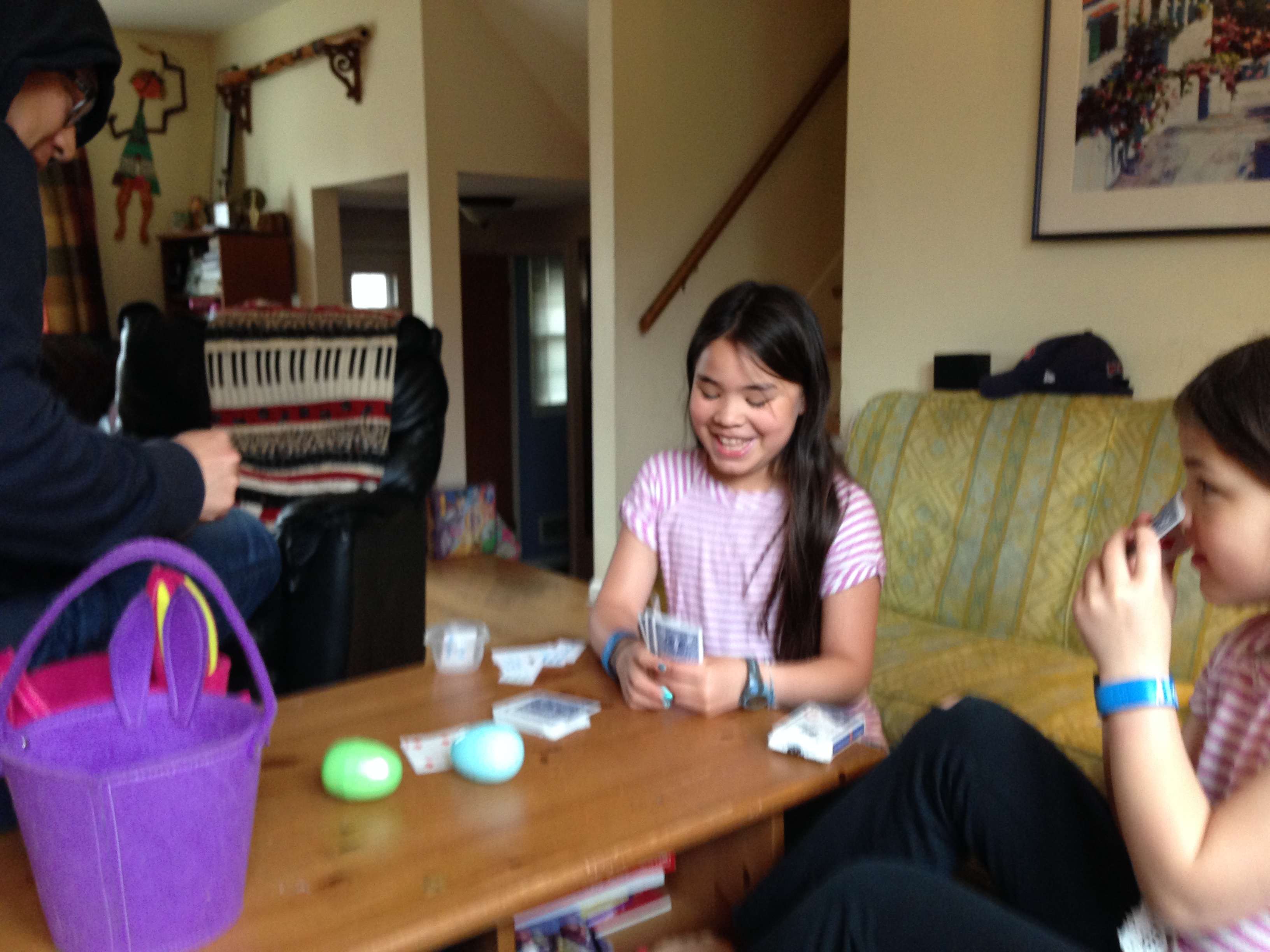
And so, on Easter morning, Annie and Ella sang to us, played the piano, made our bed (holla!), engaged in some Harry Potter trivia, cleaned the kitchen floor (for real), and played cards in order to get their eggs and baskets. As we dealt the fourth hand (’cause nothing says “He is risen” more than competitive card games), Nick and I looked at one another and said, “This is already the best Easter ever!”
easter4
Giggling over Cad (a family card game).

easter2

An Easter duet (okay, so it was “Heart and Soul,” but it totally captured the exuberant spirit of the day).


Even the more “serious” tasks were met with gleeful enthusiasm… Chocolate and presents are powerful bribes motivators, y’all!

easter6

We dyed eggs with my grandma, listened to “The Hallelujah Chorus,” got all fancied up, and went to brunch; we were totally knocking this Easter out of the park. Then, on our way home from the restaurant, the girls leaned forward in the car and said, “Ummm… So, what is Easter again?”

You’d have thought, after being dragged to church all those years, something would have stuck. Apparently not. (Except the jelly beans.)

Have you ever tried to explain Easter to young kids? Holy crap – it is THE CREEPIEST story EVER. Murder… coming back from the dead… walking around, talking to people… HOW WEIRD IS THAT?!?! Jesus is basically a zombie and everyone thinks it’s great. Let’s celebrate by dyeing eggs! Oh, and a bunny came to the house last night and dropped off a basket! Yay, Easter!!

So I told Ella and Annie the story, they nodded their heads (“Oh, right… Jesus came back from the dead… I remember now…”), but I could see that, even though they’d heard me, it wasn’t making any sense. They didn’t get why Easter was so special.

I understood. I mean, for the past 39 years, I haven’t gotten it, either.

Mostly, I’ve been okay with this. Easter’s just strange; no need to “get it” to have a good time. As the day went on, however, I grew unsatisfied with my answer. Because, frankly, Zombie Jesus isn’t a very happy thought. Just ’cause the Bible says it’s special doesn’t make it feel special – not for me, anyway. I wanted more.

And as I thought about it – as I considered why Jesus’s resurrection was such a big deal beyond the zombie mechanics of it – I felt something shift. I found myself calling the girls back and saying, “I want to talk to you a bit more about this. You know how I’ve told you that the Bible says that Jesus was dead, and then he wasn’t, and that’s what Easter is? And you know how you think that sounds really weird – probably because it is really weird? Well, I think there’s more to it than that.”

So I told them what I’ve learned, starting with ideas I’ve heard from Sophia Community, from Anne Lamott and Glennon Doyle Melton. As I went on, though, I discovered my own ideas — about why Jesus was different from the people who’d come before him, how he was really an awfully cool and amazing guy, how radically new his message was — not about God and the bible and “being saved,” but about us. About how we’re just right exactly as we are, about how we don’t need to do any more to be worthy of being loved; we are, with our flaws and imperfections, exactly who we are supposed to be. We are each enough, and we are loved, and we can do this.

It doesn’t matter if the story if real, I told them. It doesn’t matter if it ever happened. It doesn’t even matter if Jesus was real (although I think most scholars agree that he was, in fact, a real actual human; the whole divine thing is up for grabs). What matters – for me – is the message that Jesus, or even the idea of Jesus, spread: the message of love, of connectedness, of wholeness, of you are good enough just as you are. I have no idea if any of this really happened, but it doesn’t make a difference; the message, and how that message makes me feel, is what matters.

And as I spoke, I felt this very unfamiliar thing burbling up inside me – a little like indigestion, except it was happiness. It was joy.

easter9
Easter brunch in our fancy duds. Tradition, preserved!

The week before Easter, we were visiting family in Charleston and had the honor of attending my cousin’s daughter’s baptism. Before the big day, we were chatting with everyone, including my cousin’s father-in-law – a retired Episcopal priest who was in town to perform the baptism (and visit with his baby granddaughter!). Annie happened to casually slip into conversation that we used to go to church, but hadn’t in a while (kids are such fun), and then followed up with this gem, “What even *is* religion? I don’t think I have religion.” 

As I was struggling to craft a response that would explain that, of course, we have religion and how much I love my little Sophia Community and that I haven’t completely led the kids astray — TO THE RETIRED PRIEST — my cousin’s father-in-law just smiled at my little heathen and answered, without missing a beat (I’m paraphrasing slightly here because I don’t remember the exact words, but the sentiment is true and real),

“Oh, Annie, I promise you you’ve got religion. What religion boils down to – no matter which one it is – is that we’re all in this together, and we’ve got love in our hearts, and we’re helping one another. I watched you tonight, helping out, laughing. Everything you did, you did with such love. Your love came from inside of you and you gave it to all of us. That’s religion; I saw it. You have definitely got religion.”

All these months, I’ve been looking for my religion – in church, in books, online, in discussions. I’d hoped, if I figured out enough, if I learned enough, that I would find God or Jesus or something; I’d hoped I would feel it.

Turns out, my religion’s been right here inside me all along. (This is sounding an awful lot like The Wizard of Oz…) It’s in card games on Easter morning, it’s in the “You were great!” text from a friend, it’s in the holding open the door for someone at the mall, it’s in your husband and mom and dad being proud of you, it’s in the hugs that my girls give me each night before they go to sleep.

I still don’t consider myself religious, but I have definitely got religion.
IMG_2853a
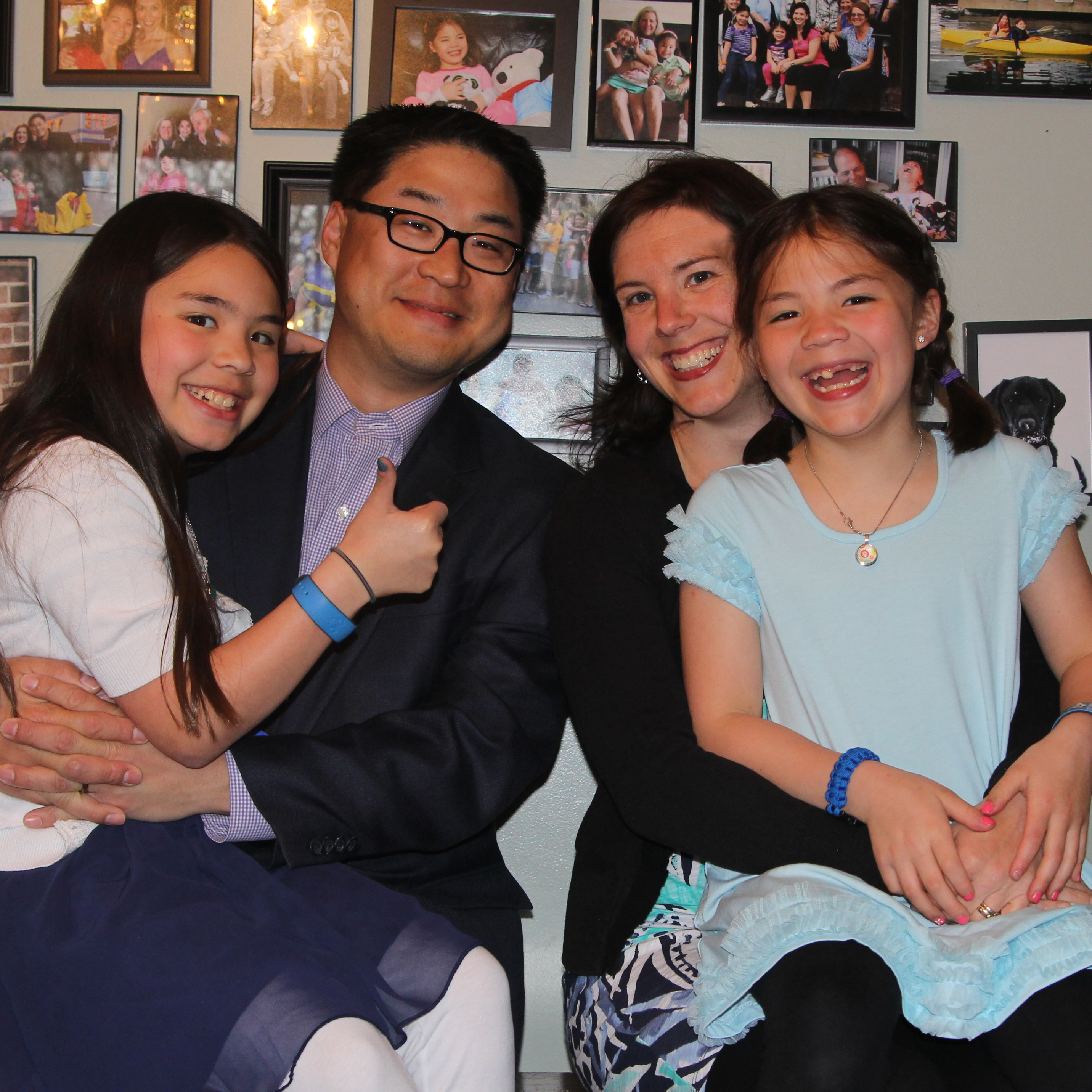
My little heathens and me all gussied up on Easter. 
They are my religion, every last one of them.
 

It Is Time

(An earlier version of this post was published last year. For a variety of reasons, I’ve updated it and am putting it out there again… because here we are again. If you’re looking for the text for the original post, you’ll find it here [scroll to the end].)

Plain and simple, I believe that the current standardized tests in ELA (English Language Arts) and Math, given annually from grades 3-8, are poorly designed and age-inappropriate and, ultimately, should be entirely revamped. I’ll go one step more: I think that a lot of families have no idea what’s happening.

Lemme break it down.

1. Testing isn’t going anywhere
Tests have been around since the dawn of schooling (and probably before that; you know that cave people were totally devising hunting “challenges” for one another). Standardized testing in the United States has been around since at least WWI. Pretty much anyone who’s lived in the USA over the last 40-50 years has heard about our “failing” education system, how we don’t “measure up” to other nations, etc. – so, clearly, something had to be done. Hence, the Elementary and Secondary Education Act was passed which, in 2002, turned into No Child Left Behind where – I’m simplifying here – in order to receive federal funds, schools needed to prove that their students were showing academic improvement. That act was met with such vitriol, this past December, the Obama administration rejiggered it into the Every Child Succeeds Act (ESSA).

Whether or not American schools are, indeed, “failing” is up for intense debate, but the fact remains that standardized tests have been around forever. They offer one small snapshot into one moment of a student’s academic year. Taken alongside the numerous other evaluations that are performed throughout any given school year, they can contribute a few brushstrokes to a child’s academic progress canvas. If these tests are well-written, developmentally appropriate, and accurate, they can also provide some sort of (small) basis with which to compare schools and teachers.

I’m down with standardized testing, as a general concept. I think most parents, teachers, and families are.

2. Common Core confusion
States adopted the Core standards with a very specific goal in mind: money. Not education reform, not improving student learning, not evaluating teaching practices or helping teachers to better their approaches, but cold, hard cash. See, there was this thing called Race To The Top (RTTT) that was rolled out in 2009-2010 that essentially said (I’m paraphrasing here ever so slightly): Hey, governing people! Want to earn more FUNDING for your states for education? THEN COME COMPETE FOR IT!! All you have to do is prove that you’re evaluating teachers more stringently, identify and turn around failing schools, promise you won’t prohibit the formation of more charter schools, adopt some common standards, and create some nifty data systems! The faster and better you do that, the faster you can earn MORE MONEY!!! It’s like a carnival up in here!

In theory, a set of shared standards isn’t such a bad idea. I like the Common Core benchmarks, broadly speaking. I like the idea of everyone in the US learning some basic, shared content. I like the thought that, if your kids changed schools or districts or moved across the country, you could count on them not being too far behind (or ahead) because everyone’s learning the same stuff at the same time, from poverty-stricken inner cities to wealthy suburbs.

In practice, because of the whole SHOW ME THE MONEY thing, the standards were written in a bit of a hurry – and, many people assert, they were written without any educator input. No, for real: according to many experts, not one single K-12 educator or child development expert was included in the creation of these standards. So they’re a bit off-base in terms of what’s developmentally appropriate for each grade level, by which I mean that they’re asking kids to know a heckuva lot more, and to use an awful lot of more complex thinking, than they’ve done before.

Which, in itself, might not be so bad — maybe even inspiring and hopeful — if the standards had been adopted at a reasonable pace with teachers being given adequate support and training to properly teach the new material.

But because there was money on the line, and because states had to act super fast if they wanted their share, they adopted Common Core with lightning speed. There was no gradual roll-out. No trying-and-seeing to determine if this set of standards was reasonable, achievable, or appropriate. No oversight by anyone in the field of education. Buckle up!

3. Many of the tests are poorly written
Even so – even with way more complex standards written by non-education people that were put into practice before anyone had a chance to review them – things might have been okay had the accompanying tests that were meant to measure performance been good, strong, accurate evaluations. But many of them are not.

For one thing, they – like the standards – are written by non-educators. (I understand that in New York state, the tests before the Common Core-based evaluations were also written by non-educators, so this is nothing new, but that doesn’t make it a good idea.)

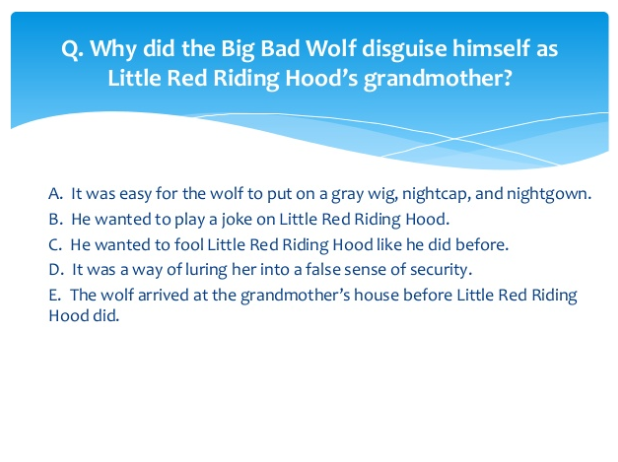
Perhaps unsurprisingly, given their authorship, the tests have been found to be riddled with errors. The test questions themselves, especially on the ELA portion of the exam, are often written at reading levels two to nine grades ahead (asking, say, third graders to read and evaluate passages that are actually appropriate for 5th- 12th graders).
Screen Shot 2015-04-11 at 5.43.27 PM
These are taken from the PARCC ELA test…

Screen Shot 2015-04-11 at 5.43.48 PMYes. Our eight year-olds are probably familiar with the idea of “luring” someone into “a false sense of security.”

Many of the test questions are vague or even deliberately misleading, which makes choosing the answer more of a guessing game than a true demonstration of understanding.

4. The results don’t mean anything
Given that the tests are badly written, error-filled, and are developmentally inappropriate, it seems safe to say that their results don’t really mean much. Additionally, since student results aren’t provided until the end of summer (or even into the start of the next school year), the child’s teacher can’t use the scores to adjust his or her instruction to better serve those kiddos.

Sure, in theory, a teacher could look at the results from last year’s class, see a deficiency in a particular area, and think, “Oh, I guess I didn’t do a good job teaching Main Idea. I’d better work on that with this year’s batch of students.” In fact, I would bet that the vast majority of teachers try to do exactly that. But the information that teachers are given – at least in New York – is rather limited.

Teachers aren’t allowed to see the actual questions from the test, nor to know ones were answered incorrectly – they only receive a broad overview of concepts and standards and whole-class percentages rather than individual student breakdowns. Did last year’s students really not understand Main Idea, or were the Main Idea questions vague? Were they deliberately misleading? Were they “sample” questions that are thrown out there each year just to see how kids do on them? Were they just plain incorrect or filled with typos?

Even if the data was reliable – there’s one final catch: the passing score changes from year to year and is determined… AFTER THE TESTS HAVE BEEN SCORED. I wish I could say that I’m kidding, but I’m not. Movable passing scores!!

5. Teachers are more than just a (faulty) number
Here’s where things get really personal for me. Let’s just backtrack for a moment and pretend that the current tests are awesome. Let’s pretend that they are appropriate, accurate, and superbly written. Even if this were the case, I think we can all agree, still, that they represent merely one moment in a child’s education, several hours out of their lives. They don’t actually demonstrate all that children have learned – not even the best tests in the entire world – because most of what we call “learning” cannot be shown in a two-dimensional standardized test.

What standardized test results really show us is how well individual children tested on a particular day. And yet many states have decided that test scores do accurately demonstrate how well teachers are teaching, often counting the scores for up to 50% of a teacher’s evaluation.

And let’s not forget about the rest of the teachers. Tests are given at only at certain grade levels in certain subjects – meaning that that the majority of teachers do not teach these subjects/grades. K-2 teachers? 9-12 non-Regents class teachers? Gym, music, art? Science (students are tested in science but not in every grade), social studies/history, foreign language, library, computer, home ec, graphics…? 

And yet 50% of their evaluations are also based on test results. Based on the performance of students they may never have laid eyes on IN SUBJECTS AND GRADE LEVELS THAT THEY DO NOT TEACH.

This is fair, appropriate, or okay because… why?

6. Greed is a powerful motivator
For decades now, politicians have been talking about how American education is failing. Thus, politicians find it pretty easy to gain financial backers for education reform. After all, once a school is determined to not pass muster, something must be done — new curricula, new textbooks, new resources.

One of the largest supporters of Common Core is Bill Gates – yes, that Bill Gates – who has poured hundreds of millions of dollars into its adoption. While I believe that Bill Gates genuinely wants to help, it’s hard to ignore the fact that Microsoft and Pearson – one of the largest producers of Common Core materials – have banded together to get additional Microsoft resources into schools.

Many people have taken issue with the fact that companies such as Pearson [which authored a) the Common Core standards, b) the great majority of the current Common Core tests, c) the “modules” of instructional materials that are sold to schools to prepare students for said tests, d) and – as of 2015 – the teacher certification examinations in eighteen states] is a business company, not a company run by education or child development professionals. (I acknowledge that pre-Common Core, tests were still written by contracted, outside companies; that still doesn’t make it right.)

That would be galling enough, but even more maddening is that Pearson is positively rolling in the money it is making off of its materials. Since Common Core was adopted so quickly, school districts had to act fast to provide their teachers with adequate curricula resources. Who better to provide that than the author of the Common Core standards? Enter the Pearson instruction modules! Need additional support materials? Pearson’s got those, too!

7. Teacher demoralization
I’m just going to put it bluntly: because of all of this Common Core testing and the hoopla surrounding it, many of our teachers* feel like crap. They have been told, in no uncertain terms, that the jobs they were doing weren’t good enough. No matter how well-liked they were, how many kids graduated from their classes, how many years they’d been teaching, how many children they taught to read or how to multiply, how many hours they stayed after school, how many hungry children they fed, how many concerts they attended… it wasn’t enough. They have to change, fast. And if they don’t? Their very jobs are at stake.

All of the teachers I know – the ones for whom I sub, the ones with whom I sub, the ones with whom I went to college, the ones with whom I used to teach, the ones who teach my own children, or the ones I’ve met along the way by happenstance – have said, unequivocally, how much they love teaching. They love their students. They are fiercely proud to be educators. But it is getting hard – really hard – for many of them to continue. You hear talk of those who are seriously considering leaving the classroom because they can no longer teach; now, they have to teach these modules, teach to the test, jump through hoop after hoop. It’s exhausting and maddening.

Losing our teachers would, obviously, be a tremendous problem; that problem is compounded by the fact that there has been a steep decline in the number of new teachers being certified in recent years. Even those who do decide to enter the profession don’t stick around for long.

To be sure, teachers have often felt under-appreciated, misunderstood, and underpaid, but rarely has their ability to do their job been so strongly questioned. Never have they been so micromanaged. We are losing some of our best teachers. We aren’t getting enough new ones. This is happening right now, all across the country, and it is terrifying.

(*Obviously, I realize that I’m speaking in very broad terms here. I have not interviewed every teacher in the nation. But I am certain that the teachers with whom I have spoken – and this is a helluva lot of teachers – have expressed their dejection, sadness, and frustration.)

8. How do we get an objective measure?
Many people who acknowledge the shortcomings of these particular tests maintain that we need them because we need some objective measure of how our kids are doing in school. We need some way to compare teachers, schools, and performance, from rural West Virginia to suburban Idaho to inner-city Houston. We need to be able to determine teacher growth and student success. Kids from the most poverty-riddled communities deserve access to the same quality education as their most affluent peers.

I hear that. I absolutely believe that all children deserve a quality education; the disparity is, indeed, unfair. I also think it would be great to, say, move across the country and be able to glean, at a glance, how a school or district compares to another.

But here’s the thing: I think we’re looking for something that doesn’t exist – not because we haven’t figured out how to do it, but because it’s just not possible. Maybe education and learning aren’t things that can be measured any more than a musical performance can be measured. Maybe teacher growth and student success aren’t confined to numbers. Maybe a one-size-fits-all assessment works nicely for obtaining a driver’s license but not so well for determining whether or not fifth graders can identify subplot or if their teachers are doing their jobs. Test scores do not indicate success or failure; they are merely numbers.

9. Quite whining! How about some solutions or ideas?!
I’m not saying that we should give up. I’m saying I think we need to – dramatically – change our approach to how we evaluate education, students, and teachers. In my Magic Wand World, I’d take a (lot of) page(s) out of Finland’s book (it is well-acknowledged that Finnish students perform among best in the world at international exams) and our teachers would be as well-respected as as well paid as our doctors.

Since it’s unlikely that we’re going to adopt too many of Finland’s ideas, I suggest that we work with what we already have to reconfigure our view of success.

  • We should de-couple the current standardized tests from teacher evaluations, period.
  • We can keep the Common Core – as I said, I like those standards – but only as a portion of what each child should learn; we need to leave the rest up to individual states, districts, schools, and teachers.
  • We should give teachers several years to become familiar with the Core standards so that they can rework their lesson plans, see where there may be deficiencies, and take it from there.
  • Standardized tests aren’t going anywhere (in the USA), but we should have new, fair, developmentally appropriate tests that have been written by educators from across the K-12 spectrum.
  • Those tests’ scores should come back before the school year is over so that the students’ current teachers can use the data to inform their instruction.
  • And then those numbers should be just one of many other things that combine together to form our opinions of teacher success and student learning. Let’s factor attendance into the equation. Graduation rates. The percentage of high school graduates who go onto college. Post-graduate success. AP exams – how many are given? What are the scores? Teacher-student ratio. Teacher retention; how many are still teaching there after three years? Five? Ten? Extra-curricular activities. Class sizes. Poverty levels. Parent involvement. Principal and superintendent evaluations. Student portfolios. Additional test scores.

Education “success” cannot be measured by any one, single thing. I will happily sing you the praises of my daughters’ elementary school, which I adore, but none of those praises – from small class sizes to close relationships with other families to the devotion of the teachers to their annual Halloween parade – has anything to do with test scores.

10. Become informed… and then do something
I’m not really the “take a stand” type. More typically, I talk and think a lot. I write letters, I sign petitions, I discuss with family and friends. With this, it was different. I’d been talking, for years. I’d been signing petitions. I’d been writing letters, dozens of them, from the governor to my locally elected officials.

Finally, last year, it became clear to me: talking, thinking, letter- writing, and petition-signing weren’t working. Our legislators weren’t listening. And in the meantime, our children and teachers were suffering.

Enough was enough. And so, after much research and consideration (and after having participated the year before), our 4th grader opted out of the tests. She was extremely nervous about taking them – and we were extremely upset that her teachers were being evaluated based on student scores on poorly-designed tests – so it seemed like an appropriate solution. Turns out, many, many parents and children in New York state came to the same conclusion. As I wrote last year:

To paraphrase the incomparable Maya Angelou, when you know better, you do better. Parents and teachers are speaking up. We are knowing better. I hope, as our voices swell – whether our children take the tests or refuse them – that our politicians will hear us and that, some day, they will do better, too.

You know what? Our New York legislators heard us. BY GOSH, THEY HEARD US! Our voices swelled and our message was clear: This situation needs to change. And so the change has begun. Test scores are no longer being used to evaluate New York teachers (CAN I GET AN AMEN!). Students may now take as much time as they need to complete the exams. As of next year, Pearson will no longer be writing the tests or curricular materials. NEW YORK IS TRYING TO DO BETTER.

“Never doubt that a small group of thoughtful, committed citizens can change the world; indeed, it’s the only thing that ever has.” – Margaret Mead

Because of the changes that have been made, my husband and I did not feel as strongly about refusing the testing this year, instead leaving the decision to our daughters (after sharing the above information with them, to the degree that they can understand it). Our oldest, again, has opted out; her younger sister is taking them. We feel very comfortable being a house divided.

No, the tests aren’t perfect (then again, what is?). With the exception of tying them to teacher evaluations, everything else remains (essentially) the same, so there remains (much) work to be done. (While I appreciate the removal of the time limit, it seems that some students are taking up to 6 hours per day to finish their tests… which is not exactly “doing better”…) Still, I acknowledge and greatly appreciate that changes are being made. It’s a step in the right direction.

Some analysts and educators argue that high-stakes tests should be banned, period. Others claim that the tests are successful. Although they’re reaching different conclusions, they’re doing so after having thoroughly done their homework (a pun!).

And that is what I encourage everyone to do: learn more, then go from there. Find out who writes the tests in your state and how teachers are asked to teach the material. Read up on others’ opinions about how valid and appropriate the tests are. Discover when the test results are returned, what information the teachers and schools receive, and how they apply that information. Learn whether or not your child’s educators are evaluated based on test scores. Inquire about what your options are.

Then, if you feel that the tests are not measuring up, ask for better. If you feel like they’re cutting muster, speak up! Maybe that looks like writing letters. Maybe it’s signing petitions. Maybe it’s attending town hall meetings. Maybe it’s talking with neighbors and teachers and administrators. Maybe it’s opting out. Maybe it’s opting in. Maybe it’s a little of everything and a lot of other things, too.

No matter how you feel about Common Core and the state tests, I think we can all agree that our nation’s children deserve awesome. Let’s work together to be thoughtful, committed citizens. Let’s help our children receive the awesome they deserve. Heck – let’s change the world.


Now and Ten

We have reached that strange, familiar-yet-unfamiliar place: neither separate nor together, too close or too far, always. She wants me to listen but not overhear, to offer advice but to allow her to figure it out on her own, to catch her and set her free, all at the same time.

Some days, she is exactly who she has been all these years. Our exchanges are easy and bright, familiar and relaxed. We both find our footing and walk forward together. Other days, it’s as though she is an entirely new and different person. Nick and I ask each other, “Wait… where did she go?” The ground beneath us is unsure, our steps tentative, maybe even backward.

And then suddenly, without warning or preamble, she bursts through again, radiating humor and happiness and contentment. Nick and I say to one another, “Oh look – she’s back!” Of course, she has always been there; just sometimes, there are a lot of clouds obscuring our view.disney01

So it’s been for a while now, but recently everything feels intensified. The clouds, when they come, are thick and far away, offering cover that we cannot quite peek through. They blow over more quickly, however, and when she returns, she is more sparkling than ever before. Or perhaps I just appreciate her light a little more, somehow.

These past few months have brought a helluva lot of figurings-out and thinking-abouts and growings-up – I was going to say for her but now I realize it’s been for both of us. As she navigates her space, she has been pulling me close, both physically and otherwise. Sit by me, Mama. Can I read this to you? Would you come talk with me, Mama? 

Still, she is working hard to be Independent and Strong, and I am constantly reminded that, despite her small stature, she is no longer a little girl.

But sometimes… When I go to tuck her in at night, I slip her hair behind her ear and just watch her breathe, the rise and fall as steady and peaceful as the tide. When she plays the piano, I am struck by her beauty, by the gracefulness of her fingers. When she asks if I can pick her up and hold her (yes, even now), I no longer even pretend that she is too big. She is, of course, but these moments are so rare, I’ll gratefully oblige.IMG_0195
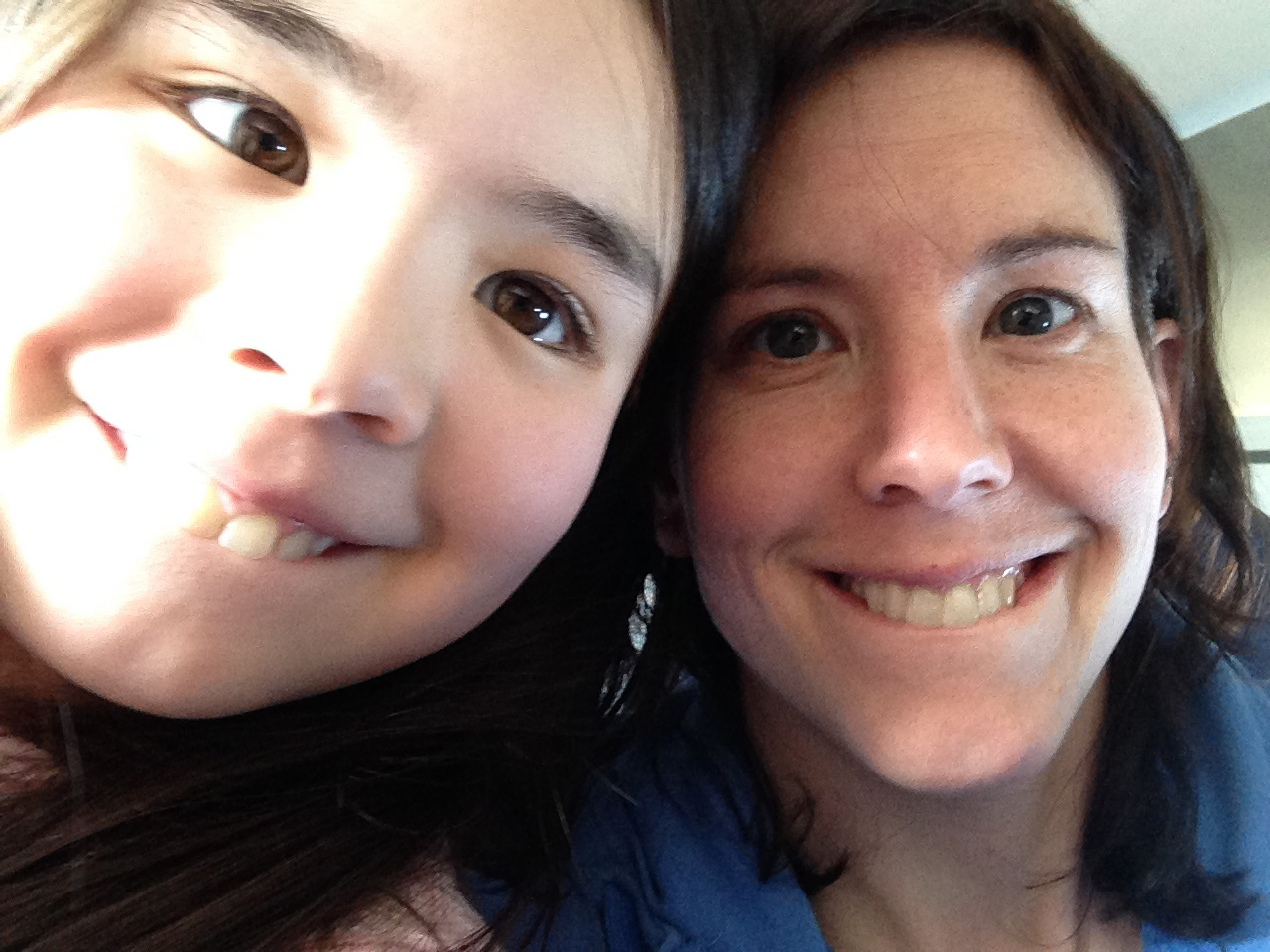
“People say we look alike…”
Taken on the plane. Shared with her permission.

Spring break was last week; as before, we visited my dad and stepmom in Kiawah and it was wonderful. Our final flight home had us taking off well past bedtime. If we were lucky, we’d get home before midnight. The girls were troopers in the airport, but they were exhausted by the time we took our seats on the plane.

She wanted to sleep – desperately – but couldn’t find a comfortable position; snoozing while traveling is just not her thing, an unfortunate trait she inherited from me. She tosses and scrunches, stretches and curls up, but nothing feels right. I murmur sympathetic noises over my crossword puzzle, illuminated by the blazing personal light that I’ve clicked on above us.

When she shifts again, I notice the exhaustion on her face, her whole being drooping like a wilted flower. I tug my sweatshirt from behind me, where I’ve balled it up to get it out of the way, and drape it across my right side. I hold out my arm, reaching around her shoulders. “Here, sweetie. Come, pull in beside me.” Unexpectedly, she does, tucking herself in against my chest. Within minutes, I can hear and feel that her breathing has slowed. I reach up with my left hand and and turn off the light.

Unable to work on my crossword, I just sit, my arm around her, my chin resting on her head. I sniff her hair; it does not smell like shampoo or sweetness, as it did when she was a baby, but instead of chlorine and sunscreen and salt and sweat – a perfect encapsulation of a day well spent in the sun, by a pool, having fun. I inhale deeply, taking her in, as though I can see her dreams radiating around us.

After ten minutes or so, my eyes have fully adjusted to the lack of light and I take up the crossword again (with one hand), somewhat half-heartedly. As we begin our descent, there is some slight turbulence. She slides forward a bit, away from me, her head tilting. I tighten my grip on her shoulder and attempt to do 39-Across.

By now, she has slid even further down. Her head is lolling forward; I’m afraid that she’ll awaken. I move my hand from her shoulder to her head, pulling her back in to me. Once more, I put down my pen. It is awkward and a little uncomfortable sitting like this, my hand pressed to her forehead as though feeling for a fever, leaning into her with each bump and dip so that she doesn’t tip right over. But I don’t care. I don’t know when we’ll be sitting like this again. I can do so little to protect her these days; these moments feel like a gift. We stay just like that until the flight is over.

When we land and finally arrive at our gate, her eyes flutter open – although she is so tired, they can hardly remain so. She says she wants to come with me to get the car (rather than wait inside for the luggage with Nick), despite having to walk in a downpour to retrieve it. She is patient and quiet when the CD player consumes our parking ticket and I have to produce my driver’s license to exit the ramp. Once we get home and I am tucking her into bed, she insists that she wasn’t actually sleeping on the flight – she was merely resting.

But minutes later, when I check on her and find her fast asleep, I watch the rise and fall of her chest again, like it had been on the plane, like the tides, and I know she was mistaken. I sniff her hair one last time – still perfect – and leave her to her dreams.

disney001

Grace Notes (aka The Great Pajama Debacle of 2015)

When we arrived at school yesterday, the crossing guard cheerfully asked if the girls were comfy – given that it was pajama day. Insert *mass hysteria* because they were not, at all, dressed in their pajamas. THE HORROR.

There was some blaming… on both parts (“Mom!! It was on that sheet that came home! HOW COULD YOU NOT REMEMBER!” “I never read any such thing!” “YES YOU DID! IT WAS ON THE SHEET!” “I believe that it is YOUR job to be in charge of things like pajama day, my dear…”). There were some angry, hissed words… on both parts. There was sulking… on both parts. There was full-on denial of any responsibility… on both parts.

As I came back home, I kept replaying it in my mind, how wrong my offspring had been for not taking responsibility for themselves, how they need to remember their own stuff, damn it! Then, after a bit of pondering, I realized that it was, indeed, a confluence of many errors – not just theirs. One daughter’s teacher did not mention pj day to the class at all (resulting in 3/4 of those classmates not wearing pajamas). One daughter did not remember that her teacher had mentioned it, and thus failed to don appropriate loungewear. And one mama (*cough*) only scanned the informational sheet that had come home rather than reading it thoroughly (although we did send in pennies on Monday and nickels yesterday for the All For Books collection, so this mama got something out of the handout…).
Still… no pajamas. My bad.

Once I realized that I’d had a part to play in The Great Pajama Debacle of 2015, I blamed myself. Harshly. I mean, if one of my kiddo’s teachers never even mentioned pj day, and it wasn’t announced over the loudspeaker, the only way she’d even know that such a thing existed was if her parents (or, in this case, me – ’cause Nick is out of town) had fully read the communication that came home and informed her of said pj day. Which I did not, and she got screwed.

So, basically a total parenting fail on my part. Which is ironic because, I mean, how many times have I berated students (and angrily chided fellow parents) for not following the directions or actually reading the emails I so dutifully type out?? HOW IS THIS SO HARD?

I felt awful. Chalk it up to another Bad Mom Moment. I DID IT AGAIN.
snow girls
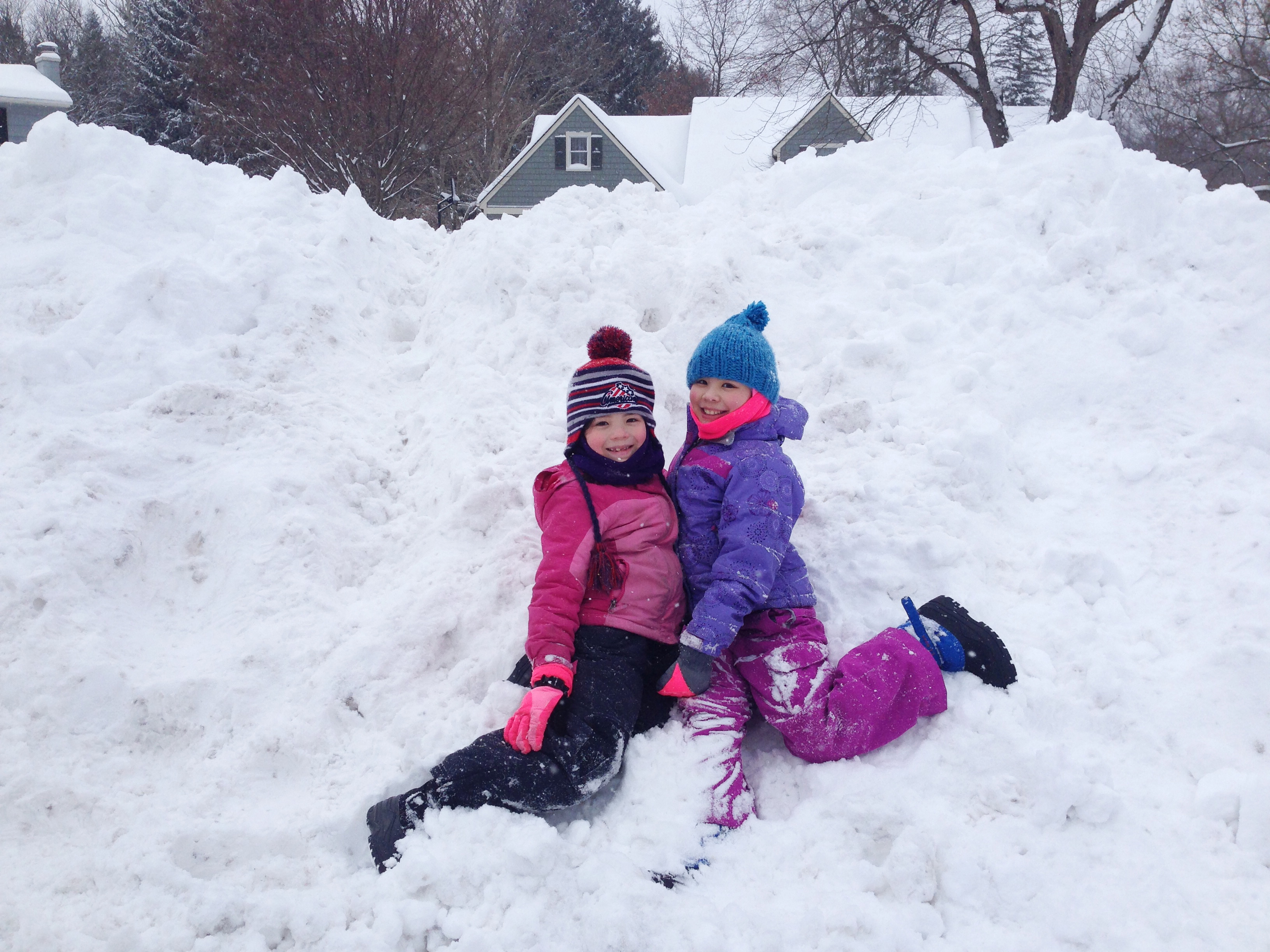
This photo has nothing to do with anything other than that they’re cute.

But then, for reasons I can’t quite place, I sat back and realized that, yes, I did do it again. I made a mistake and my kiddos suffered the consequences of it. But the thing is, I’m going to keep on making mistakes because (and this sometimes shocks me) I AM HUMAN and that’s what we do. We make mistake after mistake; hopefully, we don’t do it on purpose. Hopefully, we learn from them. Hopefully, we apologize when an apology is warranted and we mean it. Hopefully, we try really freakin’ hard to do better in the future. But mistakes are natural and normal and, even when pajama day is not remembered (cue tiny violins), even when my kids stand out like sore thumbs in jeans instead of flannels, it will be okay.

Upon this realization, for one of the first times ever, I decided to give myself a little bit of a breather. I decided to let go of the guilt, of the should-haves, of the yuckiness gnawing away at me when I looked at the bar I’d set and saw I hadn’t come close to reaching it. I decided to give myself grace – not necessarily in the religious sense (I’m not quite that powerful; see above: forgotten pajama day), but in the I’m Doing The Best I Can And If I Make Mistakes It’s Okay So I’m Not Going To Beat Myself Up For It sense.

I’ve been reading a lot about the concept of grace, especially from Glennon Doyle Melton on her Facebook page and in her book. Glennon is really just the absolute shit – funny, poignant, thought-provoking, absurd, well-spoken – but it’s what she’s written about grace, about forgiving and embracing your whole scattered, imperfect, crazy self, that has really struck a chord with me.

But man, has it been difficult to put into practice.

I’m naturally hard on myself, asolutely my toughest critic. I’m not much for keeping up with the Joneses. I don’t feel outside pressure to look a certain way, parent a certain way, be female in a certain way. I don’t worry so much about appearances (see the previous post about my duct-taped car and stain-covered clothing). Some of this is just who I am, and some of this I attribute to my ADHD – so I choose to let it go. I mean, if there’s a great likelihood that it’ll take me 37 steps just to put away the laundry, it would be expecting a helluva lot of myself to have a perfectly organized house all the time.

That part is nice – the allowing myself to just be… me. To not hold myself to impossible visible standards. But the secret is that I hold myself to impossible invisible standards; the ones I’d never expect of anyone else, the ones that are ridiculous, the ones that no one else knows about but me. And when I don’t meet my own expectations – because they’re, you know, all but unattainable – I come down on myself. Hard.

If I’d tried more. Started earlier. Listened better. Said no. Said yes. Been more organized. Gone to bed earlier. Focused differently. Paid attention. Worked faster. Put in more detail. Worried less about the small stuff. Asked for help. Done it myself. Been open to change.

You name it, I’ve failed at it.

Honestly? All of this failure just plain sucks. It’s exhausting. It’s disappointing. It’s maddening. It’s stupid.

So, I’d like to be done with it. I don’t mean I’d like to stop screwing up (that would be awesome, but it’s not what I mean), but rather that I’d like to be done feeling like a failure because I don’t live up to my own unreachable standards. To allow myself to be human, to be me. To give myself grace.
dance girls
Attempting some Irish dancing after seeing it live on St. Patrick’s Day.
Again, this has nothing to do with anything. Carry on.

I decided to start yesterday. Yep – I didn’t read the memo thoroughly. Yep, I didn’t inform my kiddos that it was pajama day. Yep, they felt left out. And it sucked. But it’s okay. It was a mistake – a small one, at that. It’s okay. I’m okay. In fact, I’m pretty damned awesome.

When the girls came home, there was not one mention of pajama day. They did not come through the doors in tears claiming I’d ruined their lives (over pajama day; I’m sure they’ll be happy to come up with other ways I’m doing them in). Still, I wanted to at least acknowledge what had happened — after all, I’d completely denied that I had any responsibility in the forgetting; I needed to set the record straight. Before I left to teach piano, I leaned in and said, “Hey – I just wanted you to know that I double-checked the note from school. You’re right; pajama day was mentioned. I didn’t read it fully, so I didn’t know. That was my fault. I’m sorry.” Without missing a beat, they looked up and said, “It’s okay, mama. We didn’t remember on our own, either. It’s not your fault.”

Which, I guess, is what it all comes down to, right? This parenting thing? Growing and learning and admitting your errors and celebrating who you are and starting over again with love and a new perspective and probably a glass of wine?

They will find out whether it’s okay to be human from you. Insist to them that it’s more than okay by apologizing and then PUBLICLY and SHAMELESSLY AND BOLDLY forgiving yourself. And then Begin Again. And Again and Again and Again and Yet Again Forever and Ever Amen.

Don’t show those babies what perfection looks like- show them what GRACE looks like.
– Glennon Doyle Melton

I am shamelessly and boldly trying. It sucks, but I’m trying.

(Damn good thing, too, considering that this morning we all remembered that it was Crazy Hat day… but, in our rush to leave the house a little earlier than usual so that I could sub, some less-than-stellar moments were had, including the moment where I might have crouched down low right in my daughter’s face and growled the phrase, “If you ever say that again, you’ll be in for a world of hurt.”

So… yeah. A world of hurt. That’s neat.
I’m having a little trouble with the grace thing on that one, but you’d better believe I’m going to apologize. And begin again. And again. And again.)

Can we fix it? No, we can’t.*

For the first time in my life as a parent, I was unable to fall asleep last night because I was worried about my children.

This is not – at all – to say it was the first time I’ve worried about them, nor that it was the first time I’ve struggled to get some shut-eye because my mind and heart are racing. But up till now, worry for my daughters hasn’t prevented me from sleeping.

It was not a welcome occurrence.

I suppose we’ve been tremendously blessed – lucky, fortunate, whatever works best for you – that Ella and Annie haven’t really given us much to worry about. For the most part, they’ve been healthy (knock wood). We can afford to clothe, feed, and house them. Academics come easily. They’re socially and emotionally well-adjusted. Sure, there have been nights when I’ve been concerned about the latest stomach bug, and the times when one of them appears at my bedside like Cousin Itt aren’t exactly the moments I count among those I want to “savor because it all goes so fast.” But overall? It’s been pretty smooth.

Even now, the stuff that I’m worrying about isn’t exactly of the life-or-death variety – more of the growing pains variety – but it’s taking up enough of our waking hours (and, apparently, my sleeping hours) that I’m having a hard time not thinking about it.  (I’ve carefully considered whether or not to describe these situations, even vaguely or as an anecdotal aggregate of many stories. There’s a part of me that wants to because I know we’re not alone and I think there’s tremendous benefit in forming connections with someone else who’s walking the same path, in feeling that someone out there understands. That benefit, however, does not outweigh the responsibility I have to my daughters to put their best interests first. Out of respect for them and their privacy, I’m choosing not to write about the specifics.)

But here’s the rub: I want to fix it. I want to step in and take the difficult stuff away. Not all of it, of course; I’m a firm believer that kids need to suffer disappointments and setbacks and struggles in order to grow and learn and become competent, capable human beings. But some of it – the nonsense, the stuff that, in the grand scheme of things, is just asinine and they’ll look at it in later years and say, “Gosh, that was a waste of time” – I want nothing more than to make disappear.

Or, at the very least, I want to magically be able to give them the tools and the moves to face their problems squarely, to stand tall and proud, to be utterly confident in themselves and their beliefs. “If you just use this wand and wear this cape and do this roundhouse kick and read from this book and say these words, you will be victorious every single time. You have GOT this. Ba-BAM!”

I’m learning the hard way that it isn’t that easy.
By God – and this is the hardest part of all – they have to learn to do it themselves.
ech 23a of 52 bookstore tradition
Me and my best big girl, Ella, age four.

I know that struggles are normal. I know that essentially no child makes it through to adulthood without some drama, without a time that was rough, without growing pains. My therapist reminded me that kids are supposed to bump into things and into one another; that’s how they feel their way, how they learn and mature; it’s normal. This reminder was simultaneously helpful and maddening.

Yesterday, we learned the wonderful news that an extended family member is expecting her first child. As I chatted with her on Facebook, she confessed that, in addition to feeling elated, she’s also worried “every second.” I so remember those feelings. For nine months, you don’t let down your guard. You check the toilet every time you pee (which is often). You wonder if the baby is moving too much, then grow alarmed when there’s not enough movement. You question each ache and pain – is that normal? Is he in the right place? Is she big enough? Am I giving her enough nutrients? What if I get gestational diabetes? Is he getting enough oxygen? What did that thing on the sonogram mean? You’re excited and anxious and basically don’t fully let out a breath until the baby takes his or her first one.

(Or, at least, that’s how I felt, especially with my first pregnancy. Maybe this is why I wanted to slap everyone who called pregnancy “magical” or touched my stomach, unsolicited.)

Then, the baby is here, in your arms – success! Pregnancy, check! The worrying is over!

Until you realize that you have no idea what to do when the baby won’t stop crying. And when was the last time he ate? Please wash your hands before you pick her up. Where did this rash come from? What do you mean she isn’t gaining weight like she should? You did put him down on his back, right? And the carseat is properly buckled? And he’s not wearing too many layers? And the music isn’t too loud?

When the danger of SIDS has passed, you tell yourself, that’s when you’ll relax. When you’re getting more sleep, you’ll be less concerned.

But then there is crawling. And baby-proofing the outlets. And making sure they don’t fall down the stairs. And cutting grapes into fourths. Toddlerhood is exhausting and all-consuming because you have to watch them or contain them every single minute. You worry that they’ll never drink from a sippy cup, potty train, sleep through the night, give up the pacifier. Surely, when they’re older – when they don’t physically need you as much, when you can go to the bathroom by yourself for the love of God – you won’t worry so much.

Those worries do fall by the wayside. I mean, I haven’t cut a grape for my kids in years – these days, they even cut their own steak. But the old concerns are replaced by new ones, and these problems are a lot more complicated.

More to the point, I can no longer fix them.
ech 27 of 52 boating
Me and my best little girl, Annie, age three.

Immediately before I exchanged Facebook messages with my friend, I’d been collecting myself after tucking Ella and Annie into bed. I’d closed my eyes and sorted through what I wanted to tell Nick – who is out of town – about how worried I am about the things that are bugging them, how worried I am that I have no idea what the heck to do, how freakin’ hard this parenting stuff is. After reading my friend’s words, I wrote back to tell her that I understood… but that we never, ever stop worrying – about our kids, about ourselves as parents, about whether we’re doing it right or enough, about how much their future therapy will cost.

When do you step in? When do you let them figure it out on their own? When they’re bumping into things, do you redirect or do you just let it happen? What do you do when they ask for help? What do you do when they don’t ask for help? Why are little girls so darn hard on one another? Why is friendship so difficult to navigate? How do you not laugh when your child lists the things that are overwhelming her – including seemingly fun stuff like playdates and parties – and says she’s “just falling apart”? How does your heart not break a little, too?

I called my mom and told her that I don’t think I’m up for this. I feel completely unprepared and unskilled; I don’t know how to be the parent my children need me to be. I asked her all of my questions and, after allowing me to ramble and sniffle and sigh, she gave me a wholly unsatisfying answer: Just be there.

Just be there. Listen. Be their ally. Hug them. Offer ideas when asked. Ask questions that help them form their own conclusions. Support them. Love them to pieces. Be there, always.

But, beyond that, they need to figure all of this — life — out on their own.

Damn it. I think my mom is right. THIS PART OF PARENTING SUCKS, Y’ALL.

I think I’m a pretty damned good mother, but the truth is, I really don’t know how to do this. Thankfully, I’m learning – day by day – to listen to the people who do know: Annie and Ella. They know themselves. They know what they want and what they need. Yeah, they don’t always know how to express those needs and wants (hell, a lot of adults don’t know how to do that), but if I give them the chance, they can almost always figure it out – sometimes with my help, sometimes alone. But it happens… I just have to let it.

I have a strong feeling that I’ll never stop worrying (although I hope I don’t lose too much more sleep) – about them, about me, about us. I’ll make mistake after mistake and apologize over and over again and hope, with everything in me, that they accept my apologies and still trust me. Their path is theirs to walk – but you can bet your bottom dollar I’ll be here… cheering them on, biting my lip, banging my head, arms open wide.

I’m still shutting the bathroom door, though. That “me” time was hard won and I’m not giving it up anytime soon.
IMG_0004
Also, I’ll definitely be here when we get to try free soda. Ba-BAM!

* Yes, the title references “Bob The Builder” – a children’s television show I’ve never actually seen but whose theme song I somehow know. THIS IS WHY MY BRAIN CANNOT STORE IMPORTANT INFORMATION – it is full up, you guys.


Bahama Drama

Remember when said that I’d tell the story of how I got hypothermia – in the Bahamas, of all places? Well, then I went and described visiting the homeless shelters, and after that there is really no appropriate segue into something as absurd – or unrelated – as Bahamian hypothermia, so I figure I’ll just go from the sublime to the ridiculous and run with it.

I do so like to keep people on their toes.

When we signed up for this cruise, one of the things we were most excited for was the day that the ship would be spending at Disney’s island, Castaway Cay (sounds like “key”). Hence, when Ella opened the curtain to our stateroom on the morning we landed and announced, “Wow – it’s really cloudy. Actually, it looks like it’s… raining…?”, it was not exactly welcome news. We slid open the door to the balcony just far enough to confirm two things: 1) it was most definitely raining and 2) it was most definitely not warm by Caribbean standards.

The forecast called for occasional showers, so we decided to take our chances (that we’d find some dry pockets in the afternoon) and head to the island after the original siege was over. As we’d hoped, the ship virtually emptied out as other sea-farers disembarked. Having the place to ourselves, we shuffleboarded… We explored… We watched Ella and Annie as they delighted in riding the water slide four times in a row with absolutely no line… We thanked our lucky stars that they were tall enough to ride without an adult because it was really freakin’ windy and there was no way we could brave the slides even once without being chilled to the bone.

disney122
Note the rather ominous-looking clouds in the background…

Soon, the wind was accompanied by rain. When the thunder rumbled, the lifeguards hustled everyone out of the pools (to our relief; even fully clothed, we were cold); the folks at Castaway Cay had similarly been ushered out of the water and away from the shoreline. Knowing that we’d soon be joined by – literally – thousands of wet, grouchy beach-goers, we made a beeline for the buffet.

Nothing says “relaxed vacation” like stampeding for the all-you-can-eat shrimp!

By the time we’d finished eating, the rain had mostly stopped. Seeing that the beaches were virtually empty, and seeing as how we’d been looking so forward to our day on the island, Nick and I told the girls that we were going to brave the elements, take our chances, and see what adventure awaited us ashore; they – and GranMary – were welcome to join us. Annie, having become entranced with the ship’s virtual, interactive detective game, opted to stay behind and solve another mystery with GranMary while Ella chose to come with Nick and me.

disney131

As we exited the gangplank (I have no idea if that’s actually what it’s called but it sounds way cooler like that), we passed wet towels that were piled at least six feet high on wheeled carts, cast off as people had boarded the boat and ditched their unnecessary gear. It became apparent the island was, indeed, all but empty the moment we boarded the tram and were the only passengers on it. Soon, we were standing on the beach, ready to do what we’d come here for: snorkeling.

disney132
See? Empty. Emmmmp-teeee.

Or, at least, that’s what Nick – and, more importantly, Ella – had come here for. Nick has loved snorkeling since he was a kid. Ella took an immediate shine to it when she tried it last year and had been itching to go again ever since. I, on the other hand, distinctly dislike snorkeling… but I decided to be a good sport and join them, if only to say that I’d done it.

When Nick picked up the snorkeling gear, he requested some towels and was given… two. Thankfully, we’d thought to bring one with us, so we had three to go ’round. Although it was no longer raining, the wind was still racing; at maybe 65*, I was chilly before I’d even stepped foot in the water, but I hoped that the shallow reef would be warm enough to feel comfortable.
disney134
Thumbs up! Let’s do this!

As I hesitantly waded in, the water felt… okay. Certainly warmer than the air, but hardly balmy. Nick and Ella swam farther out and it became difficult for me to locate their bobbing heads on the horizon, so I decided that if I actually wanted to catch up with them so we could say we’d officially snorkeled together, I’d better get going, no matter how chilly I felt.

You guys. I am just not meant for snorkeling. There’s not one specific thing that bothers me; it’s everything about it. I do get the “Oh, look – beautiful fish!” appeal, but really, I can do that at an aquarium. Or the fish tank in our living room.

Eventually, I made my way over to Nick and Ella, motioning to them so that they’d see it was me – Hey! We’re snorkeling together! Isn’t this great! MEMORIES! – but then quickly reversed course and slogged through the swelling currents back to shore. In order to try to ease the flipper-induced pain in my feet and ankles, I briefly kicked while floating on my back; it did hurt a little less, but it was also much colder than facing downward, so I turned facedown again after only a couple of minutes. Those minutes were enough to chill me from the inside out, however — by the time I (finally) schlepped ashore, I couldn’t stop shivering.

disney137
We pretty much had the lagoon to ourselves…

Given that we possessed only one towel for each of us, I was hesitant to dry myself off just yet (I KNOW, I know). I had no idea how long Nick and Ella would be snorkeling, and if Ella wanted to do something else in the water afterward, I was determined to join her and not be a spoilsport, shivering or not; it seemed prudent, therefore, to keep my towel dry so I wouldn’t have to wrap myself in something soggy later on.

A mistake, in hindsight? Hell yes.
BUT I WAS TRYING TO BE A GOOD MOM, PEOPLE. Surely that earns me some points.

I did understand that I needed to get dry and that just standing around, freezing, was pretty stupid – plus, the shivering was becoming almost violent, not to mention a nuisance – so I hobbled off in search of more towels… only to be told by more than one cast member that there were no dry towels left. NOT ONE SINGLE DRY TOWEL ON THE ENTIRE ISLAND (hence the mountains of wet towels by the gangplank), unless we wanted to purchase one as a souvenir (which, given that I’d already brought an extra towel from home for Nick’s birthday, seemed dumb).

Another thing I don’t like about snorkeling is getting sand all up in my business, so I decided that, at the very least, I could take a warm shower and try to simultaneously clean out my business and raise my body temperature. Turns out the only shower available was outside, with no temperature gauge – so although I did rid my bathing suit of sand, and although the water was warmer than the air, I didn’t exactly get nice and toasty. And I was still soaking wet.

For the record: electric hand dryers do a piss poor job of drying off your entire body.

By the time I limped my way back to our lounge chairs (see: shivering), Nick and Ella were coming out of the water (THANK YOU SWEET BABY JESUS) but I could barely carry on a conversation with them – my jaw felt so heavy, almost numb from all of the chattering.

“Why on earth didn’t you dry off, babe??” Nick – understandably – wanted to know. When I explained that I had tried to warm up but that I was saving my towel in case Ella wanted to do anything more in the water, she piped up that, no, she was cold too, so no more water activities for her… or any of us. ENOUGH WITH THIS WET RIDICULOUSNESS. While changing into dry clothes, I was relieved to see that I was no longer shivering*, but I was growing annoyed at my increasing inability to speak clearly.

* Later, I learned that stopping shivering is actually a sign that your body is shutting down unnecessary motions in order to save energy. So efficient! Go, me!

disney138
Since we’d brought sand toys with us, Ella’s one other request – aside from snorkeling -was to build a sandcastle. Wish granted!

Our favorite gift shop was on the way back to the tram, so we ducked inside for a few minutes to do some shopping. As we sorted through the I Love Castaway Cay! paraphernalia, the oddest thing happened: I began to lose feeling in my fingers. First, my pinkies went entirely numb; that numbness gradually crept into my ring fingers and then to the base of my middle fingers.

Now, I’ve gotten cold hands before. More accurately, I get cold hands all the freakin’ time; Annie and Ella laugh at how my hands are almost always like blocks of ice. Despite living in Snowland, USA, I have yet to find single pair of gloves or mittens that actually keeps me from losing feeling in my fingers, so I am more than familiar with the stinging, painful stages of early frostbite.

This numbness was entirely different; I’d never felt anything like it before, as though each finger could be pierced with something sharp and I wouldn’t even notice. I wiggled them around, clenched and unclenched my fists, but the bizarre numbness only continued to grow. When we’d finished shopping (side note: we bought a towel. I AM NOT KIDDING), I stopped Nick and slurred, “This is going to sound like I’m being overdramatic, but I’m losing feeling in my fingers and I can’t figure out why.”

He looked at me with a combination of WTF and That’s Not Good, suggesting I go to the restroom to try and warm them up under some hot water. I heeded his advice but it was no use – they remained feeling-less. As I told him about my lack of success, it became apparent that my mouth was becoming as numb as my fingers. My tongue felt heavy, my lips felt the way they do when I’m having an allergic reaction (thick and uncomfortable), and I was slurring my speech as though I’d downed several Mai Tais too many or just had a shot of novocaine (in other words: very sexy).

“This is just so weird,” I lamented. “It’s like I’m having an allergic reaction. I don’t think I ate anything unusual, though… Maybe I got stung by a rogue jellyfish?” Obviously, my head was working as slowly as my fingers.

Thankfully, Nick could still think clearly, so after a moment of consideration he postulated, “Um… actually, I think you’ve got the beginnings of hypothermia.”

This seemed preposterous, given that we were on a tropical island in the middle of the Caribbean, but Nick went on. “Somehow, snorkeling and the wind and then not getting warm afterward really messed up your core temperature, so now your body is removing heat from your extremities – like your fingers and your mouth – so it has enough to keep the rest of you going.”

The more I thought about it, about how different the numbness in my fingers felt than it ever had before, about the uncontrollable shivering, about my heavy jaw and sloppy speech, the more it appeared that Nick was probably right. Guess someone’s been paying attention to the Discovery Channel!

“Well, what the heck do I do about that??”

“I think we should get you back onto the ship as quickly as possible and then have you take a shower until you warm up.”

All in favor? AYE.

After running to catch the tram (have you ever tried to run while you’re tingly and numb? Very, very weird), we made a hasty return to our stateroom… But not before I whipped out my phone to take a group selfie, because there is always time for selfies.

disney140
Now that I’m a bit more sane, I guess my lips do look kind of blue…

Once in the shower, it took a good ten minutes for my fingers and jaw to return to normal; it was actually kind of interesting, because I could feel the warmth spreading from the inside out, one little bit at a time, like lava. Not wanting to take any chances, I pulled on every layer I’d brought and hopped under the bed covers for the rest of the hour until dinner; Nick and Ella had ordered hot chocolate from the room service menu, which absolutely sped my recovery.

Upon returning home, I Googled hypothermia and found the following:

Mild hypothermia

Signs and symptoms of mild hypothermia include:
– Shivering
– Dizziness
– Hunger
– Nausea
– Faster breathing
– Trouble speaking
– Slight confusion
– Lack of coordination
– Fatigue
– Increased heart rate

Shivering? Check. Dizziness? Check. Trouble speaking? Slight confusion? Lack of coordination? Fatigue? Check check check check. 

No, I didn’t take my temperature, nor did I visit the ship’s doctor, so I can’t be 100% certain that it was hypothermia… But people? It was hypothermia.

So, it wasn’t quite the “adventure” on Castaway Cay that we’d envisioned, but that’s my story and I’m sticking to it – especially because it makes me ridiculously badass… or an incredible wuss. At the very least, it makes an excellent ice breaker or Two Truths And A Lie factoid. I GOT HYPOTHERMIA. IN THE FRICKIN’ BAHAMAS. Not everyone can say that.

————-

I do realize that writing this is a bit outlandish, considering my last post. I’m just going to get this out of the way, then. YES, it is CRAZY that we live in a world where some of us cannot afford rent or food while others have so much “extra” money, they have fabulous vacations on cruises and islands and seeing Big Ben and the Great Barrier Reef. AND THEN those of us who have vacationed come home and gripe about the parts of our vacations that were less than stellar. “What were you doing last week? Struggling to keep your home? That really, really sucks. Oh, us? We were at Disney’s private island. It was cold, though, so I can totally relate – I mean, sometimes life hands you lemons.”

CRAZINESS.

Does that mean that we should never take vacations if we can afford them? No, I don’t think so. Does it mean that we can never complain about disappointments that we encounter on said vacations? Nah, especially if you do it with humor and grace.

With that said, I do think that perspective and gratitude go a helluva long way. You can bemoan life’s little hiccups – even while sipping a daiquiri on a beach in Hawaii – while still being tremendously grateful that you’re on that beach, period.
Even if you get hypothermia while you’re there.


Changed (aka Perspective, Part Two)

Coming off of our visit to the homeless shelter right before February break, I felt like little could match that experience. That feeling lasted all of ten days because a week ago, Annie and I joined her Girl Scout troop to host a birthday party at another local homeless shelter – but, unlike last time, this shelter is specifically for families with children rather than just adults.

You read that correctly: children. Kids, like my own… Except without homes.
Homeless children and their families.
It doesn’t get much more gut-punchingly real than that, y’all.

We had known the following going in: there were four children at the shelter with February birthdays and we were in charge of the birthday party. Our job was to provide goodie bags and some kind of craft – not only for those four kiddos, but for the other 24 children residing at the shelter. In keeping with the celebratory spirit, we elected to bring cupcakes and juice boxes for everyone (including the 14 adults living with them). We also brought some paper goods and simple decorations. The shelter itself would provide gifts for the birthday children.

And so the girls decorated the goodie bags (“Happy Birthday!” “Smile, it’s your day!”) and got together on Monday afternoon to decorate dozens of boldly-colored cupcakes. Then, on Tuesday evening, we climbed into our minivans to carpool to the shelter (since it’s in a not-so-great neighborhood, we’d been told to bring as few vehicles as possible, to leave nothing of value in the cars, and to not use our cell phones where anyone could see us), all prepared to make a difference in these impoverished children’s lives! Go, us!

We laughed at ourselves as we hung the decorations; I kept draping the streamers way too low and the “Happy Birthday” sign had come undone, so until we taped it back together it read, “HAPPY BI”. It was embarrassing, really – here we were, trying to make the room a little more festive because this was the only celebration these children would have, and it looked like somebody’s parody Pinterest page. Craft supplies were scattered across tables and our girls posed for pre-good-deed photos.

IMG_9912a

The wonderful woman in charge – S. –  gathered the troops (literally, ahem) to tell them a bit more about who would be attending the party. There were twelve rooms in the shelter; each family was allotted one room. The kids were all ages, from not-yet-one to teenagers. Some were with both parents; others were with only their mothers (some of whom were escaping domestic violence). Families stayed an average of five to six weeks and then moved on; there was a monthly celebration for each child whose birthday occurred during that month and everyone was invited to attend.

S. talked about why these families were here, about how difficult it can be to hold onto a home, to pay rent. Our little ones cocked their heads, confused. “What’s rent?” they wanted to know. It was simultaneously hilarious and mortifying, these second-graders with absolutely no concept of what it means to not be able to afford a place to live, or food, or clothes. “What are food stamps? Like the kind of stamp you get on your hand at the end of dance class?” 

Then, the residents were called in to join us… and our daughters, who moments ago had been yukking it up as they counted cupcakes, suddenly went silent. It all became very real: here were other kids their own age, kids they’d never met, kids who looked just like them… except they lived here, in this building in this dangerous neighborhood, because they didn’t have a home. There were infants toting bottles filled with juice; toddlers and pre-school-aged kids; quite a few children roughly our own girls’ ages; and several middle and high-schoolers. They were black, Latino, and white. I heard English, Spanish, and a language I didn’t recognize but that sounded maybe like it was from Eastern Europe. One girl wore a shirt that said, “Jesus Is The Way” while three other girls wore full, brilliantly-colored and bejeweled hijabs.

Seeing our daughters’ trepidation, we adults stepped in and began cajoling everyone – kids and parents alike – to the tables. “Want to make a craft? Come on over! There are really cool bookmarks! You can do one of these cute animals!” In no time, each table was filled with children and adults using glue and stickers to create their own masterpieces. There were smiles all around and lots of talking. “What’s your favorite color? How old are you? Isn’t it so cold out?” Our parental pride swelled as, gradually, our Scouts joined in, helping the littlest ones glue on googly eyes and chatting it up with the older kids.

In no time at all, our daughters had crossed the imaginary barrier separating us and them, quickly and cheerfully making casual friends the way that many children do so naturally. For me, however, it wasn’t quite that simple.

Breaking the ice was easy. “What’s your name? I’m Emily! What color bookmark would you like?” But as the conversations continued and I went from table to table, I discovered my own ignorance and awkwardness; I had no idea what to talk about. Obviously, asking where anyone lived or what they did for a living – two of my preferred get-to-know-you inquiries – were out of the question. (I later learned that many of the adults did have jobs; homeless and jobless are not synonymous by any means.) “What grade are you in?” seemed rude, because I didn’t know if the kiddos were currently attending school. I even felt uncomfortable with my “standby” small-talk topics, like favorite movies or books or restaurants, because it seemed wildly presumptuous of me to assume that anyone could easily afford to go to the movies – but, likewise, presumptuous to assume that they couldn’t afford to go to the movies simply because they were living in the shelter. I didn’t even know if asking about favorite sports teams or television shows was appropriate because I had no idea how often they could watch TV or keep up with their favorite players.

It was very strange, this no-man’s conversation land… Every topic that came into my head made me feel like I would either wind up sounding like a spoiled, clueless asshole – or like I felt sorry for or disapproved of them. Yes, they were homeless (something to which I cannot relate), but they were still so very human (something we, um, share in common)… and yet my liberal, socially progressive self didn’t know what to talk about.

As the crafting session came to an end, S. suggested that we play a game; after a vote, Bingo emerged the winner. You guys, this was no rinky-dink operation but a full-scale GAME — cards for everyone, colored markers, a spinny wire basket with Bingo balls and a large board on which to store them after they’d been chosen and called. It was on.

Our own girls didn’t get Bingo cards, instead helping the other children with their boards or simply cheering people on. It started off slowly, with a few disappointed groans as unpopular numbers were called (“Aw man, I don’t have B-13. I have B-14!”), but then it began to pick up speed. As one of our Scout’s fathers – the only dad in attendance – called out the numbers in his rich, booming baritone voice and each five-in-a-row was achieved with the jubilant “BINGO!” being declared, whoops and hollers erupted throughout the room as the victors thrust their fists triumphantly into the air. Every winner received a prize from the relatively sizable prize box, which our Scouts insisted on carrying/lugging themselves from table to table, commenting supportively on each selection (“That car is so cool!” “Ooh, crayons – I love to color, too!”).

It soon became apparent that we were going to continue playing until every child got at least one Bingo; we would not stop until everyone had won. As the games went on and the atmosphere became more electric, S. came over to me and whispered, “I know this is taking a long time, but over the four years that I’ve been running these parties, we’ve found that they really do make a difference.” 

I was about to comment that, of course, the parties made a difference when S. continued, “I mean the games themselves – they make a difference. Whenever our residents come back to visit us years later, we ask them how they’re doing, what they remember. And every single one of them says that they remember playing Bingo. Not just that it was so joyful while they played – it was, yes – but also that it was one of only a handful of truly happy memories from that time. When they looked back over their mental rolodex of good things – you know, like we all do, like how you and I recall a vacation or going to the beach as something positive when we’re going through a rough patch? Well, these folks don’t have vacations, but they do have Bingo. They tell us that the memory of Bingo games is what they call upon when they’re struggling… so we will keep playing this game until everybody has had a chance to win so that we can keep this magic alive for as long as we can.”

That was the first time I had to hold back tears.

When Bingo was over and the prize box had been thoroughly examined by every kiddo, it was time to eat. We made sure that each table was cleared and that each child kept his or her crafts. As I looked over the bookmarks clutched possessively in their little fists, it occurred to me that many of these children might not even have a book in which to place their bookmark… but I didn’t have much time to contemplate this sad reality because help was needed in handing out the cupcakes and juice.

The frosting we’d chosen was absolutely, fantastically neon-bright. The juice boxes were small, but still, they were juice – containing sugar and all of the other stuff that, you know, juice contains. We had more than enough for everyone to have at least two, which we happily doled out, but I couldn’t help but think, “Man, we’re giving these kids a lot of junk tonight. Artificial colors and sweeteners and HFCS and who knows what other crap. I wonder how their parents feel about…”

And then it dawned on me: these parents do not have a home right now. They can afford very, very little; many – most? – cannot afford to feed their children. So actually, I’d guess that they feel pretty damned excited and happy that their sons and daughters get to have not one but two cupcakes and juice boxes tonight, to be able to give their babies juice in their bottles… because it’s food. Food is important. Food is good.

Earlier in the day, a friend of mine had shared an article on Facebook about seemingly child-friendly foods that we should “never” feed our children. I’d read it and found myself shaking my head in disgust at the foods to which I’d been subjecting Ella and Annie, from Goldfish to GoGurt. I’d vowed to look even more closely at what I feed them; like many families I know, we’ve already all but eliminated HFCS and food dyes, we make sure they drink soda and juice very sparingly, and we buy products made with as few (easily pronounceable) ingredients as possible… but we can do better, damn it!

It had never before occurred to me what an incredible luxury it is to feed my children healthily. To be able to worry about how much juice they drink. To be concerned with how much sugar they consume rather than worry that they won’t get enough food to keep them from being hungry. To be able to afford something other than juice for my baby’s bottle. We are positively spoiled – and I hadn’t even realized it. (This doesn’t mean that we’re gonna go stock up on Cheetos and Fanta. Because I do have the luxury of worrying about what my girls eat, I’ll still continue feeding them as well as I can… but wow. Perspective really is something. And, hey, maybe the judgment I’ve passed over the years when I see people feeding their kids less-than-stellar meals could be adjusted. Just a smidge.)

While everyone was digging into the celebratory bounty, S. began handing out the actual birthday presents – gift bags filled to the brim with items for every birthday kid. One boy was turning seven. One girl had just turned fourteen. Another I mistook for an adult; I assumed that her child was the one celebrating a birthday. But no, I now realize that she, herself, was not yet eighteen… So, even though she was a mama already, she was being honored at the children’s party. She may not have felt much like a kid anymore, but she certainly deserved to be treated like she was important and cared for just like the rest, if only for a day. Or an hour.

And then there was the baby. She was turning one in three days. One.

I remembered my own girls’ first birthdays – just simple, family celebrations (no full-on parties like many of our friends had done; we didn’t know that many people locally!), but still… They were special. I giddily made chocolate cakes because, according to our pediatrician, they could eat chocolate starting at 12 months. We bought presents – loads of them. We sang. We took countless photos. I spent hours painstakingly making birthday videos – because one is important, you know? Your baby’s first birthday? A milestone.

presentqueen
anniebirthday3

But here was this little girl celebrating in the shelter. Because she didn’t have a home. Turning one in the shelter.

And I felt my heart just kind of crumple into pieces. This time, I couldn’t hold back the tears.

I did turn around to compose myself, however, because it somehow felt very inappropriate to cry in front of everyone, because of everyone, as though I were looking at a motivational poster. “You! The underprivileged! Your plight has moved me! I see things differently now because I have witnessed your struggle! I am saddened by what you are going through! You have given me the gift of perspective! Thank you for sharing your challenges with me!” 

It also felt wrong to cry for them. “How difficult this must be! I don’t know how you’re able to do this! You must be so broken down! My heart aches for you!” Yes, the residents at that shelter needed help. They needed compassion. They needed someone to listen. But no one needed my tears at that birthday party. They needed smiles and Bingo and cupcakes and juice and more smiles. So I got myself together and turned back just in time to see S. hauling out a milk crate filled to the brim with books.

Books. For every single child.

AND OMG THE TEARS AGAIN STOP IT STOP IT STOP IT.

You guys, when these kids saw the books… They honestly didn’t quite know what to do. Some were thrilled, others seemed bewildered (“My own book? Seriously?”), but everyone had the opportunity to take a brand new tome – or several – with them. They had a place to put their bookmarks. Suddenly, the overflowing bookshelves in our own home – the ones whose disarray I’ve bemoaned, on whom dust has gathered – seemed practically indulgent.

While the parents and kiddos munched on their cupcakes and admired their new books and chatted with our daughters (there were more than enough cupcakes for our girls to have one, too; they were ecstatic – and I, for once, could not have cared less about the neon frosting), the other Girl Scout moms and I flitted from table to table, clearing trash, engaging in conversation, making sure everyone had had their fill. For much of the last hour, Annie and her friend, A, had been sitting on either side of one of the residents – a little girl who appeared to be roughly their age. They’d oohed and ahhhed over her crafts, cheered her on during Bingo, and had eaten their cupcakes together.

All of a sudden, Annie motioned for A to get up from their seats and have a whispered conversation behind the other little girl’s back. They conferenced vigorously, shaking their heads emphatically, and were just returning to their original places beside this girl as I began to make my way over to chide Annie for her lack of manners. (Telling secrets! Behind someone else! HAVE I TAUGHT YOU NOTHING!!) Before I could say anything, however, Annie and A looked at one another, shrugged as if to say, “If it’s okay with you, it’s okay with me,” and then asked in tandem, “So… do you want to be our friend?”

I’m pretty sure their new friend said yes but I can’t be certain BECAUSE OF THE TEARS THAT HAD AGAIN OVERTAKEN MY EYEBALLS.

I really felt like I could burst. Here were these kids, these strangers – some ridiculously privileged, others without a roof over their heads. They had just met an hour ago. And yet, there they were… friends. They were in second grade and they liked the color blue and they loved to laugh and do art and eat cupcakes and so, by God… friends. The rest – socioeconomic status, race, where they went to school, what clothing they wore, where they went on vacation or if they even could go on vacation or any of the other stuff that we (and by “we” I mean my own friends and myself) get so caught up in – meant absolutely nothing. Or at least not nearly enough to not be friends. It was really something.

When I turned around again, Annie and A and their new buddy were nowhere to be seen; they – and the other Girl Scouts – had absconded into the hallway and were showing off their cartwheels. And giggling. And running and hollering and having the grandest time of all. Part of me wanted to tell them to calm down, to lower their voices, not to disturb anyone… But I caught myself before I interceded because this was a celebration, damn it, and joy is not something you should contain; it’s something you should share.

While they played, I tidied – and tried (in vain) to take in all that I’d seen. It was more than I could consider, though, and I kept coming back to the people themselves. To the parents of the baby who was turning one and their outright astonishment when they opened her birthday gift bag and saw half a dozen brand new outfits for their little girl. To the other one year-old at their table, the little girl with the swollen eye who’d just returned from the ER where she’d spent the last three days, having bitten into a Tide pod (you know, the kind that you put in the washing machine) that, she decided, looked like a toy.

I thought of her parents, how exhausted and relieved they seemed after having been in and out of the hospital, blaming themselves for their daughter’s injury (despite the fact that, I was told, the ER sees 1-2 cases each week of children who have monkeyed with laundry and dishwasher detergent packets that then exploded in their faces. When you think about it, those little pods do look like toys. I know my own girls have touched them; how easily it could have been us…). The husband recounted how frantic he’d been when he received the call at work (yes, again, homeless people can have jobs); the wife told me she was so grateful to “make a memory” with her daughter doing these crafts and eating the cupcakes.

I thought of the three little girls in their gloriously-colored hijabs and how they were so genuinely thrilled for one another when one of them got a Bingo. I thought of the boy who was turning seven and how his mom told him to thank all of us for giving him a birthday celebration – and how he chose to thank us by doling out hugs. I thought of his sister, whose face I recognized the moment she sat down but who I couldn’t quite place. It stumped me; I wasn’t just familiar with her – I knew her. I’d spent time with her.

But… when? How could it even be possible that I knew this girl? Where on earth would I have come across her?

At last, I remembered: school. Teaching. My long-term sub job last year. This beautiful, cheerful girl with the mega-watt smile had been one of my 7th grade music students. She had come and gone with her classmates, completed all of her assignments on time (and well), participated openly in class, and had just been – you know – one of the gang. The idea that she had no home was more than I could wrap my head around.

The questions wouldn’t stop… how? When? What happened? I noticed nothing last year that would have told me her family was struggling. Were they, then, and I just never knew? Did something change? I  mean, I teach in middle-class schools where students sport gleaming backpacks and new clothes and shiny lunch boxes. How is it even possible that some of those kids are homeless?

We talked; she said she knew me from somewhere but couldn’t recall where. When I reminded her that I’d been her music teacher, she gasped with recognition. “Oh yeah! I totally remember that now!”

It was her smile that gave her away; ear-to-ear, real, gorgeous. Whether they’d arrived at the shelter that week or last month or whether they’d been bouncing from place to place since last year, I don’t know. Whether they’ve struggled financially for a long time or whether an emergency situation took them from their home, I have no idea. I do know that, regardless of whatever else was going on, whatever led her family to the shelter, she kept on smiling – not on the surface, but way deep down. I obviously have a lot to learn from her.

All too soon, it was time for us to pack up and head out. As we gathered the leftover streamers and cupcakes, Annie and A’s new friend came over and gave me a full-body hug. “Thank you for the party!” While we all shouted our good-byes and nice-to-meet-yous, she came up again, saying, “I can’t remember – did I already give you a hug?” I told her that she had, but that if she wanted to, I’d love another. Her face lit up. “I love hugs!” Her arms only reached around my waist, but it was definitely my heart that felt the squeeze.

S. walked us to our cars, thanking us for coming out and providing all of the supplies. As we attempted to protest, she held up her hand. “I know – you want to thank me. I tell people this is always what happens; you think that you’re coming here to give back, but when all is said and done, you feel like you’re the ones who received the gifts. That’s why this place has birthday parties booked out for more than a year from now! Everyone wants to feel as incredible as you all do right now!”

Incredible is one word for it.
The others… Well, I don’t even know.

How do you find the words to describe an experience that made you reevaluate your life? How do you sum up what it meant to see everything you have, who you are, what you’re doing on this planet, from a completely different perspective? How do you attempt to gather your thoughts about something that has humbled you, made you cry, and prompted you to see your fellow human beings in a new light?

I guess you don’t.
Instead, you – I – vow that, from now on, I will appreciate more. I will let more roll off my back. I will be kind, be kind, be kind – because, seriously, you never know what someone is going through. I will view the other people with whom I share this planet – this town, this school – as humans, not statistics, not problems waiting to be fixed. Just humans, like us all, who sometimes – hell, a lot of times – need a little help.

(Also, I will write a ridiculously long blog post about it – but, really, how else was I to share this with you?)

And to think that this night never would have happened if our glorious group of Girl Scout slacker moms hadn’t decided that it might be good for our daughters to help out; to see what it’s like – just for an evening – to live a life that’s completely unlike their own, where rent and food stamps are a regular part of the vocabulary; to get outside of themselves for just a moment and maybe make a change…

I never imagined it would be I who would come away from that evening feeling so changed. Maybe we’re not such slackers* after all.

* we totally still are.
Even slackers can make things happen when we work together and have our hearts in the right place. That shelter is some place, y’all. Wow. 


Perspective (part one)

I had planned on continuing to talk about our vacation – the stories behind Nick’s birthday and my getting hypothermia are tremendously riveting – but something happened over the last couple of weeks that made me realize I need to take a slight detour.

Hang on.

Two days before break, the wonderful little women’s church community I’m a part of delivered dinner to a homeless shelter. We divvied up the cooking and supplies (pulled pork, cornbread, baked beans, coleslaw, and numerous drinks and homemade desserts), took everything to the shelter, and served the meal. We agreed that families would be invited to join in, so I brought Annie and Ella along.

(More accurately, our awesome babysitter, B, brought them because I was teaching piano lessons immediately prior to dinner. They arrived before me and I don’t think I’d ever seen their eyes wider than when I walked into the shelter and they found me.)

As far as homeless shelters go, this one seems to be pretty solid. They have a large, new warehouse space (after having recently made headlines when they were controversially kicked out of their tent city in December) – which, although lacking any cooking facilities or running water (hence the need to bring in prepared food; there are port-a-potties on site and a van takes the residents to other locations with bathing facilities), is almost cozy. Every resident appears to have his or her own tidily-kept sleeping space (with the vast majority on mattresses); donated and purchased winter clothing is handed out; there’s a communal TV and a few couches on which to watch it; employment-location services are provided.

I mean, it’s hardly posh – and I’m sure that all of the residents would rather be in their own homes (if they had them to return to…) – but I imagine that it beats huddling down beneath underpasses or in abandoned subway tunnels, especially in this particularly freezing Rochester winter.

It’s no secret that I’m amazingly fortunate to have grown up white, affluent, loved, and educated. Still, although I haven’t spent time in actual homeless shelters before, I have volunteered at soup kitchens, lived in the projects, worked with poverty-stricken kids, and made my way through Harlem (while in grad school) enough times to not have been shocked or taken aback by the experience at Sanctuary Village. My girls, however, had never seen anything like it – maybe not even on television or online. We’ve donated to disaster relief, watched videos of people displaced by tsunamis and earthquakes and tornadoes and violence, and discussed how very privileged we are… But, for them, seeing it in person was astounding.

They couldn’t believe that there were only mattresses, not beds (the lack of a bed was somehow very powerful to them). They were taken aback that so many people shared the same space (the shelter is absolutely overflowing beyond its capacity because of the weather). They could not comprehend that the belongings scattered around each person’s living area – most of which could fill a single trash bag – were likely everything that these people possessed.

Ella and Annie were also thrown off-guard by how exceedingly nice everyone was to them, to all of us. Here were these strangers who had seemingly everything in the world to complain about – or, at least, every right to be grumpy – and yet they were so kind. They thanked us up and down for bringing the food. They said “please” and “excuse me” when they lined up for dinner. They engaged us in pleasant, friendly conversation and told the girls they look like twins.

sanctuary village
Our group, post-meal.
Photo from the Sanctuary Village and Sophia Community Facebook pages.

In short, they were… human beings. Not statistics. Not people who had made mistakes or who “should” be doing any number of things to get out of “this situation.” Just regular folks who found themselves unable to keep a home, for one reason or another, and who had no place else to turn. It was humbling and eye-opening and nothing short of incredible. We discussed it long into the night and vowed to better appreciate our own safe, comfortable, warm homes.

And then, our food supply completely depleted, we got in our warm car and drove to the grocery store and spent more money purchasing dinner from the prepared food bar for the three of us than I had procuring baked beans and coleslaw for 60.

We had never been more grateful for a meal.
Nor, I thought, had I ever had a more moving, potentially life-changing (or at least perspective-changing) experience.
Which shows you that I really do have another think coming…

(Part Two to be posted soon.)


You know you live in a snow belt when…

On Wednesday, I volunteered as a Parent on the Playground at my daughters’ school (which essentially amounts to being a referee for ninety minutes). There was snow up to my knees as far as the eye could see and the students had been prohibited from actually using the playground equipment (too slippery to navigate in bulky snow gear) or throwing snowballs (a byproduct of today’s Safety First! approach to childhood), but that didn’t stop the kids from racing around like maniacs, trudging through snow as deep as their thighs, building forts and snow piles, gleefully throwing themselves to the ground both forward and backward (because neither hurts when there’s enough snow to cushion the blow), burying their friends up to their chins in fluffy white goodness, and challenging one another to see how far they could plunge their heads downward before succumbing to the cold.

IMG_1245
Supposedly, this is fun…

To be sure, these are the types of games that all children would play if sent out for recess when there’s a crap-ton of snow on the ground; these kiddos are not unique in this respect. But, as I watched them traverse the snowbanks, tug their mittens on and off, and zip in and out of their snow gear quickly enough that no class was late for recess or lunch, it occurred to me that these youngsters don’t treat playing in the snow as a novelty; no, they are experts at it.

Living in Western New York, we are part of region that annually sees the most snow of any metropolitan area in the nation. Add to that the fact that we also experience a great deal of lake effect snow (that same stuff that drowned Buffalo in up to SEVEN FEET of snow in November) and, well… we know snow. Admittedly, we rarely get dumped on the way that Boston and the northeast have recently – our snow typically comes bit by bit and adds up over time – but still, we are super tight with Old Man Winter.

Nick and I have lived in Denver, which certainly sees its share of snow, and Nick grew up in Minnesota, which is known for its winters – so we are not strangers to frozen precipitation. But, after being completely flummoxed throughout most of our first couple of winters in Rochester seven years ago (It’s snowing!! It’s snowing!! OMG it’s snowing! Will you be able to get to work? How much will we get? Why are the forecasters so nonchalant? Why is nobody panicking? Why does no one care? People! It’s snowing!), I’ve come to learn that life in a snow belt is just a little different from other places. Snow is a way of being, woven into our culture in ways that just don’t happen when you get snow here and there (even in large amounts) rather than almost daily (24 out of 31 days in January alone).

And so, in thinking about those kids on the playground and how, unlike me, they know nothing else, I began to consider just how living in a snow belt – whether it’s Western New York or Northeastern Pennsylvania or Maine or Alaska or higher elevations in Arizona – is its own, special thing. To wit…

~~~~~~

YOU KNOW YOU LIVE IN A SNOW BELT WHEN
(in no particular order)…

1) It’s considered an annual romantic gesture every Thanksgiving weekend when your spouse makes sure you’ve got an ice scraper/snow brush in the car.

2) You don’t take that snow brush out of your car until mid-May.*

3) You can use a four-wheel-drive vehicle year-round… for the snow and ice in the winter and for the potholes in the summer.*

4) Children learn to put on their own snow gear – including the “tricks” for tucking mittens into coat sleeves and making sure the inner lining of the snow pants properly covers the boots –  before they are potty trained (this does not mean that they actually dress themselves, nor that doing so is anything other than a production… but they know how.)

5) Your neighbors use their snowblower to create a path for your kids to use so that they can more easily walk to school.
IMG_9679

6) You have an opinion on salting versus sanding and a well-honed, definitive shoveling strategy; you will silently eye neighbors who approach their driveways and sidewalks differently than you.

7) You receive a reminder from your child’s elementary school that appropriate snow gear is necessary every day because, unless the temperature is below 13*F, it’s raining, or the wind chill makes it feel like -10, the students will have outdoor recess.

8) You have mastered the art of smooshing snow onto your car’s headlights, license plates, and rear window as a way of wiping off the perma-salt.

9) You buy your daughter a beautiful Easter dress for tradition’s sake but know that it will likely never see the light of day; under that bulky winter coat, she could be wearing a potato sack — only you know the truth!*

10) Your employer – the largest in the region – sends an email to all staff asking that they bring shovels to work with them since they never plan on closing when there is inclement weather and they cannot guarantee you won’t need to shovel yourself out due to snowfall.*

11) You give up fighting the chalky white salt stains that decorate your shoes and jackets.
IMG_9686
It gives them character.

12) There’s no reason to bother checking for school closings or delays because they pretty much never happen.*

13) You carefully construct your child’s Halloween costume to make sure that heavy layers can go under it… or you simply assume that it will be completely covered by a coat and maybe snow boots.

14) You have serious doubts about the ability of your softball season to start on time… on May 1st.*

15) In discussions about the likelihood of a snow day, a friend declares – without a hint of irony – that she doubts school will close because, “It’s only supposed to snow 10 inches.”

16) There are debates about how many seasons your region actually has. Two? (Winter and construction/pothole season… Winter and summer…) Four? (Before-winter, winter, after-winter, and July 17th…) Five? (Spring, summer, fall, winter, and mud season…)*

17) Even pre-schoolers know one of the most important questions to ask about a snowfall: Is it packing snow or not??

18) You can’t help but chuckle at the national meteorologists as they warn about the latest “Snowpocalypse” or get blown into a slushy puddle while dramatically demonstrating just how treacherous the conditions are. (Sure, logically you understand that if a region isn’t accustomed to snow and doesn’t have enough equipment to clear things up quickly, it can be a disaster [likewise, everyone you know would positively melt if temperatures soared above 90*F in June – unthinkable!]. And, yeah, two storms that dump a couple of feet of snow at a time… in a one week stretch… would make for a helluva lot of snow no matter where you live…)
But still? You find the hysteria hysterical.*

19) You can sleep in a little bit later from December through March because your morning routine has shortened; why bother fixing your hair when it will just be wet/ icy/ flattened by a hat/ covered with a hood, anyway?

20) Except you can’t actually sleep later. Because shoveling. Because of course your employer will expect you to arrive on time and the school buses will be running on schedule, regardless of the five new inches of new snow on the ground.

21) You can take a break from any kind of yard care, however, because you won’t see the ground for at least four months.
IMG_9687
The dog can’t find his ball, either, but that doesn’t stop him from plunging his head into the snow as though he is looking for it beneath the surface of a pond.
Note: Labs are built for WNY winters. Smaller dogs will require that you shovel before they can do their business.*

22) As soon as the temperatures hit 40*F, virtually every child in the neighborhood can be seen playing outside… in short sleeves.

23) There’s never a run on bread and milk before a storm because no one’s terribly worried that they’ll get snowed in.

24) You can practically determine the date by the size of the snowbanks lining the sidewalks. “Calf-high? Almost time for Christmas!” “Up to my waist? Must be early February.”

25) You think of wading through snow up to your knees on playground duty as your exercise for the day.

26) Large, blackish mounds of snow remain in parking lots well into “spring.”

27) You appreciate spring and summer more than anyone else, anywhere, ever.

~~~~~~

Don’t get me wrong – I love living here, even with its snow insanity. I’m also not trying to diss other wintery areas where people know cold (hi, Twin Cities!). But there’s no denying that living in a super-snowy place has its own… peculiarities.

With that said, if we do manage to have another snow day on Monday and my girls miss five consecutive school Mondays, “peculiarities” may not be the word I’ll choose… But for today, come on over! The snow is fine!


* taken almost word-for-word off Facebook from my friends HWK, MGD, PCS, MK, SRW, AML, SLR, CB, and MLM, respectively. Thanks, all!


Jumping in with four paws

Last week, I was in the checkout line at our local grocery store – with Fenwick in tow – when a good acquaintance got in line behind me. She knew already that we raise service dog puppies and commented about how well he seemed to be doing. After thanking her for her support, I confessed that I was actually so nervous about our visit to the store, my lower back physically hurt from the tension. What followed was a perfectly reasonable question: “What are you so nervous about?”

After considering her question, I listed the reasons, talking nonstop for over a minute. Her eyes widened as she said, “I had no idea there was so much to think about!”

See, a couple of months ago, I was asked if I would be able to bring Fenwick to a local Girl Scout troop meeting; I quickly agreed. We love to promote CCI whenever and wherever we can. Also, I always appreciate having enough time to answer some of the most commonly asked questions (“How can you give the dogs up??” or “What kinds of things do they need to learn?”) as well as dispel some of the more common misconceptions that we’ve encountered (“Oh, poor thing; he must hate having to wear that cape” and “Don’t they ever get to have any fun??” Answer: NO, NOT EVER.)

IMG_1508
Not Having Fun on Christmas Eve. 
Okay, so maybe they were’t having fun – especially Langston – but they’re definitely not serious working dogs all the time.

Plus? Sharing an adorable dog with a bunch of kids? Yes, please!

Once I agreed to attend the meeting, I promptly forgot all about it. I mean, it was on my calendar and in my to-do book and I’d figured out the logistics (pick up girls from swimming, eat dinner in the car, head over to the meeting place) and all that, but I wasn’t really thinking about it, if you know what I mean. Which kinda makes sense because, in the past, each time I’ve brought one of our CCI pups to a “formal” event, the dog has been totally prepped and ready so there’s been little for me to think about, per se.

Fenwick, however… Not so ready.

CCI is very clear with puppy raisers like us: we need to set a good example by only taking our dogs into public places when they’re up to the task. We work hard training our pups but are told not to take them out and about until we receive their “official” capes/vests (when the pups turn five months old, give or take). By then, it’s assumed that the dogs will be house trained, will have learned some basic commands, will walk appropriately on leash, and will behave in a way that, you know, befits a service dog.

I absolutely understand. We need to represent not only CCI but also the individuals who may eventually receive these dogs. The last thing I want to do is take a crazy, nutty furball into the mall, have it wreak havoc on the place, and put a sour taste regarding service dogs in everyone’s mouth.

Hence, we’ve been very careful about only taking our pups out in public when we feel they’re ready to do so. It’s always a gradual thing – first, dashing into the post office to drop a package in the slot. Next, a five minute, middle-of-the-day run to an uncrowded Starbucks. If those go well, maybe we’ll take the dog to the library while we look at books for fifteen minutes. Eventually, as the pup succeeds at each progressively more advanced/difficult task, we work our way through trips to Target, going to restaurants and movies, navigating the grocery store, and even traveling on planes. By the time we finally bring the dogs into school to meet the girls’ classmates, they’re more than good to go.

Fenwick received his official CCI cape in December and we decided to take him with us to a quick meal at Panera the next day. It did not go well. Turns out our little dude was not ready. At all. Pulling on the leash, refusing to sit, nipping at people’s hands, wriggling out from under the table, darting toward every door. We made it through but vowed that it would be a nice long while until he was ready to go out in public again.

Fast forward to a couple of days before the Girl Scout meeting when it suddenly dawned on me that, despite having not gone out in public even once since our disastrous Panera escapade, I needed to present Fenwick to these girls. Not just “present”… but represent CCI in a positive way. And, um, not look like a total schmuck with an unruly service dog.

So, with only a few days left until the Big Reveal, I did the only thing I felt was fitting: I jumped in with both feet. Or four paws. There was no time to slowly help Fenwick acclimate to public outings; I had to know immediately if he was up to the task of meeting these Scouts (’cause if he wasn’t, I wouldn’t bring him — that wouldn’t be helpful for any of us). Which is why I decided that his first foray into the real world would be a trip to the grocery store. Not just any trip, either… My Official Weekly Grocery Run – the one that would take at least an hour (even if the store was miraculously uncrowded) and which would require me to traverse every single aisle of the store and pile my cart with a gazillion items and bags.

fen's first outing
Learning the safest place to sit while the human pays for the groceries.

This was the kind of outing to which you couldn’t pay me to take my ten year-old — yet there I was, my not-quite-six-month-old puppy beside me as I weighed produce and considered the merits of unsweetened-vanilla versus regular-vanilla almond milk. Every step was so tense, I could feel the spasms building in my back.

It wasn’t until my friendly acquaintance in the checkout line asked me why I’d been so nervous that I stopped to consider all that was required for a successful visit to the store – but when I did, I was actually a little astounded at how complex a simple trip to Wegmans turns out to be. To wit:

* Fenwick could have an accident. Obviously, I stopped to have him do his business before we went into the store, but even that’s easier said than done – it can be difficult convincing a dog to pee or poop on concrete or asphalt (Fen’s actually pretty good at this, but you still never know if they’re going to have problems in-store, a la Jambi with the apples, omg…).

* He’d never even seen, much less had to walk quietly and calmly beside, a grocery cart and I had no idea if it would freak him out or not (it didn’t). I also didn’t know if he’d figure out how to walk beside a cart and not pull away or get his paws run over or step right in front of me and entangle me with his leash (he didn’t).

* He – like several of our other CCI dogs – might have wigged out when the automatic doors opened as we entered the store and the warm air whooshed past us and refused to even move (he didn’t particularly like the doors, but he kept walking).

* He might not have liked the smooth floor and decided not to take another step. (Good thing it’s not at all embarrassing when this happens and you find yourself literally dragging your dog across the store as her claws scrape against the tiles. Thankfully, Fenwick didn’t mind.)

* He’d never had food in such close proximity (we keep it away from him at the house), and certainly not fresh, unpackaged food right at his level (helloooo, tantalizing apples and oranges and tomatoes and bananas and every single item in the produce section) and I had no idea if he’d lunge for it or lick it (he did neither).

IMG_9597
Enjoying the attention of the kids at a local ice cream shop following Ella’s chorus concert. He was a big hit AND he didn’t try to eat any of the ice cream. Bonus!

* The number of people at the store, especially in the more crowded areas, could have made him nervous and he might pull on his leash, cower, become hyper, or anything else that demonstrated anxiety (he did seem a little uncertain about the busyness of the setting, but he handled it quite well).

* When people come up to pet him (because they always do, even though he’s wearing his WORKING DOG vest), he might not have greeted them properly; he’s supposed to sit or stand still and calmly allow people to pet him. This can take a lot of getting used to because many of our dogs get excited when people pay them attention. (His furry rump left the ground a few times when people approached him, but a reminder from me got his butt back in gear.)

* He’s mouthy. I don’t mean that he bites or that he’s aggressive, but just that he likes to explore things – and people – with his mouth, licking and prodding with his nose, walking right up to someone and nudging their hand, sometimes gently using his teeth. It’s something that we’re actively working on with him – teaching him appropriate interactions – but it’s definitely a work in progress and I didn’t really want to test his resolve by tempting him with the hands of 392 customers. (He did lick a little but otherwise kept to himself.)

* He might have “forgotten” all of his commands and refused to listen to me, making an ass out of both of us and also potentially getting himself into trouble or danger (thankfully, to paraphrase my girls’ preschool teachers, he used his listening ears superbly).

In short, going out in public with a service animal – especially to large and crowded and sensory-overloading places like the grocery store – requires a heckuva lot of coordination, patience, and thinking. Because Fen is our fourth CCI pup, we’ve got the mental checklist fairly well memorized and we are alert to potential bumps in the road, which certainly helps… but dogs – like toddlers and teenagers – are unpredictable.

In the end, Fenwick did a bang-up job. There are definitely a few things we need to work on, but given that he’s only six months old, that’s more than okay. I knew that he could handle meeting the Girl Scouts and that he’d represent CCI nicely; our visit went off without a hitch!

I don’t recommend that you choose your weekly grocery run for your service pup-in-training’s first big outing, but if you do, I hope your dog does as well as Fenwick and that your back holds out better than mine. And if you happen to see someone out and about with a service animal, maybe take a moment to remember that there’s a lot going on for both the animal and the person with it. If they don’t stop to chat with you or only smile politely when you acknowledge their animal, don’t take it personally; their minds might be occupied making sure that the outing is as successful as possible for everyone involved.

Or maybe they’re just rude, in which case you probably didn’t want to have a conversation with them anyway. No worries; Fenwick and I would be happy to hang out any day.

annie and fenwick
Fenwick and Annie would probably hang out with you, too. When they’re not too busy working, that is…