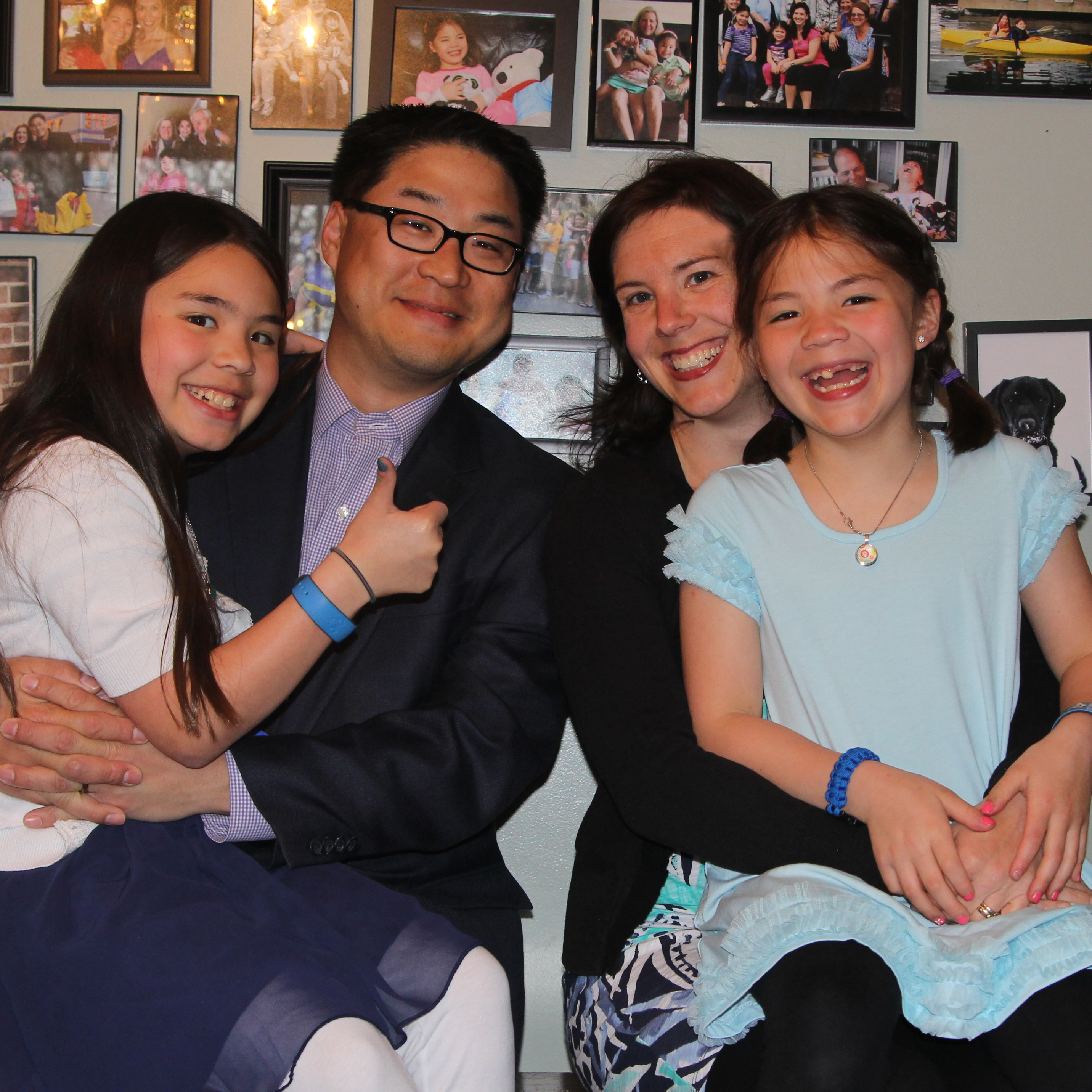
One Day

It’s officially day two of summer vacation and I’ve already taken a break from the kids.

This was a scheduled trip, though, not a desperate attempt to flee – a trip out west with friends to visit another friend who we just need to see. It’s been far too long; I’m so looking forward to being with them, to sharing hugs in person, to laughing and crying and just being together.
And also the eating. I love me some eating.

With just one day between school getting out and my leaving, I wanted to make the most of it with Ella and Annie. I wanted summer to start off right, not with me running around like a maniac or everyone scattered in different directions or me losing my temper only three hours in and yelling at them for disagreeing over Legos (not that that’s ever happened, but I’ve heard it’s a possibility).

So, by gosh, we made the most of it.

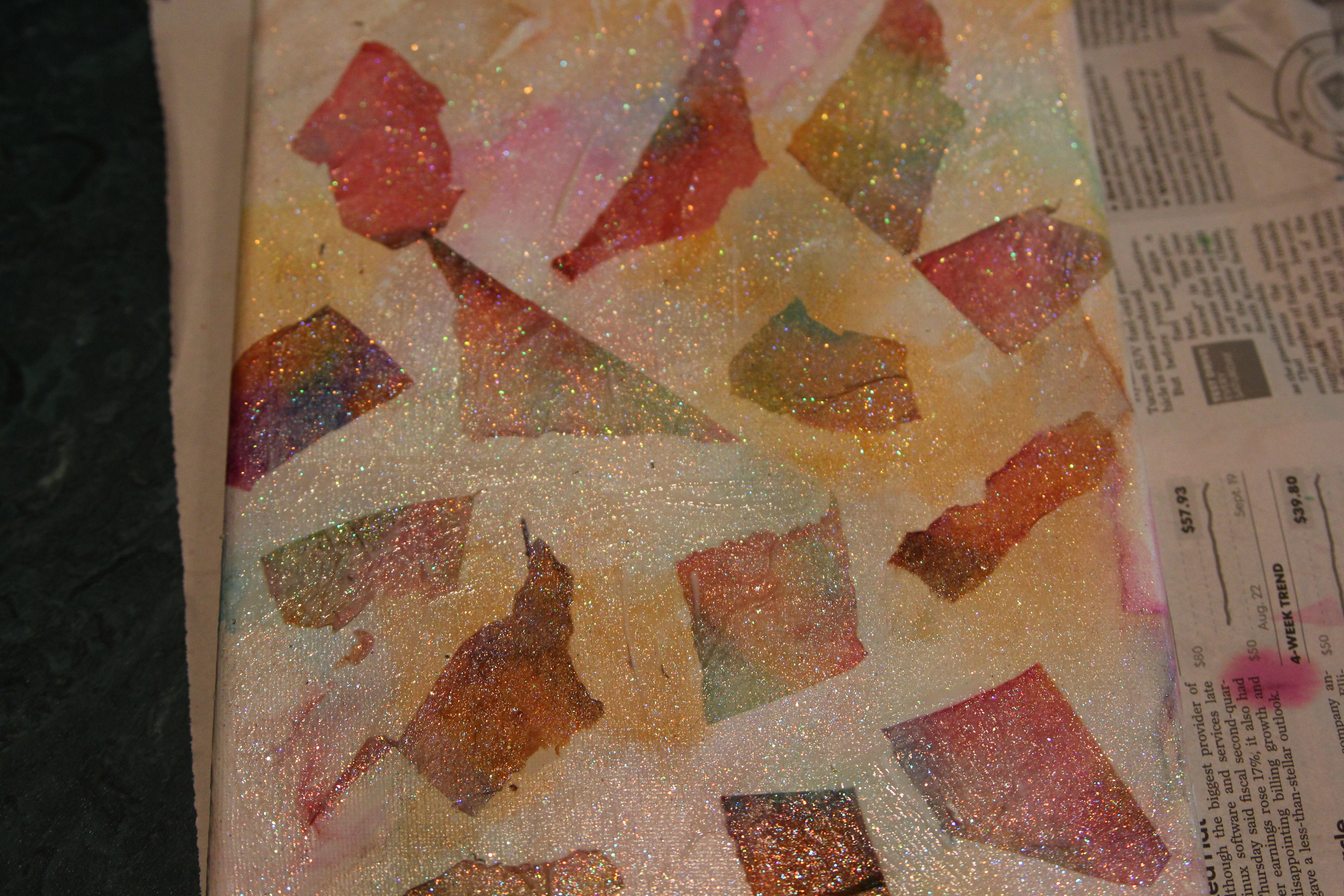
The first thing the girls wanted to do was a craft off of this year’s Summer Fun List – using bleeding tissue paper to dye a canvas and then adhering additional tissue paper to the colorful canvases with Mod Podge.
IMG_3128
 
This was totally not my idea; Annie completed the very same project at a friend’s party a few weeks ago and her family was kind enough to share the instructions – and tissue paper – with us.
IMG_3144
Photo by Ella of her final creation.
IMG_3147
Photo by Annie of her final masterpiece.

While the canvases dried, we got to do the rarest of things: shop for something silly with no timeframe or schedule, just for the hell of it, because we wanted to. To be more precise, we searched high and low for specific names on Coke bottles as part of the Share a Coke With marketing scam genius promotion that has drawn in suckers sentimental consumers like me. We’ve been on the lookout for certain names for weeks, but we’re always frantically rummaging through bins and coolers while grocery shopping or picking up prescriptions at Target, so there’s never any time to just browse in a leisurely fashion. Annie and Ella were in heaven.
IMG_1082-1
This may look like chaos, but we have got a system, you guys.

We might have pushed it a little by going to eight different establishments in search of our elusive bottles, but it was a lovely, frivolous diversion — a delightful way to pass part of a summer afternoon. And we found three more names we were looking for; holla!
IMG_1085
Fenwick was remarkably patient, but by the fourth or fifth store, he was starting to get more than a little tired of hopping in and out of the car.

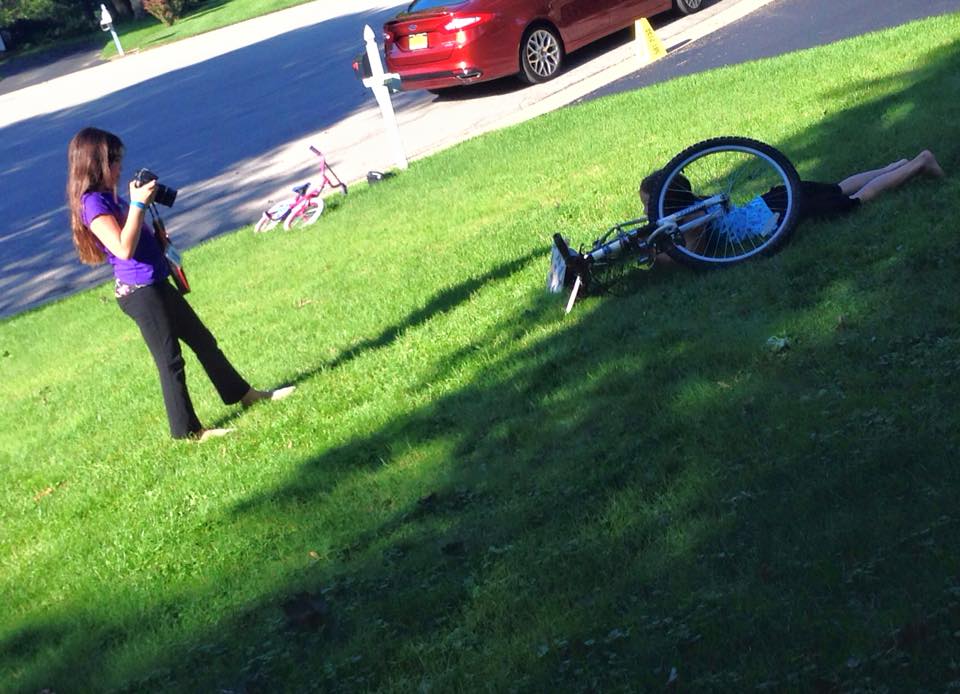
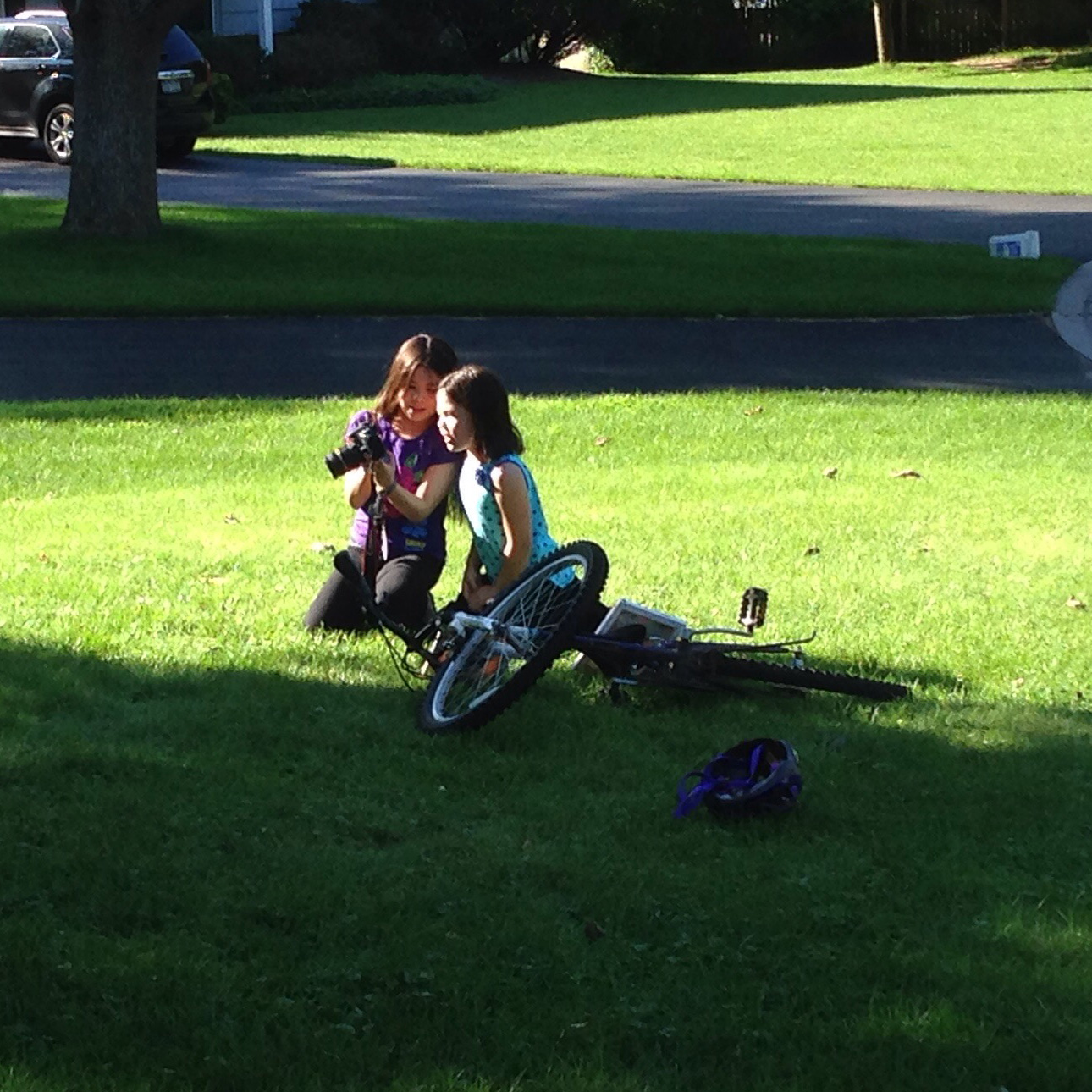
After a brief swim next door, the girls asked if they could borrow my good camera to take photos of their projects (see their first attempts, above). While I prepped dinner, they then decided – for the first time ever – to try to take “real” photos of one another posing with their canvases on the lawn, in the tree in our front yard, on the back of Nick’s scooter… and, inexplicably, Ella’s bike (artistic vision. Respect).11403411_10153334445540295_4803402200932975868_n

The results were simultaneously awesome, cringeworthy, and hilarious; once I return and have their full permission, I can’t wait to share them.
IMG_1090
I love the intensity of their examination.

Following dinner, we participated in the most classic of all summer rituals: the procuring of ice cream.
IMG_1091

And the making of butter in a jar.
What? That’s not one of your summer rituals? Lame!
IMG_1092
In all seriousness, butter in a jar is both easy and fabulous. 
YOU’RE WELCOME.

I didn’t take pictures of me running or weeding the garden, the girls’ Lego and cardboard creations, the fort that they set up in the playroom, or the dog peeing on the rug… but it all happened, my friends. It was a jam-packed, relaxing day (yep, totally possible to be both) and just the way I’d hoped our summer would begin.

As I’ve talked about several times before, summer is hard for me. The lack of routine, the absence of structure, how nothing gets accomplished, my inability to relax; it’s just complicated. I guess milestones are complicated for me, period, even small ones like the end of school. Every year, I find myself wrestling with such intense and conflicting emotions, I feel like I’m being consulted for Inside Out (which is fabulous, BTW; do see it).

I’m elated that the girls loved their teachers and are sad to leave them and I’m bummed for them that they feel so heart-worn. I’m rejoicing not having to pack lunches for ten weeks and lamenting that now I’ll have to drag the girls with me when I buy groceries. I’m thrilled that the kids are older and we’re able to enjoy so much more together and I’m shocked and dismayed, as always, that the years are flying by so freakin’ fast. I’m delighted at the thought of all the fun we’ll have between now and Labor Day and I’m anxious because I’m already afraid that we won’t get to everything and I’ll be disappointed.

Thankfully, by now, I know what to expect. I know that summer will not be this perfectly idyllic experience, nor will it be a total disaster. It will be somewhere in between – dirty and messy and yummy and tear-filled and joyful and laid-back and exhausting and crazy and good – which, when you think about it, is just as it should be.

At least I can confidently say that Ella and Annie and I got one day of summer wonderfully, deliciously right.

Save for the mosquitoes. They’re like hummingbirds this year, y’all. Evil, buzzing, bloodthirsty hummingbirds.

IMG_1093
Tucking into bed last night. 
These girls, y’all. These girls.IMG_1099

Bee’s Knees

When the house phone rings at 8:20 on a weekday morning, there are really only two possibilities as to who will be on the line: Nick or my dad. If Nick is out of town, there’s a good chance it’s him, calling to say hello to the girls before they get on with their day. If Nick is home, it’s definitely my father.

Prior to his retirement last year, my dad did not call us on weekday mornings. In fact, I’m not sure that I can recall a single time when he phoned me while he was at work, ever, unless he needed an immediate answer to a particularly pressing question. It wasn’t that he didn’t want to speak with me, but rather that, when he was at work, he was working – hard – period, the end. Once I graduated college, we chatted fairly regularly, but always after 5 p.m., save for the pressing question times.
papa's birthday
Together on his birthday this year, one of few we’ve been able to celebrate together since moving to Rochester nearly eight years ago.

When my dad phoned us that first Monday after he retired – just because he could, because he wasn’t at the office, didn’t have any meetings to attend, didn’t have an agenda that had to be considered – it was a fun novelty, but I assumed it was a one-off. Lo and behold, however, the calls kept coming; not daily or even weekly, but every couple of weeks, the phone rings at 8-something in the morning and my dad is on the other end.

He doesn’t want to speak with me, though. No, he’s calling to talk to Ella and Annie, and they know it. “Oh – it’s Papa calling again!” they’ll say as they scramble to pick up the phone.

Occasionally, if they’re in a particular rush to get out the door or are moving at a snail’s pace and are behind in their routine, they’ll hear the familiar ringing and whine, “Mom, we’re too busy! Do we have to answer?”

And every single time, my response is, “Yes, you absolutely do.”
And every single time, they do. And, when they hang up, they are glad that they did.
charleston51
Kiawah, spring 2015

Because they know why their Papa is calling; I’ve confirmed this, just to be sure.

“Mom, why does Papa call us so much?”

Why do you think he does?

“I don’t know. Because he wants to say hi?”

That’s part of it.

“Because he wants to hear our voices before we go to school?”

That’s another part of it.

“Because he’s retired now so he likes to call just because he can?”

Yep, that’s another…

“Oh! And because he’s thinking about us and he wants us to know!”

Yes, there’s that, too. But you’re forgetting the biggest reason why Papa calls you in the morning.

“What?”

I bet if you really think about it you can figure it…

“Do you mean because he loves us?”

NAILED IT!

“Well, duh. We knew that.

So, to recap, their Papa calls them on school days because he is thinking about them, so that he can hear their voices, and so that he can tell them he loves them. Those are pretty damned good reasons to pick up the phone.

This past year since my dad’s retirement has been, hands down, my favorite of our relationship. Seeing him more often, being able to truly enjoy him and vice versa, has been an incredible gift. I’ve always known that my dad thinks I’m awesome; seeing him pass the same message to my own children is one of the greatest things I know.
swim meet papa
At the girls’ final swim meet of the year, which was in February. Given that my dad and GrandMeg had just come to visit us over Christmas and had – unexpectedly – been able to attend a swim meet, I’d told him that they didn’t have to come all the way back in February to repeat the adventure. My dad’s response: “Are you kidding? We wouldn’t miss it!”

Because that’s what we all want, isn’t it? To know that someone thinks you’re awesome? That you’re the bee’s knees? To believe their feelings down to your core?

Annie and Ella are fortunate enough to have dozens of family members who think that they’re the bee’s knees. Their own daddy is no exception. Nick was away this weekend participating in his annual guys’ day tournament; we’re used to him being out of town, but being gone on a Saturday or Sunday is unfamiliar. When the tournament was first scheduled and I knew that he’d be flying back on Father’s Day, I assumed that he’d sleep in, hang with the guys, take a flight that best suited him, and return later in the day. After all, on Father’s Day, he should spend his time exactly how he wants.

Instead, he booked a 6:30 a.m. flight, landing in Rochester before I’d even awakened… because it was Father’s Day, and what he wanted most of all was to spend it with his kids.

He thinks they’re that awesome. And they know it.

I don’t know much about actual bee’s knees, but I do know that being the bee’s knees feels pretty damned fantastic.
father's day
Father’s Day surf and turf!
I love the way Ella is looking at her daddy in this photo.

————————-

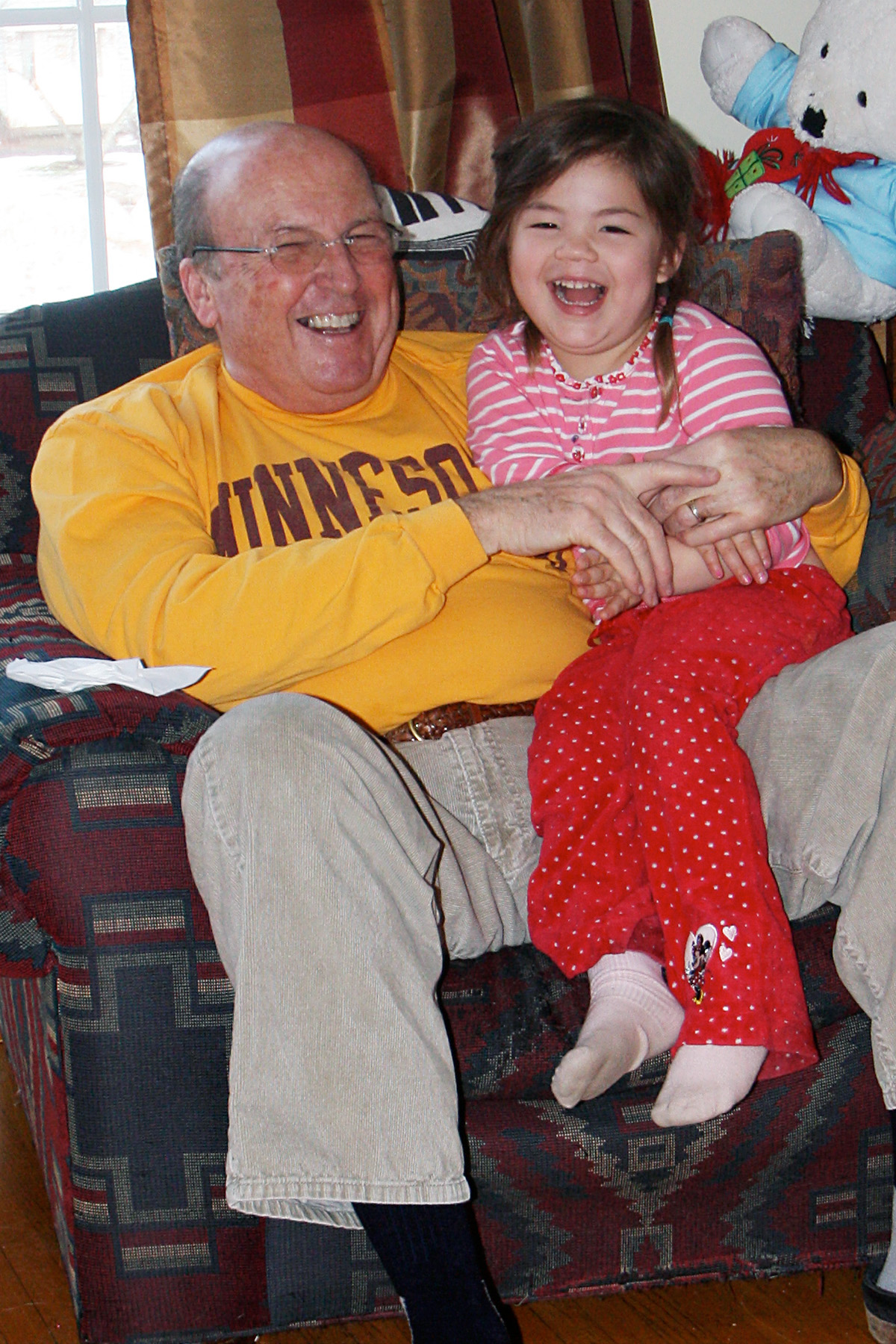
Because I have been thinking of it all day, I would be terribly remiss in not giving a shout-out to another man who thought that Ella, Annie, Nick, his sisters (Nelle and Em) and their families and I were the bee’s knees: my father-in-law, Bill. Today* would have been Bill’s 72nd birthday. A double-whammy: Father’s Day and a birthday. I so wish he were here to celebrate with us – to see his oldest grandson turn five yesterday, to see his middle grandson sing Frozen songs, to meet his youngest grandson, who is just six weeks old.

We love and miss you, Grandpa Bill, and think you’re the bee’s knees, too.
(Which is probably a good thing, because you had bad knees.)
Happy Father’s (Birth)Day!

* This was written on 6/21 but, due to a scheduling snafu (i.e. time for bed!), won’t be published until 6/22…
bill24
grandpa bill laugh
mn65

To Say Hello

My grandma (Phoofsy to Ella and Annie and many others) – always said that life was worth living so long as you were having fun. A little less than two weeks ago, unexpectedly and suddenly and to our stunned shock and heartbreak, Phoofsy stopped having fun.

You guys. I just… It’s simply not okay.

Living so near her these past eight years was one of the reasons that moving to Rochester was such a fantastic decision. My grandma was our guidepost, our touchstone, our sounding board and cheerleader, our adventure buddy, and our constant partner for dinner, games, and talking. We have never lived here without her and, honestly, I feel as though we’ve been cut adrift; Nick and I hadn’t realized how much she grounded us and made us whole.

I miss her so much, I cannot begin to put it into words.
easter
We have spent every Easter with Phoofsy since we moved here.
This year was no different.

Losing Phoofsy has been difficult for Ella and Annie as well. Sadly, they are quite familiar with loss (most importantly, their Grandpa Bill, and to a much lesser extent – although fresh on their minds – our Madison), but never before have they had to say goodbye to someone who was an integral part of our daily lives, someone whose presence would be noticeably absent at soccer games, swim meets, birthdays, evenings beside the fireplace, Sunday brunch, Wednesday nights, and every day in between.

This is an active, different kind of grieving, for all of us.
Not better. Not worse. Not harder or easier. Just different.

My mom and stepdad drove up to the lake the day after my grandma passed away and immediately got to the business of sorting through Phoofsy’s affairs (and providing lots of hugs and memories and laughs); we loved getting the chance to see them, even under these circumstances. As our little family foursome was driving back from the lake last weekend – the first-ever we’d spent there without my grandma – the conversation naturally turned toward Phoofsy.
IMG_0817
IMG_0818
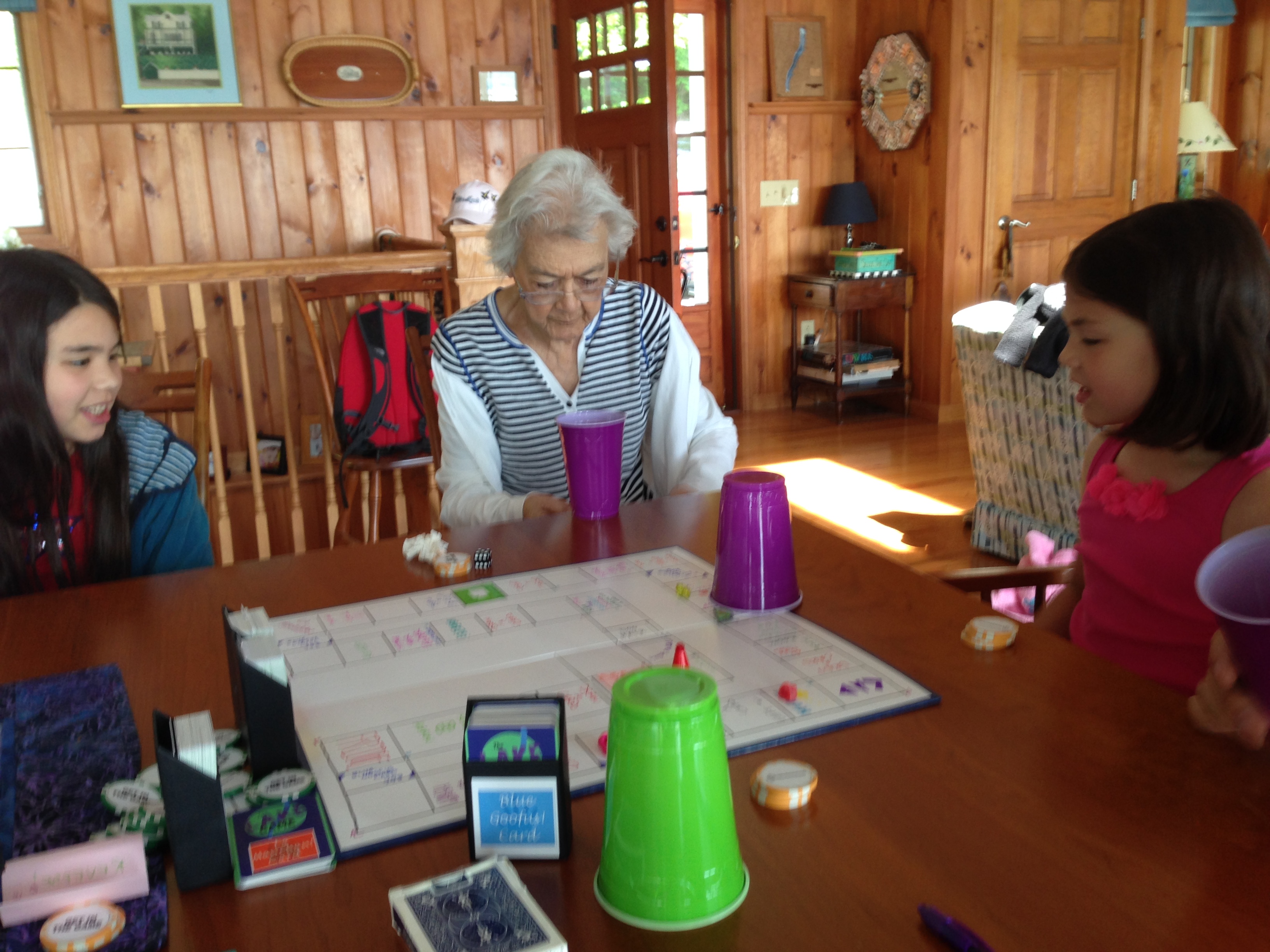
Playing The Lake Game on Memorial Day, my grandma was absolutely tickled that she managed to successfully flip her cup. We were absolutely tickled, too.

Things began simply enough, sharing stories and memories, but soon moved onto more metaphysical, abstract thinking. It started with Nick telling them that he was comforted by the idea that, one minute, Phoofsy was here and healthy, the next there was some brief confusion, and the very next, she was seeing Great‘s face as he said to her, “What took you so long?”

Annie and Ella were intrigued by this and wanted to hash things out, so we kept talking. “Where do you think Phoofsy is right now?” “If there’s heaven, do you stay the same age as you are when you die?” “Can people who have already died leave ‘messages’ for those of us who are still here?” 

As they discussed their conceptions of heaven, Nick and I grew more and more entranced. The girls’ ideas were absolutely fascinating and far more interesting and nuanced than anything I’ve imagined in my nearly-forty years. In fact, their thoughts were so lovely, so simultaneously comforting and thought-provoking, I asked if I could share them with you.
They graciously agreed.
IMG_0819
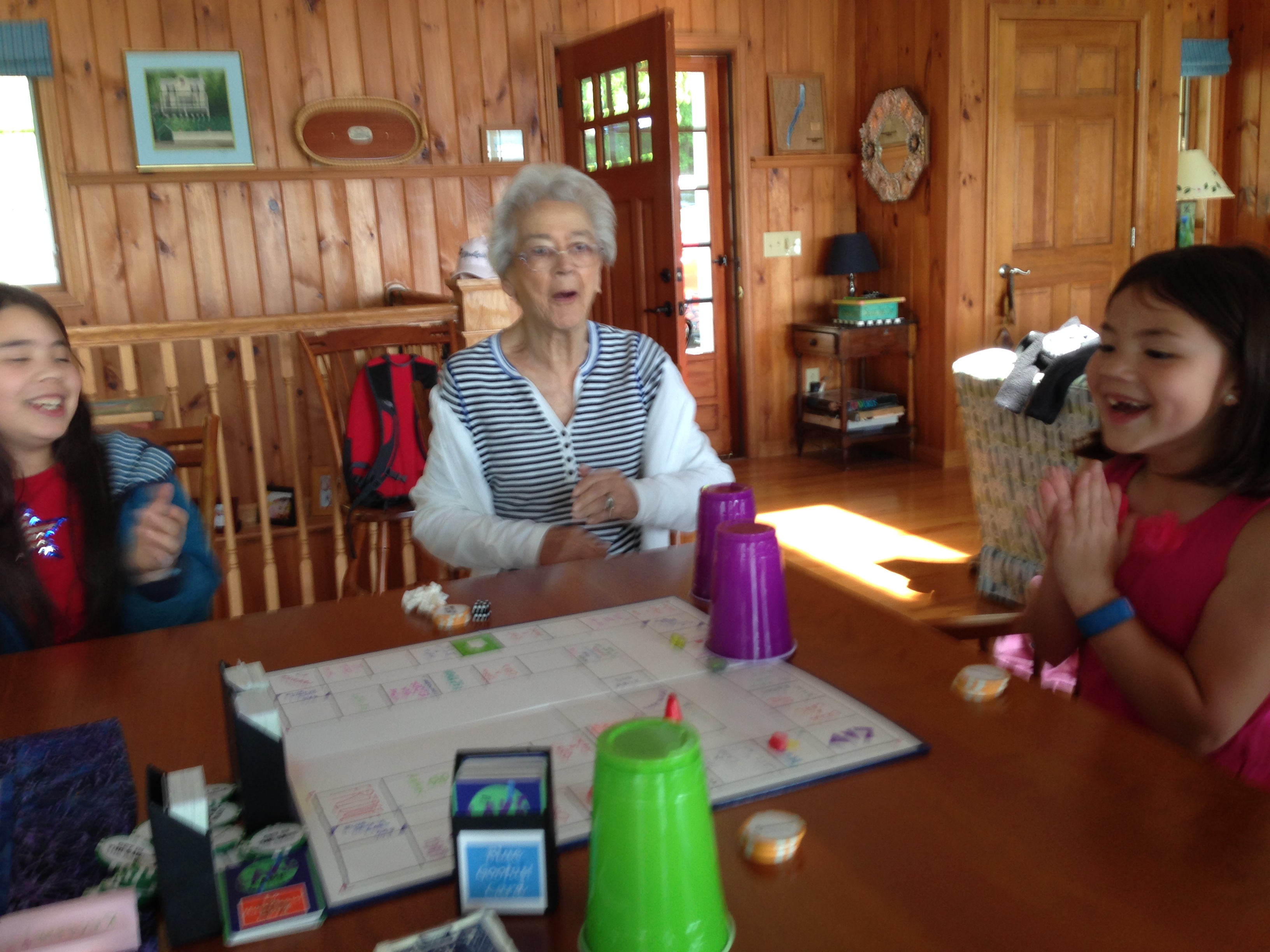
Chuckling that her poker hand was better than Ella’s.
Even when you’re 84 years older than your great-granddaughter, victory is sweet. 

—————-

“In heaven, you can be any age you want, and you can change that age whenever you like. So, if you had a really great time when you were twelve, you get to be twelve. Then, if you want to feel what it was like to be fifty again, you can be fifty for a while. Oh! And the person you’re with – like, if Phoofsy is with Great – can be another age, too. ‘Cause you know how Great was 86 when he died but Phoofsy was almost 95? That might not be fair, for her to be older, just ’cause she got to live longer. They might want to be the same age again – so they can be, together.”

(I don’t know what age I want to be yet, but that sounds pretty much like the best idea ever.)

“I think, in heaven, you can live out a dream while you’re awake. Like, you know how when you wake up after you’ve had an awesome dream and you suddenly realize it was just a dream and you’re so sad? Well, in heaven, you actually get to do the dream while you’re awake – you never have to miss anything! So Phoofsy and Great and Grandpa Bill can live out all of their dreams, for real – not just dreaming – every single day.”

(OMG THAT IS AWESOME.)

“But it’s okay to sometimes miss things. I think people in heaven might sometimes be sad. I mean, they’re mostly happy – it’s heaven after all, and they can see their friends and they can travel all around the world and have those dreams – but I think there’s a little sadness… Because life has sadness. We have to have some sadness to appreciate the happiness. Without a little, tiny bit of sadness, heaven wouldn’t be real.”

(Appreciation and perspective, even in heaven. Very cool.)

“When you’re in heaven, if you get to travel all around the world and be any age you want, I want to be a baby for a little while.” 

(Interject our incredulity. A baby?? But wouldn’t that be… boring?)

“Well, that’s the thing. We think it would be boring right now because we can’t see inside a baby’s mind and we don’t remember what it was like to be a baby. But if I could be a baby, but have my regular mind, I could see what life was like when I was a baby and actually remember it.”

(Scratch what I said before. THAT may be the best idea ever.)

“And I know that, once people are dead, they’re gone and all that. But I think they’re still with us, too — not just in our hearts, though, like people say. I think – and I know this is kind of weird – but I think that people can come and visit for a while. You can’t see them, you can’t feel them, you don’t even know they’re there… But they are. Maybe they walk with you to school. Maybe they sit next to you at dinner. Maybe they ride beside you in the car. Then, suddenly, you have a good memory of that person and it makes you feel better… and it’s because they were right there with you for just a little bit, visiting. Not all creepy like a ghost! Just a good feeling, because they came to say hello.”

—————
IMG_0645-1
Mother’s Day 2015

Ella and Annie don’t talk too much about being sad, but I know that Phoofsy is on their minds. Every day since she died, both girls, of their own accord, have made absolutely certain to keep something of hers with them; Ella now carries her books in one of Phoofsy’s old purses; Annie wears her hats around the house. Hardly a day has gone by when they haven’t worn one of her necklaces to school even though, normally, necklaces aren’t their thing.

Every time I see them toting her bags, donning her jewelry, adorned in her hats… a fleeting, glowing smile crosses my heart.

And I have no doubt Phoofsy has come to say hello.
FullSizeRender-2

A Difficult Truth

It’s been a relatively quiet week in terms of the whole riot/protest/police cycle we’ve got going on. If you dig beneath the surface, however, tensions are still simmering and “sides” are being taken. There seems to be very little room for middle ground. You’re either with us or against us. It is one thing or the other. Two opposing ideas that cannot coexist.

Quite frankly – it pisses me off. This is not an either/or situation. It’s a both/and.

This concept should not be so foreign to people; it’s how most of us operate, most of the time. Two seemingly opposing ideas can coexist. But somehow, many people seem to have forgotten that recently.

The riots that occurred in Baltimore (or Ferguson or anywhere else) are not okay. They are not the solution.
AND also death of Freddie Gray while in police custody is not okay. It is not okay at all.

Both/and.

Throwing rocks or bricks – or, frankly, anything – at police officers is not condonable.
Neither, however, is it condonable for police to overstep their boundaries and persecute the communities they are bound to protect.

Saying that “black lives matter” does not imply that you are, in any way, anti-police. It just doesn’t – no more than saying, “Doritos are delicious” means that you are, in any way, anti-Pringles. You can believe that Doritos are manna from heaven while also thinking that Pringles are pretty dope. That should go without saying.

Yes, of course police lives matter and white lives matter and all lives matter. But here’s the thing: those statements are basically givens. They’re obvious, omni-present, so we don’t need to continue saying them. Our black and brown citizens, though? Their lives have never mattered as much as non-black or brown lives.

They still don’t.
And so reminders are needed.

We have long recognized this in our society: that we need to celebrate and specially acknowledge the minority, the underdog, the marginalized. When Gonzaga first showed up on everyone’s radar in 1999, they were deemed a “Cinderella story.” Everyone was rooting for them. But while people cheered the Zags on, how many folks were on the sidelines saying, “But what about UConn?? Where are the UConn posters? UConn matters, too!” Because UConn was ubiquitous. Everyone knew them already. They didn’t need the extra support.

Or what about St. Patrick’s Day, when parades are held and people proudly tout their Irish heritage and cities dye rivers green? Do we stomp our feet with indignation that America is not being celebrated, too? “Hey, you guys! We live in the UNITED STATES. Happy St. Patrick’s Day? What about Happy America Day? When you raise that Guinness, you’re basically saying that you hate Americans.” No, of course not. Because we already know that America matters, too. We don’t need a reminder; the Irish can have their day.

Our black (and brown) citizens are told and shown, time and time again, verbally and silently, overtly and subtly, that they are not as important as the rest of us – and by “us” I mean white people. I won’t link to the (literally) hundreds of stories and articles supporting this claim; all you’d need is a quick Google search to confirm it (if you’d like, you can find some of them in this post that I wrote in November). Heck, all you’d need to do to confirm it is ask even one black friend to tell you even one story – of being pulled over when nothing was wrong, of being stopped in their own neighborhood and asked “what they were doing there,” of being followed by a store clerk, of being overlooked at a counter while the cashier or salesperson waited on other non-black customers, of being called racist epithets, of watching as people obviously avoid walking by them on streets…

Or, if you’d rather not do that, perhaps you could ask yourself (if you’re white, or at least non-black or non-brown). Ask yourself when the last time was that you worried that you’d be pulled over by the police while driving through your neighborhood. Ask yourself how often you’ve been walking your dog near your home and have been stopped and asked what you were doing there. Ask yourself if you’ve given your children (especially your sons) “the talk” — not about the birds and the bees, but you know, the one about moving slowly around authority figures, about making sure their hands don’t drift too near their pockets, about keeping both hands on the wheel at all times if they’re pulled over (for God’s sake, don’t reach into the glovebox unless you’re told to) — to help ensure that law enforcement officers have no reason to suspect them of a crime.

I would imagine, if you really asked, and then if you really, truly considered the answers, that you would see – even in this glorious America where everyone can succeed if they only try hard enough, where we have a black President, and where Oprah is the queen –  that black and brown folks are still not treated the same as white folks.

And so, sometimes, we need to be reminded that black lives matter.
IMG_0738
Did you know that even black dogs are adopted less frequently and euthanized more often than non-black dogs? CRAZINESS, you guys!
Yes, I know that dogs and people are not the same. I’m not making a direct comparison. But none of my other photos seemed appropriate… so here you go. Our black and yellow Labs, both of whom are awesome.

But we aren’t asking those questions. Or, if we are, we are jumping immediately to answers without really, really thinking about them; so often, the conclusion is drawn that race doesn’t play a role in how we treat one another. And that, really, is what bothers me the most: we don’t even acknowledge it. We, as an American society as a whole, do not acknowledge that racism still exists — I’m not talking about the overt, name-calling kind (although that exists, too), but rather the systemic, deeply-rooted, unconscious, so-pervasive-we-don’t-even-realize-it’s-happening racism.

I am going to ask, for a moment, that you ignore the riots**. I’m not saying that they aren’t horrible – they are. I’m not saying that they’re good or okay – they’re not. (Which is a rather absurd notion, anyway. Have you really come across people saying, “YAY, RIOTS!!”?) But people get all hung up on the riots (which are shown non-stop by our media), which causes them to miss the bigger picture.

For me, the bigger picture starts with the protests. Tens of thousands of citizens have been peacefully protesting for years now; the protests are growing ever more frequent. There must be a reason for this.

When we look to find that reason, however, there is almost immediately name calling and criticizing. I’ve heard some folks gripe that these protestors “have nothing better to do” – but that’s just untrue. Sure, some are unemployed. Some are looking to simply entertain themselves. But the majority are not. Protests – not the ones that last 30 minutes outside of your local Starbucks, but the ones that take hours and days and are focused and targeted – are not usually what one would consider “fun.” They take people away from their jobs, their homes, their families.

So, then. Why? Why the protests?

Have you ever had something to say and no one would listen to you? Maybe you were in a large group and couldn’t get a word in edgewise. Maybe everyone else was dead set on seeing Age of Ultron but you had your heart set on Pitch Perfect 2; in their excitement, they didn’t hear you. Maybe it was a meeting and no one asked for your ideas even though you had plenty.

Whatever the situation, I think you’d acknowledge that it feels crappy when no one’s listening. Sometimes, you sit back and just let things happen; there’s always next time. Others, maybe you email your boss or try to pull someone aside and explain your thoughts. But what if that doesn’t work? What if it happens over and over again? What if you feel ignored, unheard, shushed? What if you just can’t stand being unseen and unnoticed one minute longer?

Well, then.
You raise your voice.

You yell. You shout. You make noise. You stand up. You do whatever it takes to get people to hear you. It’s very simple, really.

That, to me, is the reason behind these protests. People are not being heard and they are sick of it. Yes, they want change. They want to be treated differently, fairly, better. They want justice. But at their core, they want someone to listen to them, by God.

And then, when they finally begin to raise their voices, we “listen”… and then immediately discount what they’re saying. Racism doesn’t exist anymore; stop complaining. Not all police are bad; stop generalizing. White lives matter too. Stop playing the race card. If he hadn’t tried to run, the cop wouldn’t have pulled his gun. When you dress like a thug, you’re asking for trouble. I don’t even see color.

(That’s a personal favorite, by the way. I understand the supposed meaning behind it – that you treat everyone the same, regardless of race – but if you don’t see color, you should probably get your eyes checked.)

Their concerns are summarily dismissed – there’s nothing more to see here. Which leads to people speaking even more loudly and strongly because they are still not being heard.

Until we can even agree on a topic, we cannot have a conversation.

Which is a problem, because holy sh*t, y’all, we need to have a conversation. We need to talk about racism in this country because make no mistake about it: racism still exists. We are all, almost without exception, racist. Yep, that includes black people. It includes teachers and scholars and human rights activists and historians and preachers. It includes me.

I try very, very hard not to allow skin color to inform my opinions of people. When I think rationally about it, I know – I believe, to my core – that white people are absolutely no better, smarter, harder working, or more deserving of respect that our non-white brothers and sisters. And yet… I still make assumptions. I feel the worry creep in. Not consciously, not on purpose. But it happens.

I am racist.

Until we can acknowledge this – until we can accept that racism is inextricably woven into the fabric of our nation, and until we can accept that non-white people still feel its sting despite our so-called “post-racial” era – things are not going to change. Men of color will continue being funneled into prisons. There will still be a wage gap between minorities and white folks. People will describe themselves as “colorblind” and pat themselves on the back for reading Maya Angelou and watching “Blackish.” Fewer black and brown citizens will attend college than their white counterparts. Police will continue to disproportionately arrest, detain, imprison, or even shoot people of color. Retaliatory shootings will continue to occur. The protests (and, occasionally, riots) will go on. And on. And on.

I’ll be honest with you: I have no idea how to fix this. We’ve been (mostly) trying for hundreds of years and we’re still not there, so obviously it’s a pretty tricky issue. But I do know that we don’t stand a chance at fixing it until we’re honest with ourselves that racism exists – all over, pretty much all the time.

Once we can do that – once we’re all on the same page, or at least in the same book – we can start a meaningful dialogue on how to make it better. It’s going to take all of us to make this change, but it’s one of the most important journeys we’ll ever embark upon.

So, for today, I’ll start with me.
My name is Emily. I believe that police have a tremendously difficult job and I have deep respect for our officers. I also believe that black lives matter. Both/and.
I believe that riots are absolutely not the answer. I also believe that the current protests are meaningful and valid. Both/and.
I believe that everyone should be treated equally, regardless of skin color. I’m also racist. Both/and.

I’d like that to change.
Let’s talk. Let’s listen. Let’s do this.

————

** (If you’re absolutely determined to focus on the riots, I’d also invite you to check out other riots that have occurred over the past five years. Yes, we all know about Ferguson, but how about this one in 2014 which resulted in fires, two shootings, and a stabbing after the San Francisco Giants won the World Series? Or this one in Lexington, Kentucky, where more than 50 instances of arson occurred after the University of Kentucky Wildcats won the national championship? Or this one, after a WVU football game, where participants “pushed over street lights and threw rocks, beer bottles and other items at public safety personnel and their vehicles”? White people are crazy, yo!)

What Love Looks Like

It’s been a busy week. You know the kind – husband out of town, subbing, kids’ extra-curriculars, errands, sick kiddo. Nothing out of the ordinary, nothing insurmountable, but just plain busy.

I had really been looking forward to going to church on Thursday night. Ella and Annie know how important this is to me; they’ve even accompanied me before when Nick’s been away so that I didn’t have to miss out. (Getting to consume Panera baked goods, use their iPads, and play with the toys that pastor Nancy brings may also have something to do with their agreement, but whatever.)

This week, though, was different. If I went to church – and by default, took them with me – they’d be gone (swimming, soccer, homework, babysitter, driving, move, move, move!) from the moment that school got out until bedtime. No playing with friends, no relaxing at home. It was a lot to ask, especially considering the busyness of the week, the sick kiddo (who had just returned to school and, I assumed, would be tired), and the toad they’d found in the back yard the day before, taken into captivity, and desperately wanted to torture play with.

So, I told them the decision was in their hands. If they were game to be away from home for the entire afternoon and evening, to bring our dinner with us and then eat it at Panera, to wait while I did my church thing, then we’d go. But if they weren’t – if they were too tired, if they really wanted to go home, if they needed some downtime, if they just didn’t want to do it, then we wouldn’t. I told them that I was good with either decision; I meant it.

They decided they wanted to go. That, despite the crazy long day, the running around, the eating out of a cooler and not playing with their friends, we would go… so that I could get my church on. They did it for me. (And Nancy’s toys and the brownie I bought them, but hey. For me.)

On the way home, we chatted – as we do – and I thanked them. For coming with me, for giving up their free time, for being so patient, for enabling me to go to church, which I so deeply love. I told them I adore being with these women, and I feel good whenever I do so, and that I was really grateful they’d allowed me to attend.

“Um, you’re welcome. But mom,” they protested, “You didn’t get to go last week. And it means so much to you. And we love you. So we said yes.”

I started to thank them again when they added, “We also really like Miss Nancy’s toys.”
Fair enough.

This is what love looks like.

It’s not the flashy signs or the expensive gifts or the dramatic proclamations of adoration (although it can be those things too; I wouldn’t complain). It’s the littler things, the ones that you don’t even think about, the ones that are so basic and mundane, they are all but unnoticed – but they are the love foundation that holds everything else up.

Love looks like your husband setting his alarm in the mornings on business trips, even when he’s in another time zone, so that he can be sure he has enough time to call your daughters before they go to school.

Love looks like your camp friend, whom you haven’t seen in 20 years, posting a message to your Facebook wall of long-forgotten camp songs and rhymes.

Love looks like your grandma saving packets of oyster crackers from her dinnertime soup and giving them to your daughters the next time she sees them, just because she knows they enjoy them.

It looks like your babysitter taking time out of her college graduation party to sit and talk with your kiddos, even though she has dozens of other guests to attend to. It looks like your other babysitter sending a thank-you note for the goodbye sign your daughters made her because she will miss them over the summer.

It is your father sending you links to stories from The New York Times because he thinks you might like them – stories that you would never have checked out on your own but you’re darned glad you did. It is doggie poop bags showing up at your door in an Amazon box after your mother reads on Facebook about how you never seem to have enough bags to pick up after your dogs.

Love looks like remembering that one child prefers the tops of asparagus while the other prefers the bottoms. It looks like the Valentine’s Day cards that show up in the mail from grandparents and uncles. It looks like taking a friend’s call even though you only have five minutes to talk because you know she had important news to share; it also looks like understanding when a friend doesn’t take your call because, hey, sometimes you just can’t talk right now and that’s okay.

Love looks like setting out sneakers for your daughter on gym day but also not bringing them to her at school if she forgets; love looks like allowing her to make mistakes and learn from them, then offering her a hug when she does.

It looks like friends inviting you over for a drink and some catching-up. It looks like your neighbors offering to watch your kids while you run an errand. It looks like the person at the gas station holding the door open for you.

Sometimes, love looks like opulence and flattery and vacations. Other times, it looks like remembering how you like your coffee. It looks like, “I’ll be right over.” It looks like your husband and daughters remembering that what one of the things you’d like most for Mother’s Day is time to write messages to your friends, and giving you time to do so.

Love looks like doing your spelling homework in the car and your science studying beside the soccer field and not returning home until bedtime so that your mama can get to church.

And for me, love looks like these folks.
Amen.
IMG_0628-1
That this was taken inside the hotel where we spent Mother’s Day eve certainly doesn’t hurt… Love does come in all shapes and sizes, after all.

My favorite Mother’s Day tradition

Like many moms, I have certain Mother’s Day requests: time with my girls. Time to myself. Something delicious (Starbucks is dandy, thanks). No cooking required. A few nice words. Nick, Ella, and Annie are really good about making sure these things happen; every year, I appreciate their consideration.

In addition to the above, I also ask for something a little unusual: computer time. More specifically, computer time to spend on Facebook, writing messages to every mother on my friends list. This may seem like an odd Mother’s Day request, but it’s actually one of my favorite parts of the day.

Over the years, people have commented on this annual rite of passage. Most are cordial or appreciative. A few are skeptical (“You spend all that time online when you could be outside or reading or laughing with your kids? Isn’t that the opposite of what Mother’s Day is supposed to be about?”). More than a few comment that the messages are “so thoughtful” or something along those lines.

While I appreciate the sentiment, I’m not comfortable with the praise ’cause here’s the truth: I didn’t start this tradition from a thoughtful place. I started it because I felt obligated.

I have a group of mom friends who I “met” through an online message board when I was pregnant with Ella; we all had babies due in December 2004. Eventually, we moved our communications to Facebook, where we continue to “see” one another today (we have also met in real life, but those are crazy stories for another day…). When I first joined Facebook, I was tickled to discover several of my former message board mama friends. Being able to easily keep up with them again was a terrific treat. Hence, in 2009 – my first Facebook Mother’s Day – I decided that I wanted to reach out to these lovely and inspirational gals.

Mother’s Day seemed perfect. After all, in addition to being pretty excellent friends, the very reason that these ladies and I had met one another was through our shared motherhood. Our friendship was made even stronger because we all had children the same age; we’d gone through leaky boobs, sleepless nights, potty training, and the first day of kindergarten – together. As much as anyone on the planet, these women shaped me into the mother I am today through their advice, their friendship, and through how they parented their own children. I wanted to tell them that they were doing a fabulous job as moms and, although it’s sappy and clichéd, I wanted to tell them on Mother’s Day.
IMG_0482

That was all: tell a small group of friends I thought they were great. Easy peasy, over and done. When I sat down and began to type, however, I found myself scrolling through my entire list of friends, many of whom are also mothers. Some I didn’t know very well, but with others, I’d see their names and think, “She makes those crazy bento lunches!” or “She’s always at her son’s football games!” or “When her daughter was sick last year, she did a helluva job holding it together.” 

So I thought, I guess I’ll write to those moms, too. And I did. And at first, I felt pretty good, writing messages to the friends whose mother-ing I knew well enough to talk about. But here’s the thing: all of the messages were written on my friends’ walls, which meant that any of their friends could see them… Meaning that the rest of my Facebook mom friends – the ones I didn’t know very well, the ones who don’t post often – could see them, too… Meaning that it would be pretty obvious that I’d picked and chosen to whom I was writing.

So then I thought, Well damn. The whole point of this was to say nice things, not to make anyone feel left out or crappy. I guess I’d better write to every mom on my friends list. Or, in other words, I felt… obligated… to write to everyone.

So I did.
And it was… incredible.

I know that whenever anyone reaches out to me and says something nice, it feels good, so I definitely hoped that my doing so would make people feel good. It did. But there was so much more than that.

Most of the time, I received an acknowledgement – maybe a “thank you.” While that wasn’t why I was writing – I wasn’t looking for recognition at all; I just wanted to make people smile – it was lovely nevertheless.

But then there were friends who were just floored. Some had had a rough Mother’s Day. Others were in a difficult place. Still others had been feeling gross about themselves for whatever reason. The vast majority of the time, I had no idea that any of this was going on; it’s not as much fun to talk about bad stuff as it is to post selfies, you know? When these ladies heard from someone randomly telling them that they were damn fine moms, it caught them off guard – in the best way. They said they felt they could go on. They said they felt good about themselves for the first time in ages.

I’d had no idea; I was stunned.

And then there was the most unexpectedly exciting thing of all: the joining in. I don’t remember why I posted on Friends’ walls instead of sending private messages, but I was immediately glad I did because other friends started adding on. Sometimes, they’d simply “like” my post. Others, they’d write comments telling the friend why she was, indeed, a kickass mother. Either way, these women suddenly had dozens of friends confirming their awesomeness.

It was stupendous.

Women do a really good job of tearing one another down, either overtly (“How can you feed your kids Teddy Grahams? They’re basically toxic” or “You allow PG-13 movies? How… interesting…”) or more quietly (“No, Raphael’s not doing soccer; we refuse to schedule any after school activities because we believe in letting kids be kids”). We whisper behind one another’s backs about everything from eye wrinkles to how often we allow our kids to buy school lunch.

This is nothing new – the whole “Mommy Wars” thing and all. It’s not just moms either, of course; women, in general, can be pretty damned nasty to one another. Yes, we are good friends; we can call on our pals when we need advice or support. We compliment one another on our outfits or our haircuts. We thank people for their help. But in my experience, it’s pretty rare for a woman to say to another woman, “You’re fantastic. You inspire me. Here’s why.”

I include myself in this statement. I’m not proud of it, but it’s true: I don’t often tell my friends that they’re wonderful just for the hell of it. Being so vocal feels… strange. Uncomfortable. Plus, when I’m telling someone that I love how patient they are with their children, the unspoken sentiment (in my own head) is that I’m not as patient. There’s a comparison (again, in my own head) that, frankly, doesn’t always feel so good.

Basically, I avoid saying nice things to other people because it makes me feel bad about myself. Which is pretty neat and not at all embarrassing.

Somehow, on that Mother’s Day in 2009, I was able to break out of my selfish, self-protective bubble, and the response was beyond anything I could have imagined. Turns out, when you say kind things to people (and really mean what you’re saying), people appreciate it. Go figure.

Writing Facebook messages to my mama friends has become a treasured tradition; there is no obligation about it. I wish them a Happy Mother’s Day and, when I know them well enough (otherwise it sounds forced or canned), tell them why I think they’re magnificent moms. Yeah, it takes hours and during that time, I’m not outside or hanging out with my daughters or reading magazines, but the happiness that connecting with these women brings – considering why they’re making a difference, why their kids are lucky to have them, how they inspire me – is incalculable.

It’s pretty hard not to feel awesome while you’re pondering someone else’s awesomeness.

So, if you’re looking for something to do this Mother’s Day, I’d encourage you to tell some moms that you think they’re doing a bang-up job. You don’t have to go through your entire Facebook friends list or your entire neighborhood or even your entire family tree; just pick a mom or two or ten and tell them that they’re fabulous. Be genuine. Mean what you say. Then sit back and revel in the delicious feeling that accompanies celebrating other moms.

I mean, that’s what Mother’s Day is about, is it not?
Although I’m sure as heck not going to turn down any Starbucks or handmade cards or You just sit here and we’ll do the dishes. Life is all about balance, after all. My mother says so.
mama n me
You can bet, come Sunday, I’ll be telling my own mama why she rocks.

Throwback Thursday: I swear

For the past month or so, our girls have had a bit of an obsession with swear words. They’re not using them in everyday conversation (not that I’m aware of, anyway), but it’s clear that they have recently been introduced to a whole bunch of “bad” words (at school? with friends? I honestly don’t know…) and they’re finding this knowledge fascinating.

We haven’t had an issue with curse words (aside from a small misunderstanding a couple of years ago) since the girls were little – but, hoo boy, that was a good time…

It was 2008 and Annie was approximately 18 months old when, as I was changing her diaper, I heard her mutter something that sounded like, “fuggin’.” There was a definite g-sound in the middle of that word – not a k-sound – so it was a bit ambiguous; perhaps I’d misunderstood. Knowing that if I made a big deal out of any word, and especially if I freaked out over it, it would instantly become more attractive to her, I decided to approach things delicately.

Um, sweetie, what did you just say?

“Fuggin’!”

Hm. Wow. Where did you hear that word?

“Daddy say, ‘fuggin’ diaper.'”

Well, then. Not so ambiguous anymore.
anniebath2
Annie, 18 months

I attempted to reason with her and explain that that wasn’t a nice word, but given that she was so little, it wasn’t easy to “reason” with her. The first time she said fuggin’ while we were out and about, it caught me so off-guard, I responded quickly and animatedly — which, as everyone knows, is the surest way to guarantee that your toddler will continue his or her inappropriate behavior. After all, what’s more fun than getting a rise out of your parents? NOTHING, really.

“Reasoning” with her hadn’t worked, nor had becoming upset, nor had reprimanding her; if anything, they made things worse. So I decided that the best course of action would be to ignore her entirely when she said that word so that it would lose its appeal all together and she’d just forget about it. My plan worked… but it would take a good four months.

In the meantime, Annie tested out fuggin’ everywhere she could. She said it while we were running errands. She said it while picking Ella up from preschool. When cashiers at the grocery store would smile at my adorable cherub all buckled into the seat on the shopping cart and ask her name, she would smile right back and say, “My name is Annie. FUGGIN’!!” When a single utterance wouldn’t do, she took to repeating the word over and over – at top volume, of course. One time, we blasted into the children’s section of the library with her running ahead, yelling FUGGIN’! FUGGIN’! FUGGIN’! at the top of her lungs.

And all the while, I looked like an absolute lunatic because I was (seemingly) doing nothing to prevent or remedy the situation. Yup, that’s my kid – the one screaming obscenities. Doesn’t bother me a bit. Isn’t she darling?
annietoothbump
FUGGIN’!!!

Parenting is a blast, y’all.

After months of receiving absolutely zero attention for her potty-mouthed antics, Annie gave up. Fuggin’ left her vocabulary as quickly as it entered; I didn’t hear her or Ella utter another swear (or almost-swear) word for years.

The allure of these illicit words is clearly growing, however, for both of our girls. Just this past weekend, our neighbor (who is a year older than Ella) rather gleefully informed us that Ella and Annie know all the swear words. “Yeah!” her little brother chimed in, eyes wide. “They know the d-word and the h-word and the f-word and the s-word and the c-word and the h-word and…” This would have been charming in and of itself, but it was made even more so because the conversation was had in front of our four and six year-old neighbors – and their parents.

Our daughters are awesome role models. So glad you moved next door.
ellaface3
And one of Ella in 2008, age three, for good measure.
Would this face ever say anything inappropriate??

Nick and I quickly ended the conversation, telling the girls we’d discuss this later, but part of me wanted to clarify things a bit. How were you using these words? Were they actually a part of your conversation, or were you just naming them – like calling out Jolly Rancher flavors? Were you quizzing one another? Did you say them to our young neighbors?? And wait a minute – how did our other neighbors know for sure that you knew what the swear words were… unless they knew them all, too???

(Also – what do you think the c-word is? ‘Cause I didn’t learn the “real” c-word till I was, like, twenty.)

Eventually, we had a talk with our girls and explained that we absolutely understood the allure of saying these words. “But mom,” they said, “they’re just so funny!” There’s something thrilling about it; I get it. (I distinctly remember being in second grade and learning all of the words to “Jellicle Songs for Jellicle Cats” from the musical “Cats” [I’m sure that this level of geekdom surprises no one] where one of the lines is, “Have you been an alumnus of heaven and hell?” I had a friend at the time whose mom [or grandma; that part of my memory is fuzzy] absolutely despised swear words and remember thinking it would be an absolute hoot to be over at my friend’s house and sing that line from “Jellicle Cats” right in front of her mom – so that then I could respond innocently, “But Mrs. So and So — it’s just a line from a song in ‘Cats’!” and watch her eyes bug out when she realized I wasn’t swearing but practicing art. MAN, did I know how to push boundaries!)

So, I understand about curse words; I really do. I know that my girls will test them out, that they’ll say them with friends, that they’ll whisper them in corners. I also know that they’re both such straight arrows, sharing swear words with friends is pretty daring; it’s not like we caught them stealing or smoking underneath the bleachers.

Still, we explained, there’s a time and a place for those words — and saying them in front of our four and six year-old neighbor is not okay. They agreed and said they wouldn’t.
So far, so good… although I know that surely we’ll cross this road again.

Shit, man. Kids say the darndest fuggin’ things.

We Have Been Chopped

If there’s one thing that can be said about our family, it’s that we love to eat. (It could also be said that we tend to sing a lot and that we always have dog hair on our clothes, but eating is more fun.) Rather conveniently, we also love to cook — all four of us. One of our favorite things to do together is watch cooking and baking shows, from Cake Boss to Restaurant: Impossible to The Next Food Network Star to MasterChef Junior.
carlos7
We stumbled upon Cake Boss in 2010 before the show’s popularity skyrocketed; the day we visited Carlo’s with my mom and stepdad, Buddy flew to Chicago to be on Oprah… and everything changed!
carlos9
Naturally, the girls are blurry so that the baked goods could be in focus…

We have also logged a lot of time watching Chopped, the Food Network show where the four contestants receive baskets containing “mystery ingredients” (i.e. rice cereal, squid, jelly beans, and cucumbers), all of which need to be incorporated into their final dishes to be presented to the judges… within 20 or 30 minutes. The moment those baskets are opened, we four backseat chefs get to work calling out what we think could/should be done with the ingredients, oohing and ahhhing and gasping and groaning at the chefs’ crazy and awe-inspiring creations.

Although Annie and Ella are very comfortable in the kitchen and, for years now, have been combining… unusual… foods just for the fun of it, they have long opined that it would be truly great to participate in their own version of Chopped — to be given mystery ingredients and then to create something, not only edible but delicious, out of them.

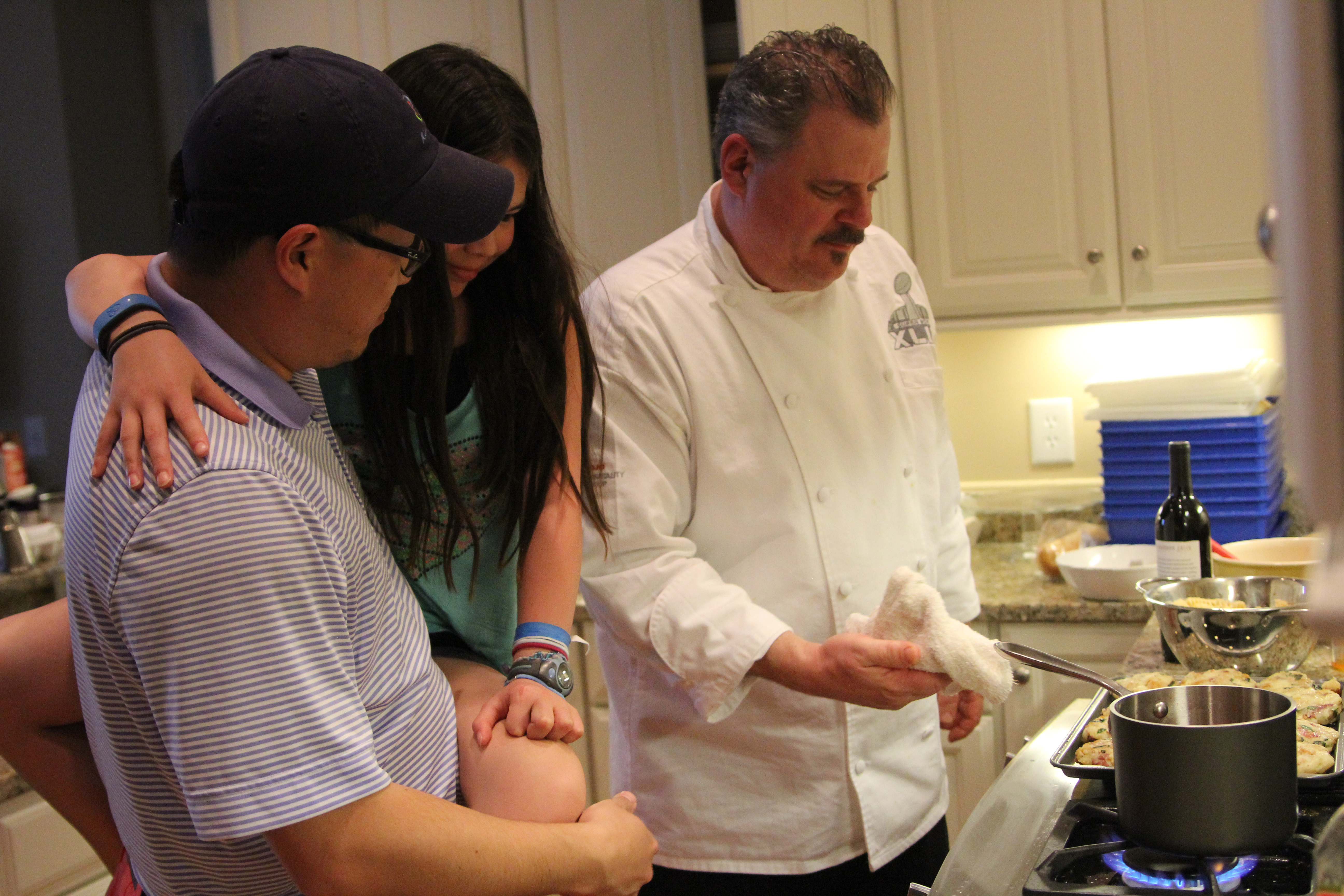
A good many years back, my dad and GrandMeg had gotten to know one of the chefs on Kiawah Island. Eventually, Chef Patrick left the restaurant business to focus on a more entrepreneurial, private chef approach; since then, he’s made several fabulicious meals at my dad and Meg’s house (on Kiawah) for special occasions. For Christmas this year, my dad and Meg very generously “gave” us dinner with Chef Patrick.

Normally when Patrick does his private chef thing, he does all the cooking; occasionally, he gives basic cooking lessons. Seeing that we were going to be in close quarters with a top notch chef who might be able to really teach us a thing or two beyond what we already know, I sent Meg the following email proposing something a little bit different:

When we watch these cooking shows, what impresses us the most is how the chefs are able to think on their feet, how they understand foods and flavors and how to work with the ingredients to create delicious dishes with amazing flavors… We can cook any recipe well; we want more!
So, THAT’S what we’d like to learn. How food works. What ingredients go well together and why? What basic sauces go with what foods, and how do we make them on the fly? What are some simple ways to elevate basic meals to something more flavorful? If we’re getting dinner on the table in a hurry, how can we mix things up so that it tastes different even if we’re pressed for time and using more or less the same ingredients?
So, you know… Essentially Culinary School 101. 😉
.
Meg then forwarded my rather, um, broad request to Patrick, who responded like this:
 .
I think a great place to start would be stocks, sauces and soups and then go into flavor pairings. We could cover the different areas of taste buds on the tongue which make different combinations of food taste so good together… Also covering ingredients you may have sitting in the pantry which could be used to whip up or add flavor to a dinner would be great.
 .
We could also get the creative juices going with a couple of surprise baskets with different ingredients in them like the show Chopped and see what y’all can come up with for dinner. You could all decide what you could make for dinner with whatever is in the basket. Of course it will be more like some blue plastic boxes. Sounds like fun to me!!
 .
I was dumbfounded. We get to pretend like we’re on Chopped? But with a real, live, uber-talented chef to guide us? Are you freaking kidding me?? When I read the email to Ella and Annie, they could barely contain their excitement. DREAMS DO COME TRUE, Y’ALL!
 .
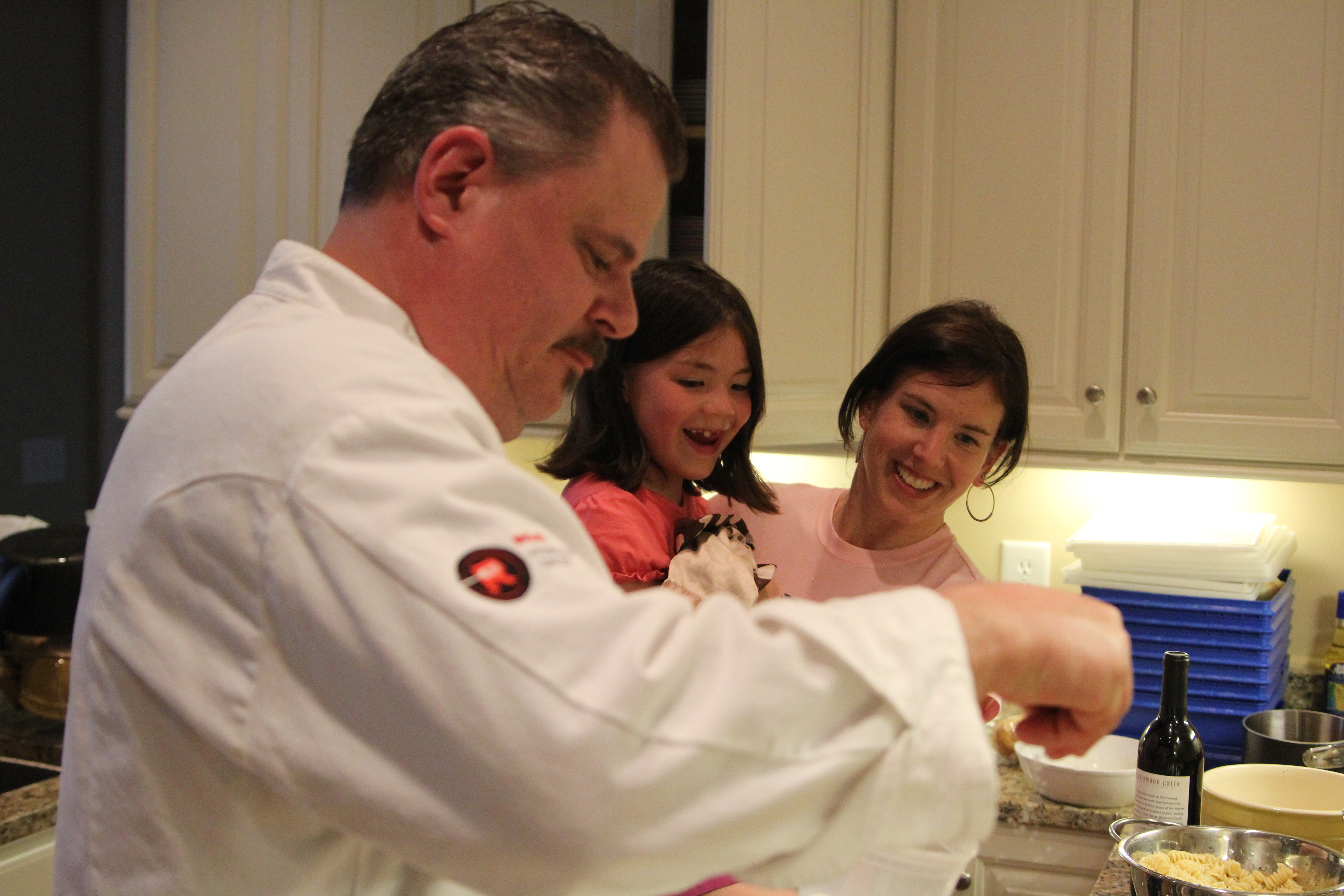
For the first few days of our spring break, we simply took in Kiawah and Charleston, like always, and enjoyed hanging out with family… but really, we were barely containing our excitement for our dinner with Patrick. When at last the day arrived, Chef Patrick showed up and, as promised, lugged in several blue plastic boxes and set them on the counter. Once he’d gotten everything ready, he invited the girls to do the unveiling; they were more than happy to oblige.
 kiawah cooking1
 .
One box held proteins – chicken, sausage, etc. The others held vegetables, fruits, and starches – squash, carrots, parsnips, peppers, white and sweet potatoes, strawberries, raspberries, kiwis, fresh herbs. Additionally, like the contestants on the show, we could help ourselves to the “pantry” – a section of the counter on which Patrick had spread out staples like pasta, garlic, onions, cream, salt and pepper, chicken stock, etc.
kiawah cooking2
kiawah cooking3
 .
As soon as they looked everything over, both girls immediately had ideas about what to make. Rather than just listen to their thoughts, Patrick had the (genius) idea of inviting them to draw their finished dishes so they could really envision their creations as actual meals instead of just ingredients.
kiawah cooking4
kiawah cooking5
 .
Next, he checked out their illustrations asked them to describe their “recipes” while he wrote down the key ingredients.
kiawah cooking6
Yes, that coat does have the Super Bowl insignia on it because Patrick was one of the chefs at this year’s game. So, that’s not cool or anything…
 .
Once he’d gotten a feel for what the girls wanted, the fun really began. See, ’cause while their ideas were very original and creative, they weren’t necessarily… doable… in their original form. Not wanting to disappoint or discourage them, Patrick considered their suggestions and, working with each girl, tweaked them into something more polished.
 .
Or, in other words, the tables were turned and suddenly Chef Patrick became the Chopped contestant. Take these random ingredients and make something amazing out them HAHAHA GOOD LUCK.
 .
Annie’s idea was fairly simple: chicken and pasta with mushrooms and red wine. With Patrick’s guidance, they agreed upon pasta with grilled chicken and mushrooms in a sundried tomato, pesto, and red wine sauce.
kiawah cooking7
Annie’s drawing was… interesting…
 .
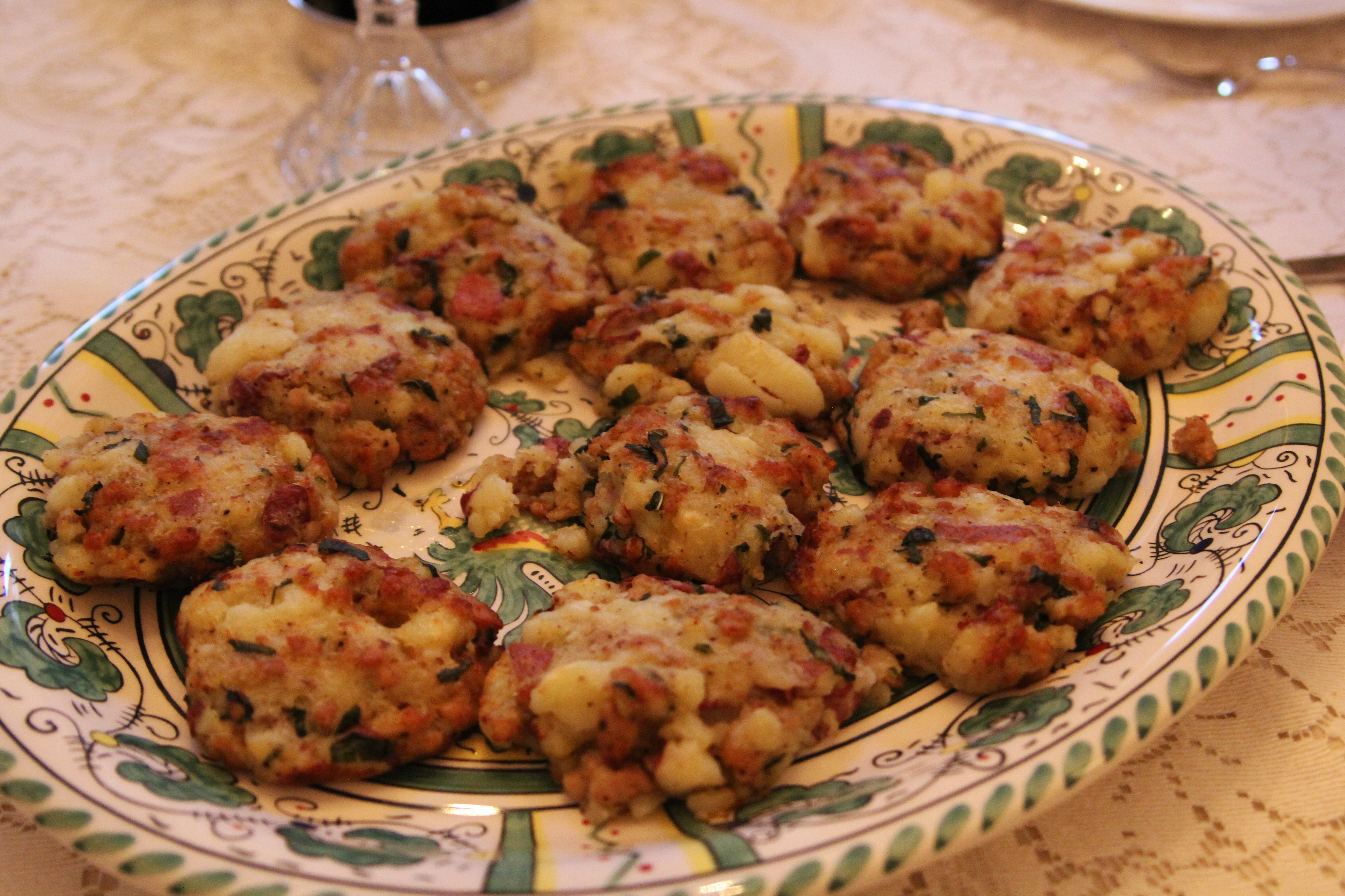
Ella’s idea was a bit more out of the box. Originally, she envisioned “sausage and potatoes with basil-stuffed raspberries.” After much discussion, with Patrick gently trying to figure out how the heck to incorporate raspberries with the sausage, he and Ella decided on Italian sausage and potato cakes with a raspberry basil balsamic glaze.
kiawah cooking8
You’ll notice the raspberry glaze drizzled nicely around the outside of Ella’s plate…
 .
Then it was time to get to work. Although Patrick absolutely ran the show, we helped out in every way that we could – chopping vegetables, chiffonading basil (I don’t know if you can  add -ing to chiffonade but I’m doing it anyway because it sounds way more chef-y to be “chiffonading basil”), browning sausage, boiling potatoes, cutting chicken. When we got to forming the potato cakes (a combination of Italian sausage, white potatoes, onions, basil, and olive oil), we were really winging it – even Patrick admitted he’d never attempted anything like this before, so there was little “advice” to be given.
 .
Over the course of the several hours it took to pull everything together, Annie and Ella grew antsy and would occasionally wander away to play. As their dishes were nearing completion, we called them back in to show them how things were looking — that Chef Patrick was nearly finished with turning their ideas into a real, honest-to-goodness dinner.
kiawah cooking9
Watching Patrick add salt to the sauce for the pasta.
.
kiawah cooking10
Checking out the nearly-complete raspberry glaze.
.
Finally, after an evening of thinking and prepping and cooking, everything was ready. We set the table, gathered up the two main courses, and sat down, anxious to see if the final dishes would be anything beyond merely edible.
kiawah cooking14
Annie’s pasta with chicken and mushrooms in a sundried tomato, pesto, and red wine sauce. (Obviously, I’m not a food photographer… Carry on…)kiawah cooking15Ella’s Italian sausage and potato cakes (raspberry basil balsamic glaze to the side).
.
You guys? They were more than merely edible. They were delicious.
 .
The pasta was light and fresh but filling. The sausage-potato cakes, the ones that Ella and Chef Patrick invented on the spot and then had to actually make doable? SO. FREAKIN’ GOOD. The potato and the sausage combined beautifully, the texture was just right, and the onions and basil added the perfect amount of flavor; even the raspberry sauce was fabulous, a sweet-ish (but not too sweet) complement to the saltiness of the cakes. We were in heaven; when Patrick joined us (we insisted that he eat with us because duh), he agreed, somewhat stunned, that their collaboration had turned out pretty damned well.
kiawah cooking16
Just a wee bit proud of herself… 
Oh! And you can see the raspberry sauce in the tureen, too.kiawah cooking17Thumbs up!
.
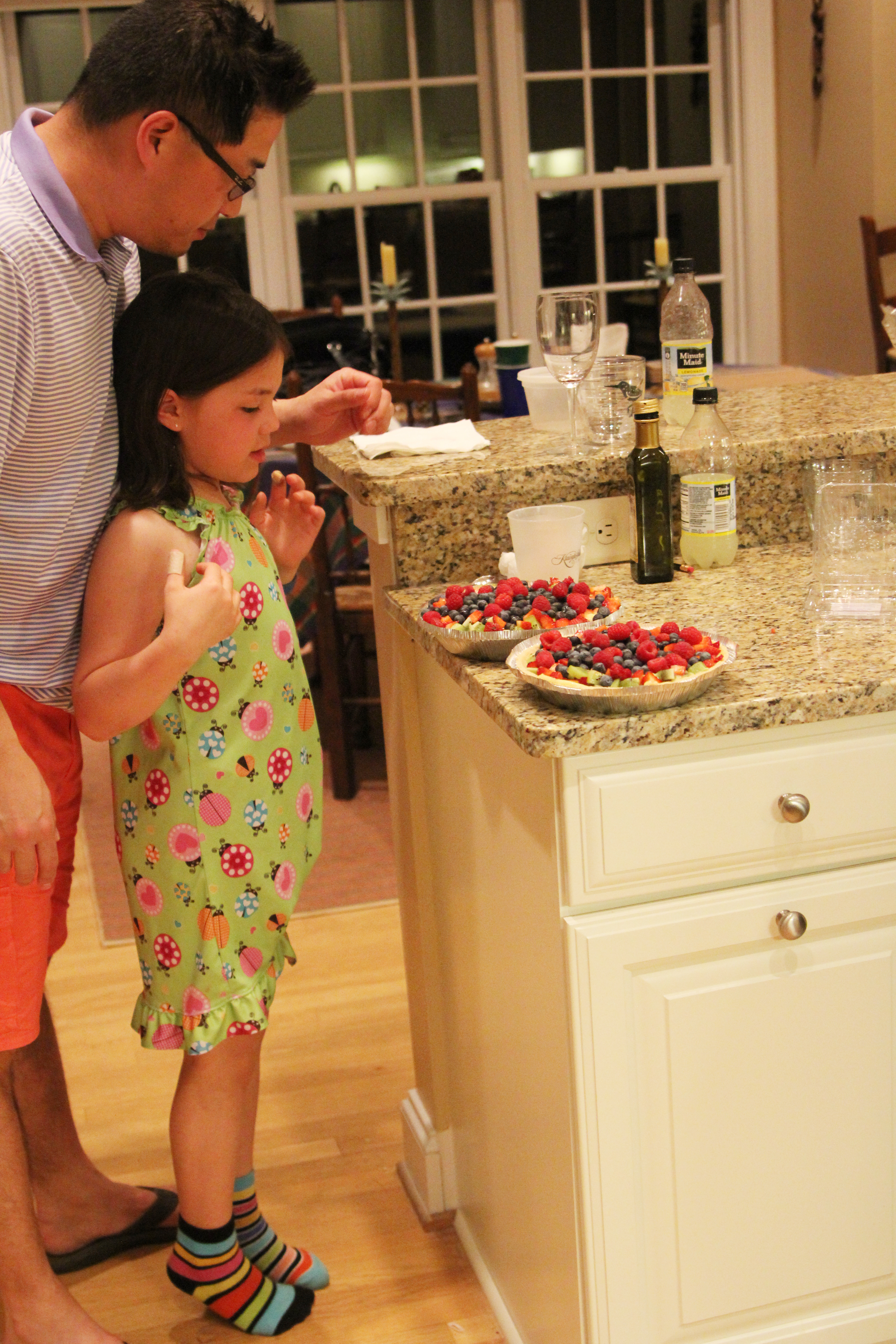
After dinner, Annie helped Chef Patrick assemble two super-easy pudding fruit tarts. They, like the main courses, were absolutely dee-lish.
kiawah cooking11
kiawah cooking12
kiawah cooking13
It got late, so she changed into her jammies…
 .
It’s a month later and still we can hardly believe it: our girls created recipes off the top of their heads (recipes that were inspired by Chopped-style baskets!) and then a world-class chef took their ideas and turned them into dinner. CHEF PATRICK MADE THEIR RECIPES! It’s like we sent an idea to JK Rowling and she wrote a story based on our thoughts! Holy crap, people!!
 .
Or, at Annie succinctly put it:
kiawah cooking7a
 .
They say that, if you’re aiming to cultivate happiness, focus on experiences and not things; you’ll soon grow tired of the latest gadget, but the memories you make while doing something incredible will provide you with lifelong joy. I can say, without a doubt, that the memories of our evening spent watching Patrick make magic (and dinner!) with our girls will continue bringing us happiness for – well, pretty much forever. How unbelievably fortunate we are, and how grateful we are to Chef Patrick (and my dad and Meg) for making it so!
 .
We have been Chopped… in the best possible way.

Finding my religion

I am not really what you’d call religious.

We do celebrate Christian religious holidays like Christmas and Easter – but we also eat latkes and spin dreidels during Hanukkah, just because we enjoy it. Ella and Annie were baptized in our wonderful, little Episcopal church back in Westchester; Ella’s (phenomenal) godparents are Jewish. I took the girls to church weekly for years, but I’ve never read the Bible. In fact, I’m unfamiliar with most biblical stories unless they’ve worked their way into popular lexicon.

I would probably be a great People magazine Christian. “Joseph’s Eleven Brothers: Where Are They Now?”

With that being said, religions have always fascinated me, both from a personal/ spiritual and a historical/ anthropological perspective. Theology is really cool; understanding the beliefs of different religions is something I believe in, deeply.

Still, I haven’t exactly felt that belief, myself. I mean, I know that I believe – in God, in Jesus – but it’s never really moved me. I really wish it would.

I want to figure out how to make sense of my liberal social politics, my love of science, the voices of my friends who feel that people who believe in God are either stupid or blind, my negative experiences with organized religion… but also that part inside of me that just knows there’s something more out there, that does believe in God, that wants to reconcile that belief with all the rest of the stuff I’m lugging around.

easter8
Cyclops Easter egg!
I know this photo seems oddly out of place; I think it’ll make more sense in a minute…

Basically, I want to attend a church run by Anne LamottGlennon Doyle Melton, and maybe Brené Brown, too. These women rock my world. They curse. They openly support gay rights. They don’t take the Bible literally. They doubt. They wonder. They encourage and enlighten and broaden and brighten and inspire, not to mention that they’re freakin’ hilarious. BUT ALSO they feel super-tight with God and Jesus and don’t feel weird about saying so. I want me some of THAT religion.

Alas, these three amazing women live nowhere near me… but I’ve found the spirit of their messages in the new little start-up church that I’ve been attending since October, Sophia Community. Every week, we gather together, read from the liturgy, and discuss it (“Um, what the heck is going on here? Why on earth would this be in the Bible? I really don’t like this passage.”). We wrestle with finding meaning in the words, even though we don’t take them literally. We pray, hard. It’s a completely safe space; every viewpoint is encouraged. There are no right answers, and I have loved every minute of it.

Still, I’ve been waiting for the Big Moment — I mean, I’ve been reading biblical passages, I’ve been talking and thinking and opening my mind! I am talking about Jesus and it doesn’t feel totally weird!!! Surely my spiritual epiphany is just around the corner. COME AND GET ME, GOD!

Well, it’s been a lot of months and no bolts of lightning. Damn it.

easter5
Just one more sentence and these photos will make sense, I promise…

When my grandma asked us if we were going to church on Easter (AH HA!) morning, I quickly answered (maybe a little too quickly) that we were not. We used to for the sake of “tradition,” but when the girls began absolutely dreading the service and Easter morning became a combination of wrestling match meets bribery meets hysterical sobbing, I decided that the church traditions I really enjoyed on Easter were a) the music and b) wearing new clothes. Forcing Ella and Annie to sit through the service by shoving jelly beans in their mouths and threatening to take away their Easter baskets if they didn’t stop braiding the bookmarks in the hymnals just didn’t feel right… so we stopped going.

Instead, for the past several years, I’ve pulled up the “Hallelujah Chorus” on YouTube and we’ve all slapped on new duds on our way to brunch and all has been right with the world.

Well, almost all. A lot of people seem to get really excited about Easter – like really, really excited. They exude this JOY about it that seems to go beyond excitement over Cadbury caramel eggs (it must be caramel; the creme eggs are gross). I, myself, get pretty psyched about those eggs and I love watching my girls with their baskets… but true joy at Easter has been basically nonexistent for me.

This year, especially with all of my new Jesus knowledge, I wanted to find Easter joy. Joy is fun. Joy is feeling. I wanted to FEEL Easter.

So, after the girls had gone to bed the night before the big day, I decided to haul my Bible and, for the first time ever, read the four New Testament accounts of the crucifixion and resurrection. The stories were interesting enough (I honestly had no idea that they were completely different from one another; I mean, it’s the same story four times – how different can it be? HAHAHA WRONG) and I was genuinely bummed out by the way that Jesus died, but I wasn’t moved. No joy for me.

When Easter morning came around, the girls waited patiently for us to come downstairs so that they could earn their eggs. Yes, that’s the right word – earn. The previous day, Nick and I had told them that we didn’t have the energy to create an elaborate scavenger hunt for their eggs and baskets (as we did last year), but we could either hide their eggs or they could earn them. To our surprise, they chose B: earning their eggs.

easter01
Nick and I hemmed and hawed over whether or not to make the tasks fun/silly or actual work. In the end, we chose a combination of both… with heavy emphasis on the silly… and wrote them down on little cards, to be chosen at random in the morning.

easter3
This is what awaited the girls when they came downstairs: a bowl with tasks to earn their eggs, the eggs themselves (one completed task = one egg), small baskets in which to put their eggs, and one final egg each that told them it was time to go find their actual baskets.

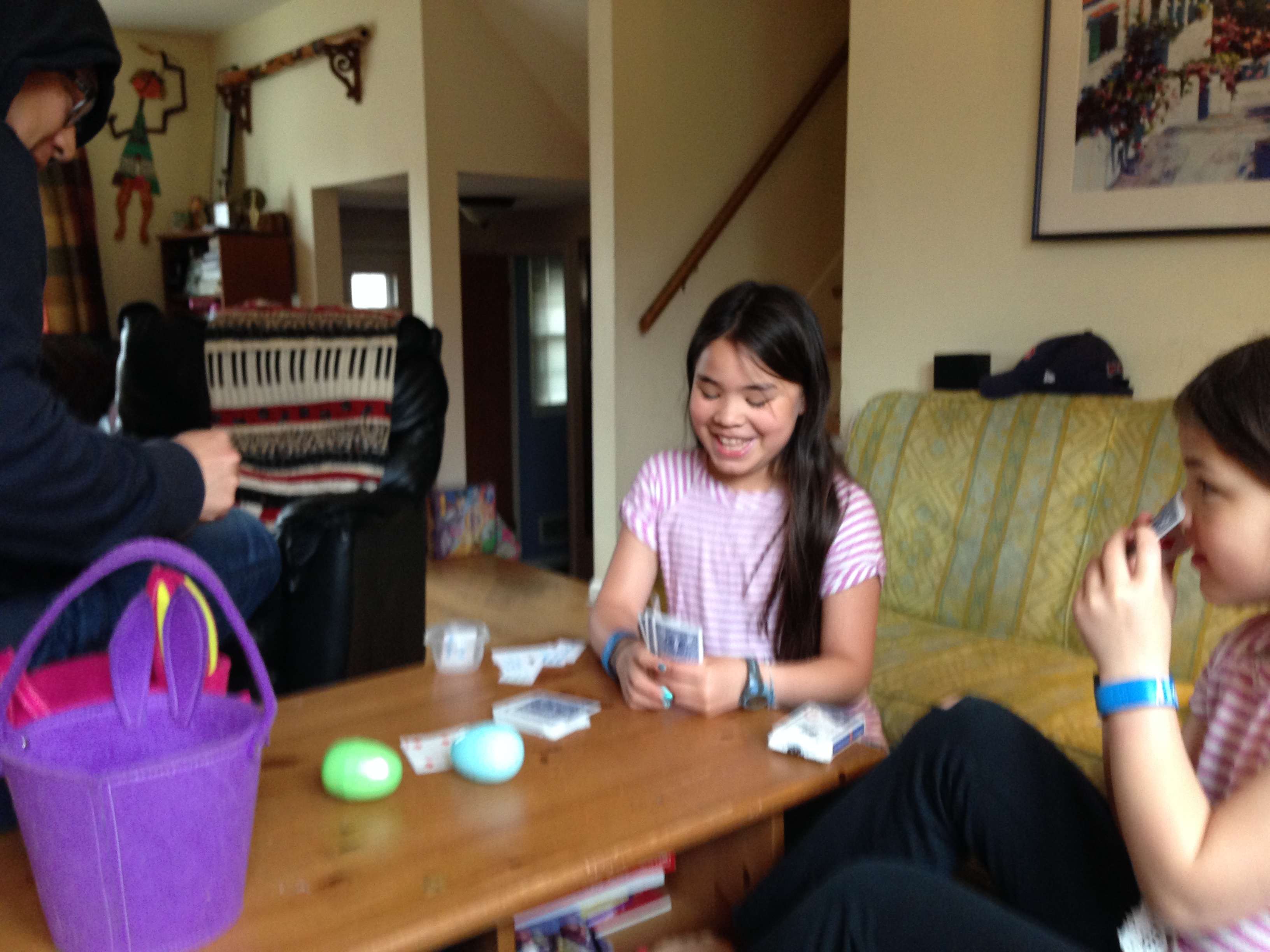
And so, on Easter morning, Annie and Ella sang to us, played the piano, made our bed (holla!), engaged in some Harry Potter trivia, cleaned the kitchen floor (for real), and played cards in order to get their eggs and baskets. As we dealt the fourth hand (’cause nothing says “He is risen” more than competitive card games), Nick and I looked at one another and said, “This is already the best Easter ever!”
easter4
Giggling over Cad (a family card game).

easter2

An Easter duet (okay, so it was “Heart and Soul,” but it totally captured the exuberant spirit of the day).


Even the more “serious” tasks were met with gleeful enthusiasm… Chocolate and presents are powerful bribes motivators, y’all!

easter6

We dyed eggs with my grandma, listened to “The Hallelujah Chorus,” got all fancied up, and went to brunch; we were totally knocking this Easter out of the park. Then, on our way home from the restaurant, the girls leaned forward in the car and said, “Ummm… So, what is Easter again?”

You’d have thought, after being dragged to church all those years, something would have stuck. Apparently not. (Except the jelly beans.)

Have you ever tried to explain Easter to young kids? Holy crap – it is THE CREEPIEST story EVER. Murder… coming back from the dead… walking around, talking to people… HOW WEIRD IS THAT?!?! Jesus is basically a zombie and everyone thinks it’s great. Let’s celebrate by dyeing eggs! Oh, and a bunny came to the house last night and dropped off a basket! Yay, Easter!!

So I told Ella and Annie the story, they nodded their heads (“Oh, right… Jesus came back from the dead… I remember now…”), but I could see that, even though they’d heard me, it wasn’t making any sense. They didn’t get why Easter was so special.

I understood. I mean, for the past 39 years, I haven’t gotten it, either.

Mostly, I’ve been okay with this. Easter’s just strange; no need to “get it” to have a good time. As the day went on, however, I grew unsatisfied with my answer. Because, frankly, Zombie Jesus isn’t a very happy thought. Just ’cause the Bible says it’s special doesn’t make it feel special – not for me, anyway. I wanted more.

And as I thought about it – as I considered why Jesus’s resurrection was such a big deal beyond the zombie mechanics of it – I felt something shift. I found myself calling the girls back and saying, “I want to talk to you a bit more about this. You know how I’ve told you that the Bible says that Jesus was dead, and then he wasn’t, and that’s what Easter is? And you know how you think that sounds really weird – probably because it is really weird? Well, I think there’s more to it than that.”

So I told them what I’ve learned, starting with ideas I’ve heard from Sophia Community, from Anne Lamott and Glennon Doyle Melton. As I went on, though, I discovered my own ideas — about why Jesus was different from the people who’d come before him, how he was really an awfully cool and amazing guy, how radically new his message was — not about God and the bible and “being saved,” but about us. About how we’re just right exactly as we are, about how we don’t need to do any more to be worthy of being loved; we are, with our flaws and imperfections, exactly who we are supposed to be. We are each enough, and we are loved, and we can do this.

It doesn’t matter if the story if real, I told them. It doesn’t matter if it ever happened. It doesn’t even matter if Jesus was real (although I think most scholars agree that he was, in fact, a real actual human; the whole divine thing is up for grabs). What matters – for me – is the message that Jesus, or even the idea of Jesus, spread: the message of love, of connectedness, of wholeness, of you are good enough just as you are. I have no idea if any of this really happened, but it doesn’t make a difference; the message, and how that message makes me feel, is what matters.

And as I spoke, I felt this very unfamiliar thing burbling up inside me – a little like indigestion, except it was happiness. It was joy.

easter9
Easter brunch in our fancy duds. Tradition, preserved!

The week before Easter, we were visiting family in Charleston and had the honor of attending my cousin’s daughter’s baptism. Before the big day, we were chatting with everyone, including my cousin’s father-in-law – a retired Episcopal priest who was in town to perform the baptism (and visit with his baby granddaughter!). Annie happened to casually slip into conversation that we used to go to church, but hadn’t in a while (kids are such fun), and then followed up with this gem, “What even *is* religion? I don’t think I have religion.” 

As I was struggling to craft a response that would explain that, of course, we have religion and how much I love my little Sophia Community and that I haven’t completely led the kids astray — TO THE RETIRED PRIEST — my cousin’s father-in-law just smiled at my little heathen and answered, without missing a beat (I’m paraphrasing slightly here because I don’t remember the exact words, but the sentiment is true and real),

“Oh, Annie, I promise you you’ve got religion. What religion boils down to – no matter which one it is – is that we’re all in this together, and we’ve got love in our hearts, and we’re helping one another. I watched you tonight, helping out, laughing. Everything you did, you did with such love. Your love came from inside of you and you gave it to all of us. That’s religion; I saw it. You have definitely got religion.”

All these months, I’ve been looking for my religion – in church, in books, online, in discussions. I’d hoped, if I figured out enough, if I learned enough, that I would find God or Jesus or something; I’d hoped I would feel it.

Turns out, my religion’s been right here inside me all along. (This is sounding an awful lot like The Wizard of Oz…) It’s in card games on Easter morning, it’s in the “You were great!” text from a friend, it’s in the holding open the door for someone at the mall, it’s in your husband and mom and dad being proud of you, it’s in the hugs that my girls give me each night before they go to sleep.

I still don’t consider myself religious, but I have definitely got religion.
IMG_2853a
My little heathens and me all gussied up on Easter. 
They are my religion, every last one of them.


It Is Time

(An earlier version of this post was published last year. For a variety of reasons, I’ve updated it and am putting it out there again… because here we are again. If you’re looking for the text for the original post, you’ll find it here [scroll to the end].)

Plain and simple, I believe that the current standardized tests in ELA (English Language Arts) and Math, given annually from grades 3-8, are poorly designed and age-inappropriate and, ultimately, should be entirely revamped. I’ll go one step more: I think that a lot of families have no idea what’s happening.

Lemme break it down.

1. Testing isn’t going anywhere
Tests have been around since the dawn of schooling (and probably before that; you know that cave people were totally devising hunting “challenges” for one another). Standardized testing in the United States has been around since at least WWI. Pretty much anyone who’s lived in the USA over the last 40-50 years has heard about our “failing” education system, how we don’t “measure up” to other nations, etc. – so, clearly, something had to be done. Hence, the Elementary and Secondary Education Act was passed which, in 2002, turned into No Child Left Behind where – I’m simplifying here – in order to receive federal funds, schools needed to prove that their students were showing academic improvement. That act was met with such vitriol, this past December, the Obama administration rejiggered it into the Every Child Succeeds Act (ESSA).

Whether or not American schools are, indeed, “failing” is up for intense debate, but the fact remains that standardized tests have been around forever. They offer one small snapshot into one moment of a student’s academic year. Taken alongside the numerous other evaluations that are performed throughout any given school year, they can contribute a few brushstrokes to a child’s academic progress canvas. If these tests are well-written, developmentally appropriate, and accurate, they can also provide some sort of (small) basis with which to compare schools and teachers.

I’m down with standardized testing, as a general concept. I think most parents, teachers, and families are.

2. Common Core confusion
States adopted the Core standards with a very specific goal in mind: money. Not education reform, not improving student learning, not evaluating teaching practices or helping teachers to better their approaches, but cold, hard cash. See, there was this thing called Race To The Top (RTTT) that was rolled out in 2009-2010 that essentially said (I’m paraphrasing here ever so slightly): Hey, governing people! Want to earn more FUNDING for your states for education? THEN COME COMPETE FOR IT!! All you have to do is prove that you’re evaluating teachers more stringently, identify and turn around failing schools, promise you won’t prohibit the formation of more charter schools, adopt some common standards, and create some nifty data systems! The faster and better you do that, the faster you can earn MORE MONEY!!! It’s like a carnival up in here!

In theory, a set of shared standards isn’t such a bad idea. I like the Common Core benchmarks, broadly speaking. I like the idea of everyone in the US learning some basic, shared content. I like the thought that, if your kids changed schools or districts or moved across the country, you could count on them not being too far behind (or ahead) because everyone’s learning the same stuff at the same time, from poverty-stricken inner cities to wealthy suburbs.

In practice, because of the whole SHOW ME THE MONEY thing, the standards were written in a bit of a hurry – and, many people assert, they were written without any educator input. No, for real: according to many experts, not one single K-12 educator or child development expert was included in the creation of these standards. So they’re a bit off-base in terms of what’s developmentally appropriate for each grade level, by which I mean that they’re asking kids to know a heckuva lot more, and to use an awful lot of more complex thinking, than they’ve done before.

Which, in itself, might not be so bad — maybe even inspiring and hopeful — if the standards had been adopted at a reasonable pace with teachers being given adequate support and training to properly teach the new material.

But because there was money on the line, and because states had to act super fast if they wanted their share, they adopted Common Core with lightning speed. There was no gradual roll-out. No trying-and-seeing to determine if this set of standards was reasonable, achievable, or appropriate. No oversight by anyone in the field of education. Buckle up!

3. Many of the tests are poorly written
Even so – even with way more complex standards written by non-education people that were put into practice before anyone had a chance to review them – things might have been okay had the accompanying tests that were meant to measure performance been good, strong, accurate evaluations. But many of them are not.

For one thing, they – like the standards – are written by non-educators. (I understand that in New York state, the tests before the Common Core-based evaluations were also written by non-educators, so this is nothing new, but that doesn’t make it a good idea.)

Perhaps unsurprisingly, given their authorship, the tests have been found to be riddled with errors. The test questions themselves, especially on the ELA portion of the exam, are often written at reading levels two to nine grades ahead (asking, say, third graders to read and evaluate passages that are actually appropriate for 5th- 12th graders).
Screen Shot 2015-04-11 at 5.43.27 PM
These are taken from the PARCC ELA test…

Screen Shot 2015-04-11 at 5.43.48 PMYes. Our eight year-olds are probably familiar with the idea of “luring” someone into “a false sense of security.”

Many of the test questions are vague or even deliberately misleading, which makes choosing the answer more of a guessing game than a true demonstration of understanding.

4. The results don’t mean anything
Given that the tests are badly written, error-filled, and are developmentally inappropriate, it seems safe to say that their results don’t really mean much. Additionally, since student results aren’t provided until the end of summer (or even into the start of the next school year), the child’s teacher can’t use the scores to adjust his or her instruction to better serve those kiddos.

Sure, in theory, a teacher could look at the results from last year’s class, see a deficiency in a particular area, and think, “Oh, I guess I didn’t do a good job teaching Main Idea. I’d better work on that with this year’s batch of students.” In fact, I would bet that the vast majority of teachers try to do exactly that. But the information that teachers are given – at least in New York – is rather limited.

Teachers aren’t allowed to see the actual questions from the test, nor to know ones were answered incorrectly – they only receive a broad overview of concepts and standards and whole-class percentages rather than individual student breakdowns. Did last year’s students really not understand Main Idea, or were the Main Idea questions vague? Were they deliberately misleading? Were they “sample” questions that are thrown out there each year just to see how kids do on them? Were they just plain incorrect or filled with typos?
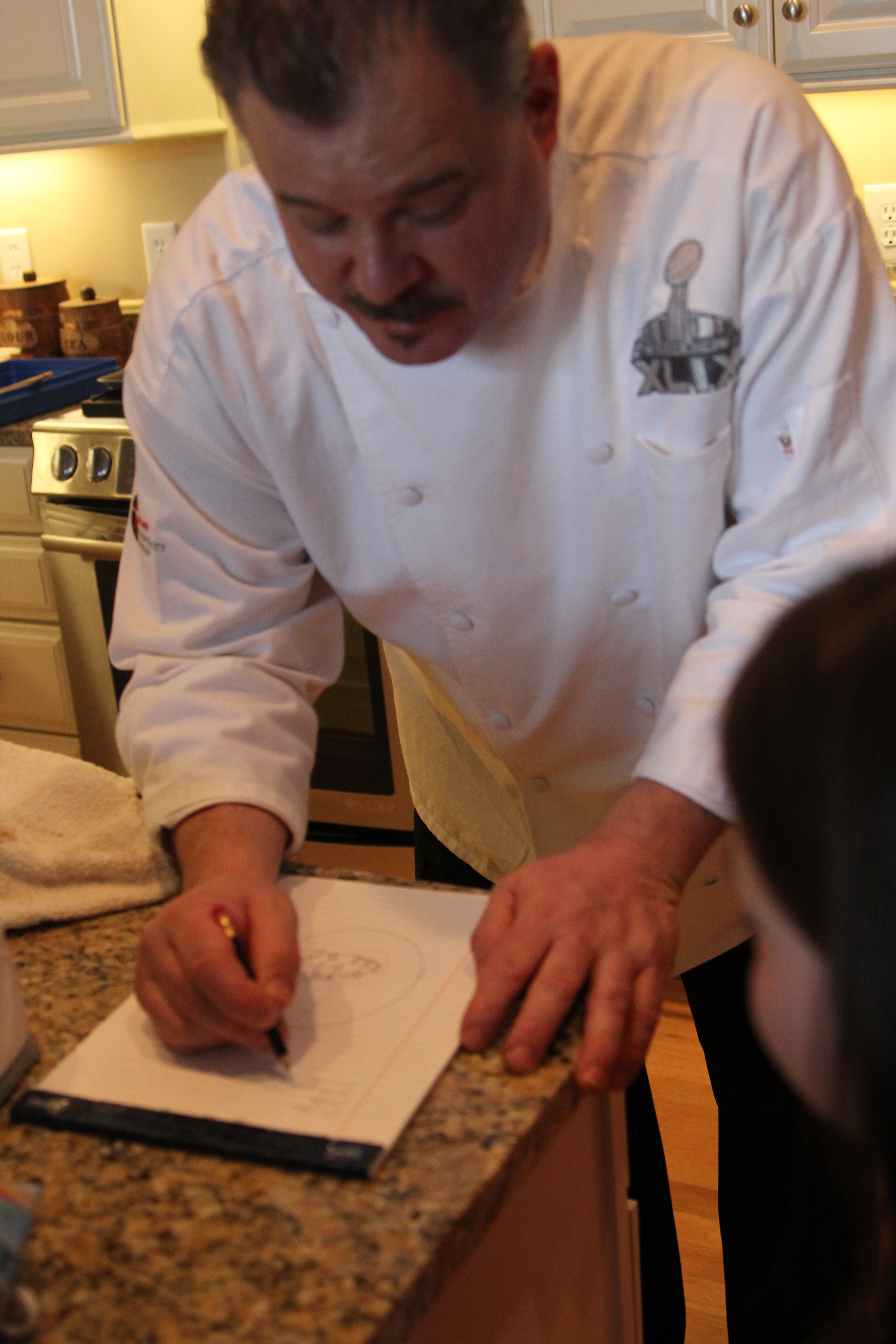
Even if the data was reliable – there’s one final catch: the passing score changes from year to year and is determined… AFTER THE TESTS HAVE BEEN SCORED. I wish I could say that I’m kidding, but I’m not. Movable passing scores!!

5. Teachers are more than just a (faulty) number
Here’s where things get really personal for me. Let’s just backtrack for a moment and pretend that the current tests are awesome. Let’s pretend that they are appropriate, accurate, and superbly written. Even if this were the case, I think we can all agree, still, that they represent merely one moment in a child’s education, several hours out of their lives. They don’t actually demonstrate all that children have learned – not even the best tests in the entire world – because most of what we call “learning” cannot be shown in a two-dimensional standardized test.

What standardized test results really show us is how well individual children tested on a particular day. And yet many states have decided that test scores do accurately demonstrate how well teachers are teaching, often counting the scores for up to 50% of a teacher’s evaluation.

And let’s not forget about the rest of the teachers. Tests are given at only at certain grade levels in certain subjects – meaning that that the majority of teachers do not teach these subjects/grades. K-2 teachers? 9-12 non-Regents class teachers? Gym, music, art? Science (students are tested in science but not in every grade), social studies/history, foreign language, library, computer, home ec, graphics…? 

And yet 50% of their evaluations are also based on test results. Based on the performance of students they may never have laid eyes on IN SUBJECTS AND GRADE LEVELS THAT THEY DO NOT TEACH.

This is fair, appropriate, or okay because… why?

6. Greed is a powerful motivator
For decades now, politicians have been talking about how American education is failing. Thus, politicians find it pretty easy to gain financial backers for education reform. After all, once a school is determined to not pass muster, something must be done — new curricula, new textbooks, new resources.

One of the largest supporters of Common Core is Bill Gates – yes, that Bill Gates – who has poured hundreds of millions of dollars into its adoption. While I believe that Bill Gates genuinely wants to help, it’s hard to ignore the fact that Microsoft and Pearson – one of the largest producers of Common Core materials – have banded together to get additional Microsoft resources into schools.

Many people have taken issue with the fact that companies such as Pearson [which authored a) the Common Core standards, b) the great majority of the current Common Core tests, c) the “modules” of instructional materials that are sold to schools to prepare students for said tests, d) and – as of 2015 – the teacher certification examinations in eighteen states] is a business company, not a company run by education or child development professionals. (I acknowledge that pre-Common Core, tests were still written by contracted, outside companies; that still doesn’t make it right.)

That would be galling enough, but even more maddening is that Pearson is positively rolling in the money it is making off of its materials. Since Common Core was adopted so quickly, school districts had to act fast to provide their teachers with adequate curricula resources. Who better to provide that than the author of the Common Core standards? Enter the Pearson instruction modules! Need additional support materials? Pearson’s got those, too!

7. Teacher demoralization
I’m just going to put it bluntly: because of all of this Common Core testing and the hoopla surrounding it, many of our teachers* feel like crap. They have been told, in no uncertain terms, that the jobs they were doing weren’t good enough. No matter how well-liked they were, how many kids graduated from their classes, how many years they’d been teaching, how many children they taught to read or how to multiply, how many hours they stayed after school, how many hungry children they fed, how many concerts they attended… it wasn’t enough. They have to change, fast. And if they don’t? Their very jobs are at stake.

All of the teachers I know – the ones for whom I sub, the ones with whom I sub, the ones with whom I went to college, the ones with whom I used to teach, the ones who teach my own children, or the ones I’ve met along the way by happenstance – have said, unequivocally, how much they love teaching. They love their students. They are fiercely proud to be educators. But it is getting hard – really hard – for many of them to continue. You hear talk of those who are seriously considering leaving the classroom because they can no longer teach; now, they have to teach these modules, teach to the test, jump through hoop after hoop. It’s exhausting and maddening.

Losing our teachers would, obviously, be a tremendous problem; that problem is compounded by the fact that there has been a steep decline in the number of new teachers being certified in recent years. Even those who do decide to enter the profession don’t stick around for long.

To be sure, teachers have often felt under-appreciated, misunderstood, and underpaid, but rarely has their ability to do their job been so strongly questioned. Never have they been so micromanaged. We are losing some of our best teachers. We aren’t getting enough new ones. This is happening right now, all across the country, and it is terrifying.

(*Obviously, I realize that I’m speaking in very broad terms here. I have not interviewed every teacher in the nation. But I am certain that the teachers with whom I have spoken – and this is a helluva lot of teachers – have expressed their dejection, sadness, and frustration.)

8. How do we get an objective measure?
Many people who acknowledge the shortcomings of these particular tests maintain that we need them because we need some objective measure of how our kids are doing in school. We need some way to compare teachers, schools, and performance, from rural West Virginia to suburban Idaho to inner-city Houston. We need to be able to determine teacher growth and student success. Kids from the most poverty-riddled communities deserve access to the same quality education as their most affluent peers.

I hear that. I absolutely believe that all children deserve a quality education; the disparity is, indeed, unfair. I also think it would be great to, say, move across the country and be able to glean, at a glance, how a school or district compares to another.

But here’s the thing: I think we’re looking for something that doesn’t exist – not because we haven’t figured out how to do it, but because it’s just not possible. Maybe education and learning aren’t things that can be measured any more than a musical performance can be measured. Maybe teacher growth and student success aren’t confined to numbers. Maybe a one-size-fits-all assessment works nicely for obtaining a driver’s license but not so well for determining whether or not fifth graders can identify subplot or if their teachers are doing their jobs. Test scores do not indicate success or failure; they are merely numbers.

9. Quite whining! How about some solutions or ideas?!
I’m not saying that we should give up. I’m saying I think we need to – dramatically – change our approach to how we evaluate education, students, and teachers. In my Magic Wand World, I’d take a (lot of) page(s) out of Finland’s book (it is well-acknowledged that Finnish students perform among best in the world at international exams) and our teachers would be as well-respected as as well paid as our doctors.

Since it’s unlikely that we’re going to adopt too many of Finland’s ideas, I suggest that we work with what we already have to reconfigure our view of success.

  • We should de-couple the current standardized tests from teacher evaluations, period.
  • We can keep the Common Core – as I said, I like those standards – but only as a portion of what each child should learn; we need to leave the rest up to individual states, districts, schools, and teachers.
  • We should give teachers several years to become familiar with the Core standards so that they can rework their lesson plans, see where there may be deficiencies, and take it from there.
  • Standardized tests aren’t going anywhere (in the USA), but we should have new, fair, developmentally appropriate tests that have been written by educators from across the K-12 spectrum.
  • Those tests’ scores should come back before the school year is over so that the students’ current teachers can use the data to inform their instruction.
  • And then those numbers should be just one of many other things that combine together to form our opinions of teacher success and student learning. Let’s factor attendance into the equation. Graduation rates. The percentage of high school graduates who go onto college. Post-graduate success. AP exams – how many are given? What are the scores? Teacher-student ratio. Teacher retention; how many are still teaching there after three years? Five? Ten? Extra-curricular activities. Class sizes. Poverty levels. Parent involvement. Principal and superintendent evaluations. Student portfolios. Additional test scores.

Education “success” cannot be measured by any one, single thing. I will happily sing you the praises of my daughters’ elementary school, which I adore, but none of those praises – from small class sizes to close relationships with other families to the devotion of the teachers to their annual Halloween parade – has anything to do with test scores.

10. Become informed… and then do something
I’m not really the “take a stand” type. More typically, I talk and think a lot. I write letters, I sign petitions, I discuss with family and friends. With this, it was different. I’d been talking, for years. I’d been signing petitions. I’d been writing letters, dozens of them, from the governor to my locally elected officials.

Finally, last year, it became clear to me: talking, thinking, letter- writing, and petition-signing weren’t working. Our legislators weren’t listening. And in the meantime, our children and teachers were suffering.

Enough was enough. And so, after much research and consideration (and after having participated the year before), our 4th grader opted out of the tests. She was extremely nervous about taking them – and we were extremely upset that her teachers were being evaluated based on student scores on poorly-designed tests – so it seemed like an appropriate solution. Turns out, many, many parents and children in New York state came to the same conclusion. As I wrote last year:

To paraphrase the incomparable Maya Angelou, when you know better, you do better. Parents and teachers are speaking up. We are knowing better. I hope, as our voices swell – whether our children take the tests or refuse them – that our politicians will hear us and that, some day, they will do better, too.

You know what? Our New York legislators heard us. BY GOSH, THEY HEARD US! Our voices swelled and our message was clear: This situation needs to change. And so the change has begun. Test scores are no longer being used to evaluate New York teachers (CAN I GET AN AMEN!). Students may now take as much time as they need to complete the exams. As of next year, Pearson will no longer be writing the tests or curricular materials. NEW YORK IS TRYING TO DO BETTER.

“Never doubt that a small group of thoughtful, committed citizens can change the world; indeed, it’s the only thing that ever has.” – Margaret Mead

Because of the changes that have been made, my husband and I did not feel as strongly about refusing the testing this year, instead leaving the decision to our daughters (after sharing the above information with them, to the degree that they can understand it). Our oldest, again, has opted out; her younger sister is taking them. We feel very comfortable being a house divided.

No, the tests aren’t perfect (then again, what is?). With the exception of tying them to teacher evaluations, everything else remains (essentially) the same, so there remains (much) work to be done. (While I appreciate the removal of the time limit, it seems that some students are taking up to 6 hours per day to finish their tests… which is not exactly “doing better”…) Still, I acknowledge and greatly appreciate that changes are being made. It’s a step in the right direction.

Some analysts and educators argue that high-stakes tests should be banned, period. Others claim that the tests are successful. Although they’re reaching different conclusions, they’re doing so after having thoroughly done their homework (a pun!).

And that is what I encourage everyone to do: learn more, then go from there. Find out who writes the tests in your state and how teachers are asked to teach the material. Read up on others’ opinions about how valid and appropriate the tests are. Discover when the test results are returned, what information the teachers and schools receive, and how they apply that information. Learn whether or not your child’s educators are evaluated based on test scores. Inquire about what your options are.

Then, if you feel that the tests are not measuring up, ask for better. If you feel like they’re cutting muster, speak up! Maybe that looks like writing letters. Maybe it’s signing petitions. Maybe it’s attending town hall meetings. Maybe it’s talking with neighbors and teachers and administrators. Maybe it’s opting out. Maybe it’s opting in. Maybe it’s a little of everything and a lot of other things, too.

No matter how you feel about Common Core and the state tests, I think we can all agree that our nation’s children deserve awesome. Let’s work together to be thoughtful, committed citizens. Let’s help our children receive the awesome they deserve. Heck – let’s change the world.